
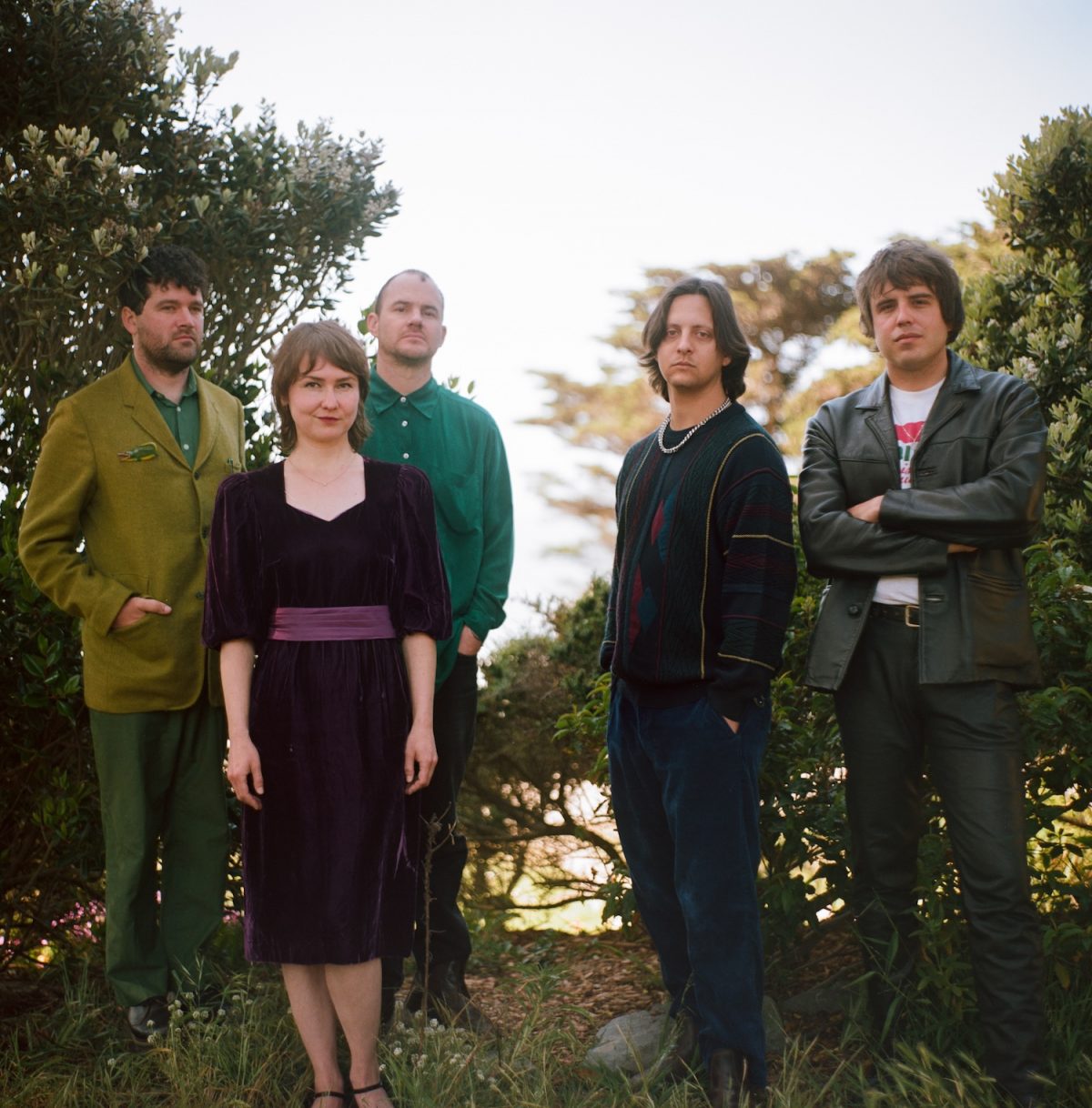
Magic Fig’s Valerian Tea (Exploding In Sound) is quite the swirling mass of ambition—one that’s administered with mind-expanding intent and executed in a way that intimates a small psych-pop/prog-rock orchestra (think mellotron and glockenspiel). Featuring former members of the Umbrellas, Healing Potpourri, Almond Joy, Whitney’s Playland and Blades Of Joy, the core trio of bassist Matt Ferrara, guitarist Muzzy Moskowitz and keyboardist Jon Chaney has been fleshed out nicely with Inna Showalter on vocals and keys and Taylor Giffin on drums.
That makes San Francisco’s Magic Fig a supergroup of sorts, one that blends more demonstrative elements from their previous projects into satisfying kaleidoscopic whole that evokes King Crimson, classic Yes, Peter Gabriel-era Genesis and even lighter prog-ish fare like Styx and Kansas. Given those busy reference points, it shouldn’t come as a shock that Valerian Tea sounds more accomplished than most proper debut LPs.
MAGNET’s Hobart Rowland tuned in and turned on with Magic Fig’s Ferrara, Moscowitz and Chaney.
This new LP arrives a year after your self-titled EP, but most of the songs on this album were written before the EP’s release. Would you walk us through the strange chronology?
Chaney: We started working on music as a trio with various drummers during the COVID lockdown, around the time where shows weren’t happening but restrictions were loosened a bit. I think that has a lot to do with why we had a lot of material by the time Taylor and Inna joined. We also just never stopped practicing and writing throughout the process of recording the first EP.
Ferrara: Our musical ideas tend to be fragmented. Sometimes a full song is actualized, but most of the time we let things ferment until the time is right. Unfortunately, scum floats above the brine, and you then have to start over.
In what ways does Valerian Tea expand on the EP?
Moskowitz: It’s a continuation of that sound. Most of the songs were an attempt to write more multi-part songs in the vein of “PS1” and “Obliteration” from the EP. We’ll stick together some unrelated parts and get a six-minute song instead of two three-minute songs.
Ferrara: Valerian Tea was made in a much more draconian way than our previous EP. The studio felt like a dungeon. Every idea was scrutinized and overanalyzed to the point of self-flagellation. Our collective pain brought us close to religious experience. But was it worth it?
How does San Francisco’s current music culture and rich rock history play into the Magic Fig philosophy?
Moskowitz: While I love a lot of music from the Bay Area and am fascinated by the ’60s counterculture stuff, I don’t see the band as being inspired by music from here in a conscious way.
Ferrara: You really have to fight to make music when you live in Baghdad By The Bay. Venues close, rents go up, and friends tend to move to L.A. or New York. None of us really had the privilege of having cheap rents and being able to work two days a week selling healing crystals. That makes it really hard to relate to the Haight-Ashbury scene of the ’60s.
The songwriting process for the new album was a true collaborative effort. Tell us more about how you fleshed out the music.
Chaney: Usually someone would come in with an idea for a song, and we’d play it over and over and record those ideas with a field recorder. Some spontaneous ideas were kept, or a member would come in with a new part to add to the song we were working on.
Moskowitz: Usually, we’re playing around with various ideas at rehearsal. Some will stick around and become songs, and others are forgotten. The ones that stick grow over many months until they sound like a song. Jon records all our practices and puts everything in a folder. Every once in a while, I’ll check out a neglected file from years ago called something like “organ thing new.m4a” or “weird riff.wav” and think, “That could be something.”
Ferrara: We wrote down 1,347 ideas and then pulled them out of a 19th-century top hat. After consulting Joel and Moloch, the god of the streaming algorithm, we then discussed which ideas would do the best on Tik-Tok.
Discuss your relationship with producer Joel Robinow and what he brings to the band’s sound and vision.
Moskowitz: Joel is a brilliant musician with an amazing ear. If I’m not sure if an idea is good or not, I can usually rely on him to accurately assess the situation. He also inspires us to indulge our whims. There’s always a ‘let’s add a third or fourth harmony’ mentality. We can always mute it later.
Ferrara: We met Robinow at an Erewhon in Los Angeles. He was in the vitamin aisle and recommended K2 to improve our pineal-gland functions. Musically and meta-spiritually, he’s our sonic guru, and his production style is akin to Rick Ruben or Phil Spector. Joel would say things like, “That’s a good idea … That’s a bad idea … Go up on the studio roof and reflect.” Every day, he made us sit in a circle and pray to Moloch. Our mantra was, “We will do anything to be playlisted and be liked by everyone. Oh, great Moloch, make us go viral.”