
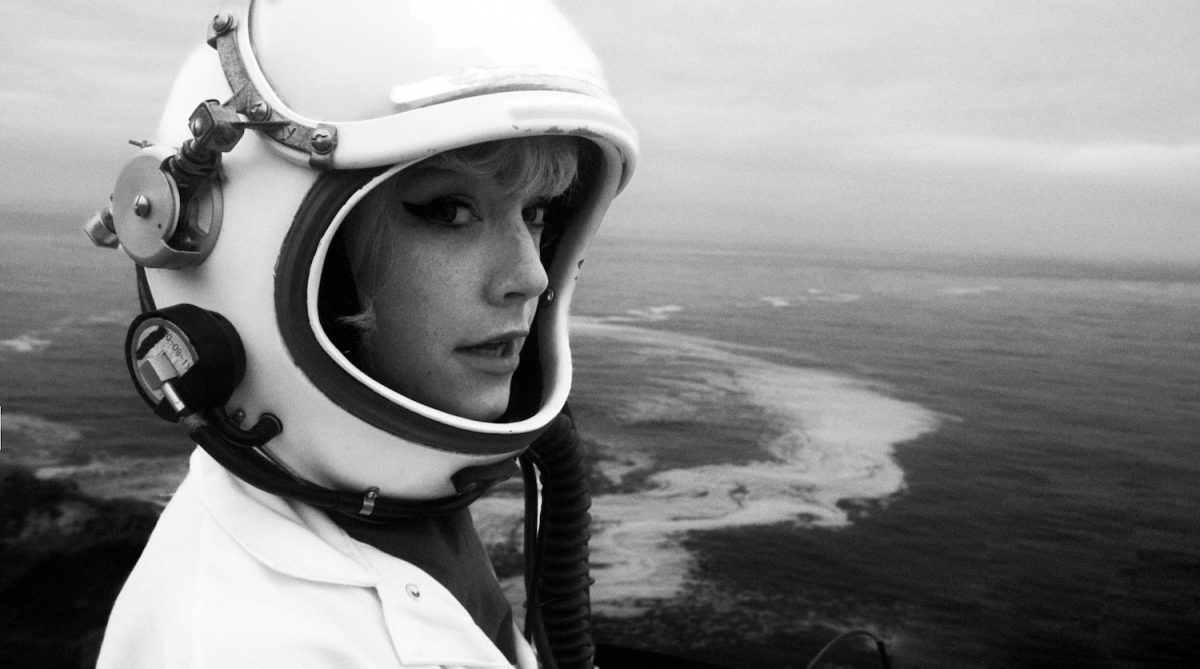
By and large, synth music is still considered a fringe genre, sometimes dismissed as too fabricated and ephemeral for all but the most forgiving human ears. Danz MC (formerly Computer Magic, birthname Danielle Johnson) is doing her part to alleviate that unfounded stigma through her Synth History website, magazine and podcast series. Most recently, she curated Synth Utopia Vol II (CAM), a compilation of rare soundtrack finds from ’70s and ’80s French and Italian films. Culled from the extensive archives of Italy’s CAM Sugar label, the selection includes obscure early work from familiar names like Ennio Morricone, Vangelis and Marcello Giombini.
Raised in New York’s Catskill Mountains and now based in Los Angeles, Danz does it all, from writing, singing and playing to producing, mixing and mastering. A talented graphic designer and founder of the Channel 9 label, she’s amassed an impressive 10-year body of recorded work that marries her passions for sci-fi and synthesizers of every type. Her latest release, Lärm!, pays homage to Cluster, Can, Neü and other ’70s krautrock acts. Oh, and she’s big in Japan.
MAGNET’s Hobart Rowland recently established contact with the Danz CM space pod for an informative interface.
How did you come to collaborate with CAM Sugar for this project?
Synth History is basically a vessel for all the stuff I’m a fan of—and I’m a fan of film. The brand began collaborating with film-focused partners like the Criterion Channel and the ongoing Iconic Scores screening series at Vidiots to spotlight not only front-and-center synth scores—like Vangelis’ score for Blade Runner, which I love—but also lesser-known works. Or films you might not even realize contain synthesizers at all, like Jodorowsky’s The Holy Mountain. CAM Sugar reached out, and the collaboration just made sense. I think what they’re doing is very important: restoring and archiving all these hard-to-find Italian and French film soundtracks. And I love the genres their archive consisted of, like giallo. So that’s how it came to be.
Where does this latest compilation fall on the synth continuum?
It very much feels like a snapshot of a specific moment in time. In the ’70s, synths were no longer confined to sci-fi and began to be taken seriously. You had composers working with tight budgets turning to them because they could give you the feeling of a whole orchestra. Giallo and b-movies had budgetary constraints but seemed to also give composers more creative freedom to experiment. Digital instruments and MIDI hadn’t arrived yet. So, with that combination of creative freedom and technical limitation, you get these incredible pieces of music created primarily with analog equipment that sound so, I don’t know, human. Or maybe raw is the right word. Unique.
By the early ’80s and onward, as digital synths and MIDI became commercially available, film scores began to sound increasingly more polished—at least in my opinion. This compilation captures that transitional period, and I think it’s really interesting.
As a remixer, what attracted you to Fabio Frizzi’s “Sette Ragazze Di Classe”? It’s from an erotic film, correct?
When you’re remixing a song, you’re trying to figure out what you can add or subtract—or spin in a way that makes it your own. When I listened to “Sette Ragazze Di Classe,” in my head I could hear a drumbeat and some melodic ideas … It just stood out. Like a lot of older songs, the stems no longer existed. I only had the song itself to work with, as opposed to individual, separate tracks. I had to think more in terms of what I could add and change, instead of being able to mix and subtract instrument parts. I didn’t want the remix to sound too modern, so I went with acoustic drums. I added a new bass line and new melodies with a Minimoog, formatting the whole thing into more of a pop structure.
I actually learned it was from an erotic film after I chose the song to remix. It just goes to show how talented Fabio Frizzi is—for a track this epic to be in an underground film.
You recently released Lärm!, your latest Danz CM effort. Tell us more.
For the past three years or so, I’ve been working on a synth-pop followup to (2021’s) The Absurdity Of Human Existence. The process had become slower than usual because of all the time Synth History began to take up. In the process of getting that album mixed, I was feeling overworked. I got antsy and wanted to make something. I recorded Lärm! in a day. It was one big song I split up—that’s why all the tracks blend together. The only intention behind it was to simply create and improvise without overthinking anything, just to serve as an artistic release. The name came later, inspired by early krautrock bands, since the recording process and instruments I used were very much inspired by that era. The lyrics also came later, inspired by the Viking Age, which I was getting really into researching and reading about at the time. The album was originally going to be all instrumental, but I added vocals at the last minute.
The cover art is amazing. Are there any ties to the Synth Utopia comp?
Over the past year, I’d been getting into painting with acrylics and just decided to paint the cover myself. I painted a carton and scanned it. On the back of the vinyl is a painting I did of mountains. In terms of a common thread between Lärm! and the compilation, they both take inspiration from the 1970s.