
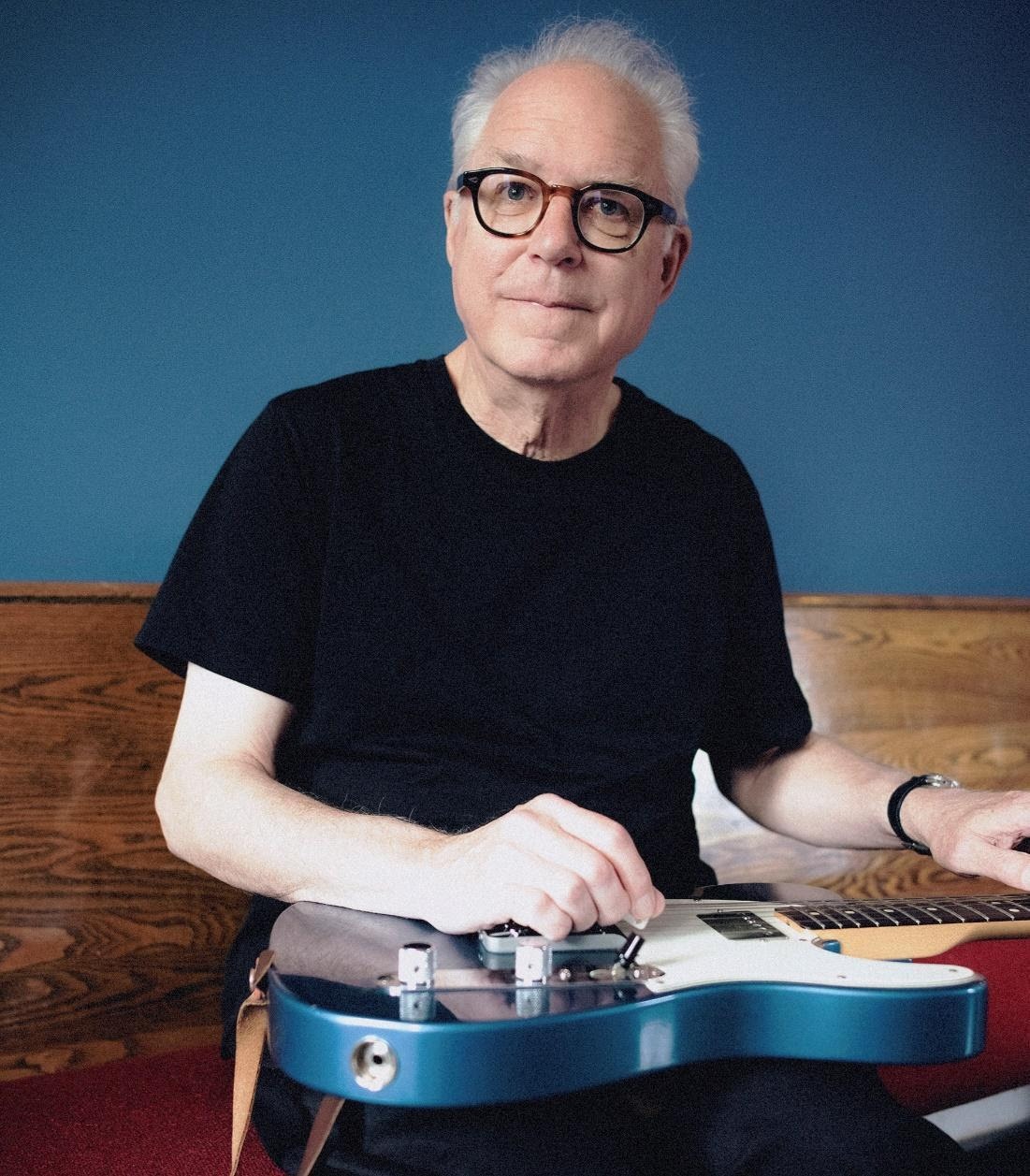
With well more than 85 albums as a leader or co-leader to his credit and documented sideman gigs in the hundreds, Bill Frisell is one of the most versatile guitarists in any genre. Few, if any, mavericks in their field are as humble and introspective as this legendary jazz innovator. In My Dreams is the latest manifestation of Frisell’s uncanny ability to mine collaborative gold from his journeys inward. And given his celebrated 45-year discography, it’s hard to believe that this is just his fifth LP for the iconic Blue Note label.
In My Dreams spotlights some old friends: Jenny Scheinman on violin, Eyvind Kang on viola, Hank Roberts on cello, Thomas Morgan on bass and Rudy Royston on drums. And while their connection with Frisell goes back decades, they’ve never performed together as a sextet. The basic tracks were captured live in 2025 at concerts in New Haven, Conn., Brooklyn and Denver. The recording was overseen by producer Lee Townsend and engineer Adam Muñoz, and Frisell did do some additional tracking with Muñoz at Berkeley, Calif.’s Ninth Street Opus Studios. Nothing about those post-performance sessions was corrective, so the music still bristles with spontaneity, invention and interaction.
Ticking another item off his bucket list, MAGNET’s Hobart Rowland chatted with the 74-year-old Frisell via Zoom from his Brooklyn home.
Tell us about your history with the In My Dreams group?
Hank Roberts and I met in 1975 when we were in school, so that’s more than 50 years ago. But with everyone, I’ve had a long relationship. The most recent is Thomas Morgan—but even with him, it’s getting to be decades. It’s getting weird, these spans of time. We’ve played in so many different contexts, in different combinations. I’ve been playing a lot with Thomas and Rudy Royson as a trio, but it had been a while since I played with the strings. There’s been a lot of mixing and matching going on, but I just got it in my mind that it was time for us all to get back together. In the press release for the album, they say it’s like a family reunion—and it feels that way to me a little bit.
Is there something different that comes out in the performance when you’re that comfortable with somebody?
What I’m always hoping for is that I’m surprised. I want to be shocked, and I don’t want it to be routine. The idea is not that we’re playing a show. The idea is not to refine it into something that we do over and over again every night. The idea is, “OK, we trust each other. Let’s go on this adventure.” No one’s judging each other. We want to go to a place we’ve never been, and we want to help each other. I don’t want to be afraid to try something that I’ve never tried before. And if it doesn’t work, I know these guys aren’t going to be like, “Oh, you made a mistake.” It’s not a contest. If everybody feels that safe, you can take a lot of risks. For me. that’s where the music really lifts off. You enter this zone where you’ve never been. And, wow, it’s amazing.
Does the fear of the unknown still play a role in what you do?
If I go into a situation where I don’t know anybody, and I don’t know if they know me, then, of course, there’s more fear. But you hope you can shake that off. So much of it has to do with trust. If the other person is listening and you’re listening, things usually work out. With this sextet, I can jump off the cliff, and somebody will swoop by and just pick me up and take me somewhere.
You’ve spoken about a dream you had that inspired the new LP. Are you any closer to realizing that dream?
The nature of music is that you’re just never going to get there. You’re making progress, you’re moving, you’re learning, you’re doing this and that. But it’s always just beyond your grasp. I learned a long time ago that I’m never going to get there, and I that I’ve got to feel comfortable with the fact that it’s amazing to just to be in the process. That’s the joy—just that you’re learning and you’re progressing somehow.
If I’m dreaming about something, it just evaporates as soon as I wake up. Some people are better about remembering what happened, but for me it’s sort of like, “I know I was somewhere.” And that’s what it feels like when the music is really happening, and I’m in the midst of this ecstasy of playing. I’m in this incredible place, and I just want to be there all the time. But it’s tricky, because if I notice it, it’s going to take me out of it. Once I get to the position where I’m the person outside looking in at what’s happening, I’ve lost it—it’s gone. It’s a fragile thing.
There’s also the other thing about dreaming that I think about these days … like Martin Luther King Jr.’s “I Have A Dream.” Somehow, we have to hold on to this dream of a possibility of that we’re going to get it together and make it through this mess we’re in. It gets so dark these days—and overwhelming. Music has always been this model for me, like, “If everybody just played a guitar, this shit wouldn’t be happening.” Because you have to listen. You try to find harmony with each other. Empathy, compassion, loving each other—all that stuff happens in music.
With jazz, there’s the challenge of recording it. What was the process for In My Dreams?
My idea was to make a live album. I got a gig at this place called Roulette Intermedium in Brooklyn, which is a really great room I feel comfortable in—an old meeting hall kind of place. Then we got another gig the day before at this place in New Haven called Firehouse 12. It’s a small performance space, but it’s also a recording studio. Since it was all set up, we thought we might as well record it. We did that, and then we did the gig at Roulette. Then I thought, “OK, cool, we got it. That’s going to be the record. I’ll take this and we’ll mix it.”
But then, a few weeks later, we had another gig in Denver—and Denver’s where I grew up. My old guitar teacher, Dale Bruning, was there. He’s 91 years old and one of the most important people in my life. He introduced the band. They had a setup there, so we recorded it as sort of an afterthought. The band didn’t know we were recording, which was interesting. We’d already done the thing at Roulette a month before, so we could just let loose. Later I went back and listened, and the stuff from Denver sounded pretty good.
Then it got into a different process where we started taking bits and pieces from different performances. There might be a melody that came from Denver, something else that came from Brooklyn, then a little piece from New Haven. The engineer was so great. He found a way to make it sound like a unified piece of music. Then I overdubbed a little guitar. It still has the live energy, but it was worked on quite a bit.
You’ve been in this industry a long time, and it’s changed so much. How have you managed to keep a safe distance from it to the degree that it hasn’t driven you insane?
I’m not so sure. Sometimes I think, “Wait, am I losing my mind?” [Laughs] The music always tells me what to do. And I’ve been unbelievably lucky to actually be able to keep recording stuff. It’s like the whole structure is just disintegrating around me, and somehow I’m still able to make another record. I don’t know how long that will last.
Do you think jazz has been more immune from industry upheaval?
What we call jazz has always been underground. It’s not a big money-making thing. You listen to the Sonny Rollins A Night At The Village Vanguard record, and there’s like 15 people clapping in the audience. But the music itself is so strong. No matter what happens, there’s no way human beings are going to stop making amazing stuff, despite how it’s sold or not sold. Music is never going away.
See Bill Frisell live.