
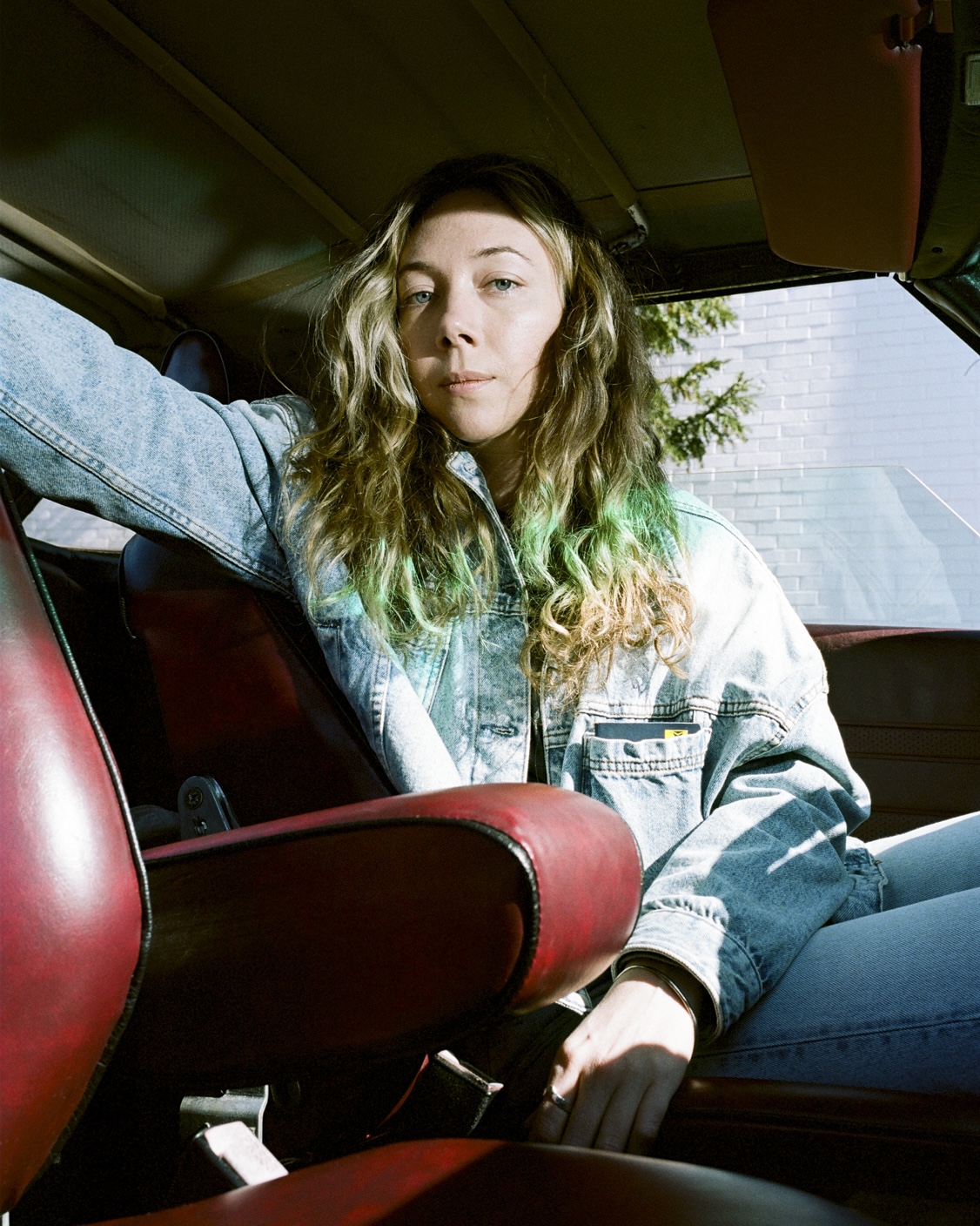
For Gen Z artists weaned on TikTok vids and Spotify playlists, there are no boundaries. Sometimes, it can lead to an unwitting mess. Other times, it sounds more like Burnout/Boys (Only One On The Mountain). Recently recovered from an eye-opening jaunt to Los Angeles to pursue technical writing, Ski Team’s Lucie Lozinski marks her renewed commitment to music with one of the best singer/songwriter albums of the year.
“I found musicians I deeply admire in New York, and I go to as many of their shows as I can,” says Lozinski, who’s now living in Brooklyn. “Just being in the place where the thing happens, you’re much more likely to give it more of your focus.”
Raised in New Jersey, Lozinski was serious about music as a kid before shifting her focus to literature studies and writing at Ivy-level Wellesley College. Not a flashy vocalist, she has an uncanny way of rising to the moment, whether its whispery intimacy or a surprising crescendo. Lozinski displays the same subtle flair for the dramatic in her lyrics, which can veer from overtly confessional to evocatively impressionistic in short order. “California woke to the smell of allium in the gunfire smoke,” Lozinski sings on Ski Team’s latest single “Gilroy,” written in the aftermath of a 2019 mass shooting in California. “You wanted it to sting.”
Burnout/Boys’ playlist covers a ton of ground, from Phoebe Bridgers, Aimee Mann and Rickie Lee Jones to Chappell Roan, Sara Bareilles and Avril Lavigne. The album was produced by Philip Weinrobe (Adrianne Lenker, Cass McCombs, Buck Meek) with a surplus of inventive touches that always serve the songs. It’s the sound of a talented artist searching for her true voice—and the journey is (at least) half the fun.
Fresh off a pair of album-release shows in L.A. and New York, Lozinski fielded some questions from MAGNET’s Hobart Rowland.
You got away from music to focus on writing. What brought you back to your first love?
Good question. It never left. I remember walking at Ocean Beach in San Francisco with a friend, and he was talking about life goals, having a family, getting married and buying a house—and how all the work we were doing was really to support and enable those dreams. I told him something like, “All I have like that is … I want to make records I think are good. I could die happy if I did that.”
Did the time you devoted to writing make you a better singer/songwriter?
I never studied music formally, which means I can feel comfortable doing whatever I want. I don’t really know the rules and never got graded on it. I think that’s helpful for expression and trusting your own ears and intuition. I really admire writing that’s a little funny and doing a lot that you don’t notice. I don’t like flowery writing. I learned a lot from Hemingway: Just state what’s happening, and let the beauty come from that, rather than trying to be beautiful in the words. And from writing essays: Give the reader something concrete to hold onto, give them all they need to feel the same thing you feel. Then use structure to drive a message home. So … anyway … the short answer is yes, probably.
How did you wind up with Philip Weinrobe as your producer?
I made a spreadsheet. Whenever music feels perfect, I look up who produced it, where it was recorded and who was involved. I started tracking producers who seemed to make everything better—whatever they touch, it’s good. Philip is one of those producers. I think I sent him an email, sent him some demos, and we eventually got on the phone and decided to set up a session. Once the recording was scheduled, it went very fast. I’d never met Phil or any of the players before. I showed up at 10 a.m., drank coffee, met everybody, played them a song on acoustic guitar. Then we played it together until it felt good. Phil got the take, we ate lunch, and we did it again for the next song. Two of the songs (“Killer” and “Gilroy”) I didn’t think would work well with that process—certain layers I wanted to control a bit more. For example, “Gilroy” has a lot of humming as this instrumental bed. I didn’t want to add them later—I wanted it to be a core part of the song, and I wanted the whole song to feel kind of raw and not get too fun. For that one, (guitarist) Will (Graefe) and (drummer) Jeremy (Gustin) came over to my friend Eric (E. Sanderson’s) studio in Red Hook. We had two people filming because the studio had just opened, and Eric wanted some footage to put on the website. We tracked it live but listened back, added layers of guitar, got a sample of this creaky dock out in the water, added harmonies. We pretty much finished it that evening, but it was a little less live than the Phil sessions.
Which artists of your generation do you feel a kinship to and why?
Jeff Tweedy. He’s just … His voice is warm and crackly and effortless and laid back and cool and young and old all at once. The words are perfectly scattered—he brings you from idea to idea and leaves you with a sense of story that isn’t as heavy-handed as a lot of singer/songwriter music. The melodies are simple and feel like something you should’ve already heard, but they’re catchy and unique. Sharon Van Etten has a good mix of darkness and levity I really appreciate—and just this casual way of delivering the words. It’s not tuned and perfected, just sung. Most of her songs feel lived in already when I first hear them. I love Adrianne Lenker and Big Thief—and (experimental jazz artists) Sam Wilkes, Joshua Crumbly and Sam Gendel.
The new album strikes the perfect balance between restraint and catharsis—and nowhere is that more evident than on “Landslide.” Tell us about the inspiration for that song.
I’m pretty sure it was the last song we tracked because I wasn’t sure it was done. I got it caught in my head and don’t really remember writing it. It was more of a subconscious kind of flow of song. I was moving in with the man I was dating and really nervous about it. But I felt like, “All right, we’re either moving in or breaking up. Something’s gotta move, so let’s try investing harder and being closer and seeing if that feels right.” I suppose I had a lot on my mind and spirit with the session coming up, and I moved out of my apartment and into his place the night before the first day of recording. Throughout the week, I kept tweaking the words. I was reading about various tyrannies in history and trying to subtly get this theme of war tactics into the lyrics. I wanted to capture this violent energy of like, “You think I’m not committed, you think I’m set on being independent? Watch this—look how committed I am. I’ll destroy everything I’ve built on my own and build something fresh with you.” I guess I was feeling some pressure to show vulnerability and make a bigger show of commitment.
I had the ending idea, but it was pretty loose and I wasn’t sure how to fit that part into with the rest of the song. The hard transition was Phil’s idea, and the studio fade. Phil put his arms up and slowly dropped them, so we all knew when to get quieter and quieter until the sound was gone. Also, Booker Stardrum is the drummer on that one, and it was so incredibly fun having him pour out and be the backbone of that song—just like throwing shit off a cliff and then shifting into that jam at the end. I love that guy.
Bonus question—and the one you’ve likely been dreading: Ski Team?
Ha-ha. People had a hard time with my last name: Lozinski. I also thought I could maybe convince my brother to be part of the project. He has the same last name. Two Lozinskis … Ski Team. He already has a band, though. So now it’s me and whoever I can get to join me project to project.