

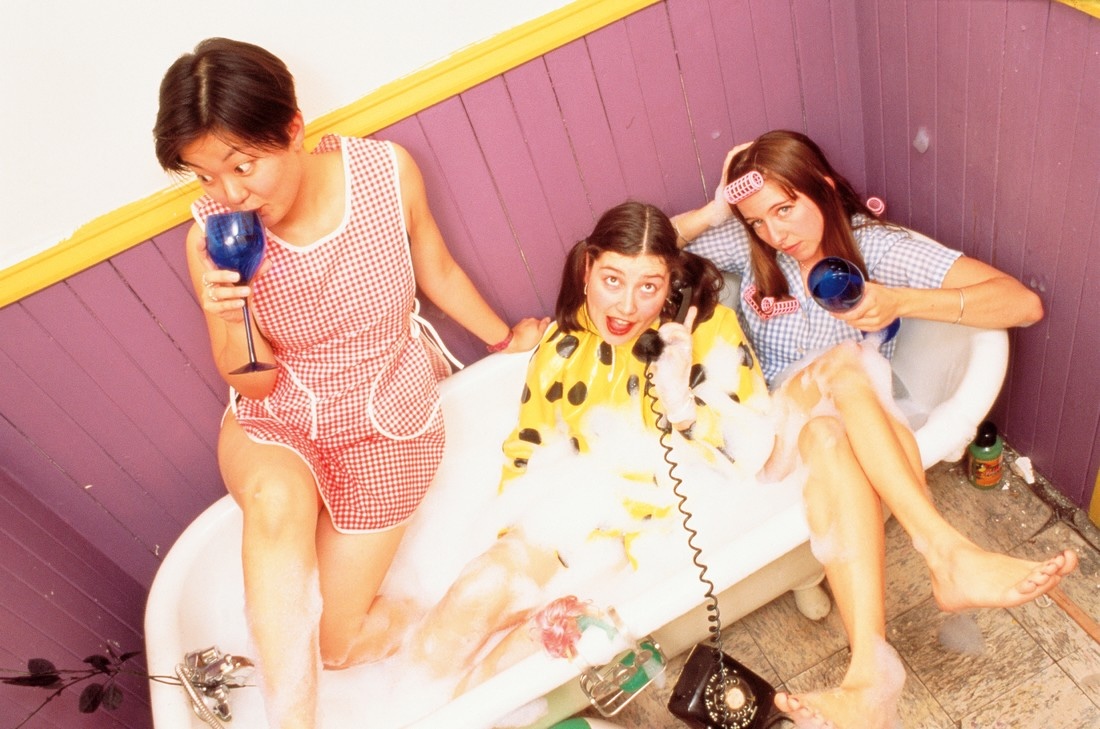
Cub recently poked its head out of the post-’90s void with the 30th-anniversary reissue of Come Out Come Out (Mint). Fans of the Vancouver-based cuddlecore pioneers may still have copy of the original triple-seven-inch vinyl version the band was selling on tours with They Might Be Giants, Sebadoh, Yo La Tengo, De La Soul and other marquee acts. The all-girl trio earned those choice opening slots after its 1993 debut, Betti-Cola, doused grunge-addled college radio with a fizzy, easy-on-the-ears mocktail of surf, punk and pop.
In many ways an equal to its stellar predecessor, Come Out Come Out was reissued with bonus tracks in 2007. But the new remaster on standard vinyl has a reconfigured track list and reimagined Fiona Smyth artwork to fit the 12-inch format.
MAGNET’s Hobart Rowland took a stroll down memory lane with Cub guitarist Robynn Iwata (sister of Mint co-founder Randy Iwata).
What went into making this such a fun and creative reissue for Cub fans? Take us through the process.
The original release of Come Out Come Out was as a three seven-inch-record set and a CD. While going over the pre-remaster audio, I realized the total running time of the original seven-inch versions would happen to fit around the running-time limits—for audio quality—of a single 12-inch record. Thinking through that possibility a bit further led me to consider how the two sides would be divided compared to the running order over the three seven-inches. This freed me up to put them in an order that was simply what I thought was the best a- and b-side listening experience. Turns out there weren’t that many re-arrangements needed for it to flow very nicely.
Of course, the consideration of expanding it all onto a 12-inch meant that there would be big artwork. I remembered that there’d been some unused original Fiona Smyth artwork—and to our surprise and delight, it was unearthed from the Mint vaults … except it was only on very faded, almost completely destroyed faxes. I set about hand-restoring all the pieces, combining it all into the new back cover and inner gatefold design. While all this was going on, (vocalist/bassist) Lisa (Marr), (drummer) Lisa G. and I were closely discussing and refining these choices with Mint. In the end, along with a new remaster done specifically for vinyl, we arrived at the 30th-anniversary edition.
When Come Out Come Out was released in 1994, the music industry was just starting to wean itself off grunge. How did Cub manage to be such a successful antidote to all that testosterone?
Cub’s motivations weren’t really reactionary, and we weren’t out to prove anything. We simply wanted to be the band we were, which was a place for us to put our creativity—much of it being extra-musical, as well—into joyful action. Being in Vancouver—just a stone’s throw to Seattle—and being involved in grassroots college radio, we were all deeply connected to and influenced by the music scene just south of the border down the I-5. Expanding further south, the West Coast scene was pretty all-inclusive, with lots of prominent woman-powered bands—Hole, L7, Red Aunts, Dickless, 7 Year Bitch, Tribe 8, the Fastbacks, the Muffs, Lois and Mecca Normal, to name a few—along with the riot grrrl and queercore scenes.
As far as testosterone goes, I found the outpouring of angst, volume and raw energy to be cathartic. Generally, we found the harder-rockin’ community to be super warm and supportive of Cub. It seems to me that many of those bands were genuinely reacting against the shiny, soulless mainstream rock and pop format and the music-industry rulebook of that time. If Cub was an antidote to anything—and it’s not my place to say if it was or wasn’t—it would be those things, as well. As I mentioned, we were truly DIY because we simply wanted to be hands-on, doing the work for ourselves. That’s where the fun, learning and passion is. It’s the ego that wants things to be done for you.
Speaking of the music industry, it was a much different beast in 1994. How was Cub able to negotiate that minefield on your own terms?
Being on Mint Records, we were mostly able to avoid it, thankfully. The label and the group worked very well as an extended family—in my case, literally—and was a network of similarly minded friends. That home-base gang made it all very “safety in numbers.” We didn’t have that direct net when we were out on the road, but we never really had any serious problems with any venues or promoters and the like. Quite the contrary—we played some gnarly places with some burly bands, and it almost always seemed to work out where we seemed to be slightly protected—always being treated and watched out for like someone’s sisters or something. Cub always seems to bring out the good in people somehow—including us.
Thirty years later, how do you feel about Cub’s “cuddlecore” designation?
I feel now basically the way we felt about it soon after the novelty wore off, which was quick. The term itself is catchy in a meme-like way, which is likely why it stuck regardless of whether it was particularly accurate. By definition, labels are limits. We didn’t feel that cuddlecore spoke to the complete scope of what we were up to by the time of Come Out Come Out. Even though we ourselves used it, I don’t think we were ever quite as thoroughly twee and one-dimensional as the term suggests.