
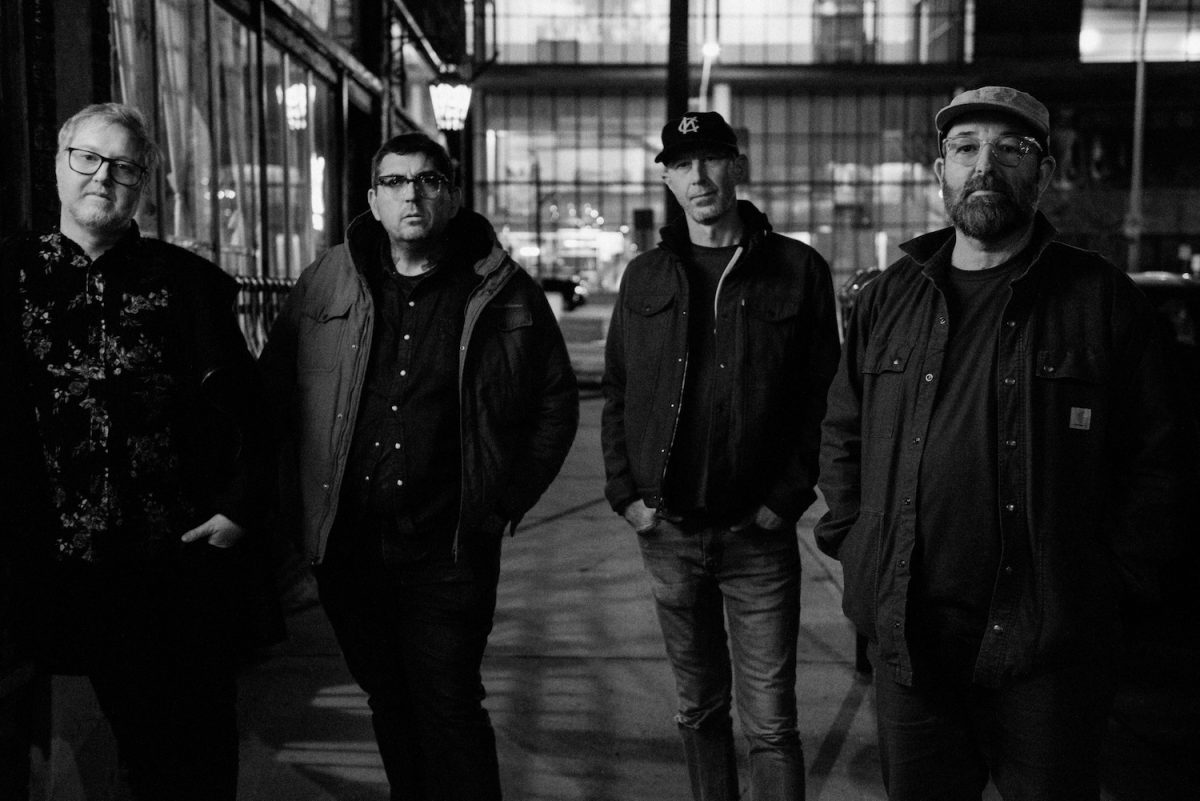
Legitimately emo years before emo was a thing, the Midwestern indie rockers in Boys Life are back with their first collection of original music in almost 30 years. Juiced by a recent reunion tour, the band recorded the new Ordinary Wars EP (Spartan) at Weights And Measures Soundlab in its native Kansas City, Mo. Working with Duane Trower (Seasons To Risk, Quitters Club), Boys Life leaned into a jam-induced methodology of live takes and no-nonsense production. There’s a boatload of blue-collar despair behind the words, but the catharsis inherent in the music finds reason for hope.
Here’s more on Ordinary Wars from singer/guitarist Brandon Butler.
—Hobart Rowland
“All the songs on the EP are about the fabric of reality we’ve lived under for a very long time, and how that fabric has gotten really thin in the past eight to 10 years. The working-class people see now that there’s a caste system in this country. It became very apparent over COVID that the term ‘essential worker’ meant servant. While middle management and up in the corporate world continued to earn from the safety of their homes, the rest of us had to go out and risk our lives to pay our bills. I remember feeling somewhat expendable. We’re just like every other animal on this planet, but somehow we have to pay to be here? We don’t get to decide what the fee is, either.”
1) “Bleeds”
“This song talks about how no one is coming to help you—and how easily people forget the atrocities and bullshit that go on every day. We’re drenched in modern conveniences; we have everything at our fingertips. With all the hundreds of friends I have on social media, I only see two every week. My attention is constantly being diverted away from the fact that life is a finite journey and that it all goes by pretty quickly.”
2) “Ordinary War”
“I think about how short life is. A lot. We buy into a fantasy that America, money, status, time and titles are real. Those things are really just fabrications in the framework of the American psyche. Our government has failed us. Corporate America owns every facet of our lives. We’re all glued to social media: cheap dopamine hits scrolling by. Your ideas and feelings used to be the only thing someone couldn’t take from you—and now they found a way to take those. America is a business, and we all work for the company. If one were to fight a war against these fabrications, one would have to start breaking down that framework and value system. The war would be inside each of us, denying those forces trying to buy our minds and time. We’re a part of something much bigger. It’s not an ordinary war.”
3) “Equal In Measure”
“This is tied to the same theme as ‘Ordinary Wars,’ except it touches on the death process. I was the one who had to make the call to pull my dad off life support after he sustained injuries in his home in Florida. I was at work in Kentucky. It was such a transactional phone call: ‘Here’s the situation. What would you like to do?’ My sister was with him. There was an ultimate suffering happening, and I was able to end it. But what about the suffering in me? Am I grinding every day to save money so I can have a comfortable last five years of my life? What’s the fucking point? I don’t think there’s a good answer anymore, and that’s a dark place to be. I’m certainly not alone in that feeling. These songs are me just trying to navigate this world. I had the opportunity to sing my truth, so I did. I’d hope if anybody else feels this way, these songs would resonate with them.”
4) “Always”
“Throughout life, we’re always keeping some piece of youthful energy and being—not allowing the role of adulthood to become real. If you stop playing and having unconditional fun, you won’t see the wonder in things. Ram Dass said, ‘We spend most of our lives in “somebody” training, and in the end, we begin our “nobody” training.’ We start as no one and become no one. Everything in the middle should be wonder, discovery and celebration, but it’s usually just assigned roles. Some of us have figured out that the roles are just parts people need us to play. We’re universe incarnate—not our names, titles or ego. We’re always here in one form or another. We should treat life like children treat joyful things.”