
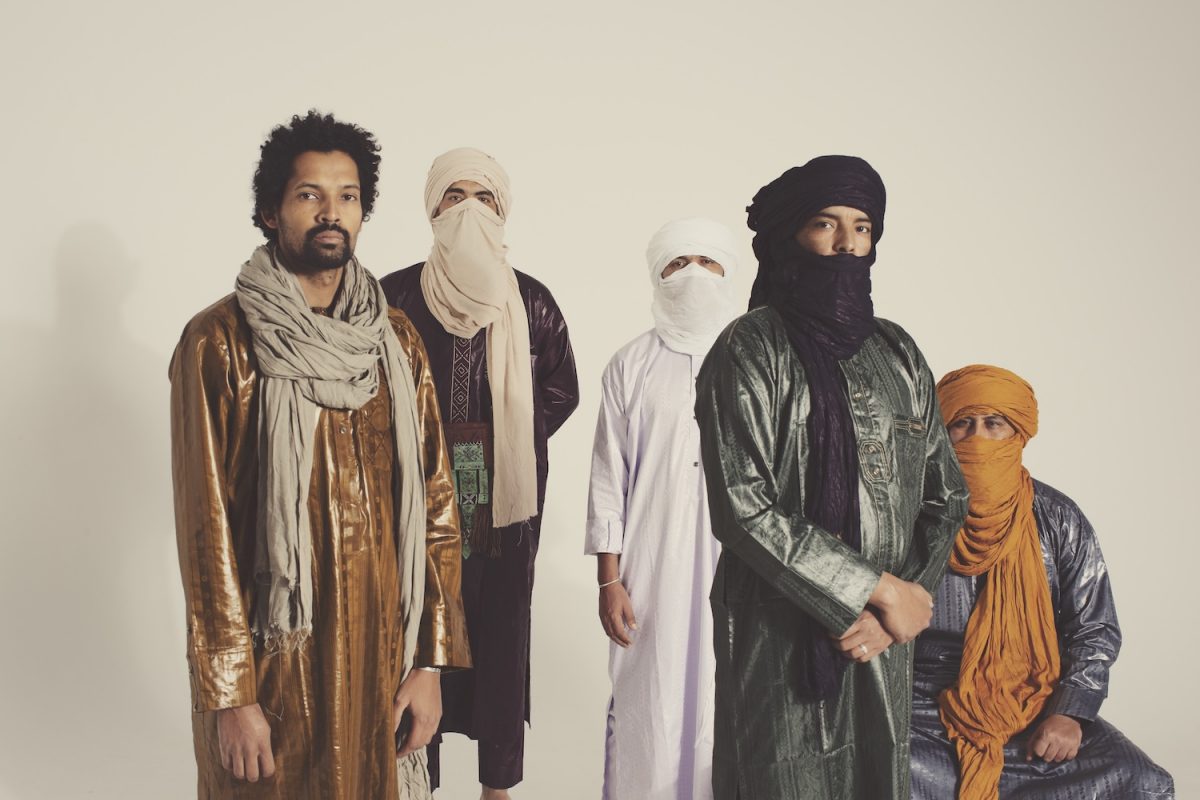

For a band whose music can best be described as fringe (at least to Western ears), Imarhan has made some significant strides in a quest to assimilate that wasn’t necessarily at the top of its to-do list to begin with. For the Algerian quintet, it’s always been more about a cultural exchange than fitting in. Purveyors of assouf (a Tuareg desert blues that emerged in the late 1970s in the Saharan region of northern and western Africa), Imarhan offsets its guitar-driven sound with elements of funk, psych rock and pan-African rhythms.
Over three albums, the band has managed to strike a chord with some notable Western acts, opening for Kurt Vile and collaborating with Super Furry Animals’ Gruff Rhys and Giant Sand’s Howe Gelb. With the new Essam (City Slang), Imarhan continues to diverge from the guitar-driven style many associate with Tuareg, even as the fivesome illuminates the nomadic group’s rich oral culture of tea ceremonies, poetry, traditional animistic beliefs and a distinct Sunni Islamic faith. The album was recorded at the band’s Aboogi Studio in the heart in southern Algeria with a core lineup led by Sadam (a.k.a. Iyad Moussa Ben Abderahmane) and Hicham Bouhasse.
MAGNET’s Hobart Rowland unravels the mystery of Imarhan with help from Sadam and Bouhasse.
Essam is a considerable evolution from your previous work.
Sadam: It’s very different from the rest of our discography. For the first time, we’ve ventured into electronic territory. It’s our fourth album, and we’re not the same people we were 10 years ago when our first album came out. So, I guess our composition and playing skills have improved quite a bit.
How did the regional and global events of the past several years feed into the vibe of the new music?
Sadam: Our songs are inspired by our everyday lives, which can be sometimes happy, sometimes sad. Over the past four years, we’ve seen a lot of suffering among Tuaregs, with people from northern Mali fleeing violence caused by the Wagner militia. Some of us have lost family members and friends in attacks on civilians. Perhaps you can feel some of that in some songs, but I think there is a bit of everything on this album: different colors.
How did you expand your collaborative circle on Essam?
Sadam: Our friend Maxime Kosinetz, who recorded our first three albums, stepped in as a producer. His creative input has been essential, helping us reshape our sound in a contemporary way, without losing the assouf identity.
Bouhasse: Assouf is the sound of the desert and the music specific to the Tuareg people. It’s a musical style, like blues or reggae. It comes from the tende, which was played by women and inspired by the rhythms of the camel’s walk. Later, Tuareg groups such as Tinariwen added electric guitars to it. That’s how assouf was born. With Essam, we’re trying to give this genre a new breath.
In particular, there’s your work with Emile Papandreou (of French electronic-pop duo UTO). What did he contribute to the fresh direction on Essam?
Sadam: Emile brought a modular synthesizer and processed our instruments live while we were all playing in the same room.
Bouhasse: The work of Emile and Maxime is quite global on the album because we played everything live. They made a significant contribution to what we tracked and brought a new and distinctive texture to our sound. I particularly love the synth pad on “Ahitmanin” coming in progressively and setting a special vibe. Synths also play an important role in “Tamiditin.” The subtle notes and ambient sounds create a soothing atmosphere, almost like a new space where the vocals and the guitar can sit comfortably. On “Okcheur,” the drum-machine beat is quite unusual, but it doesn’t feel out of place at all. I have to say I didn’t get the point of adding that drum loop on “Azaman Amoutay” at first. But now I understand it and love the song.
Collaboration has always been a crucial component of Imarhan. Tell us about your some of your projects with other artists.
Bouhasse: There’s our collaborations with the members of Tinariwen. With them, it’s truly unique, because it’s the founding generation of this music that passes on its knowledge and recognizes the younger generation—who, in turn, seek to give it a new breath. We’ve also collaborated with many other artists, like Sudanese singer Sulafa Elyas and (Blur’s) Damon Albarn. These encounters and collaborations bring us a lot, both on a human level and in our sound. For me, that’s what makes great records.
Sadam: There’s a big, unexpected project in the works, but it’s too early to say more … Stay tuned.