
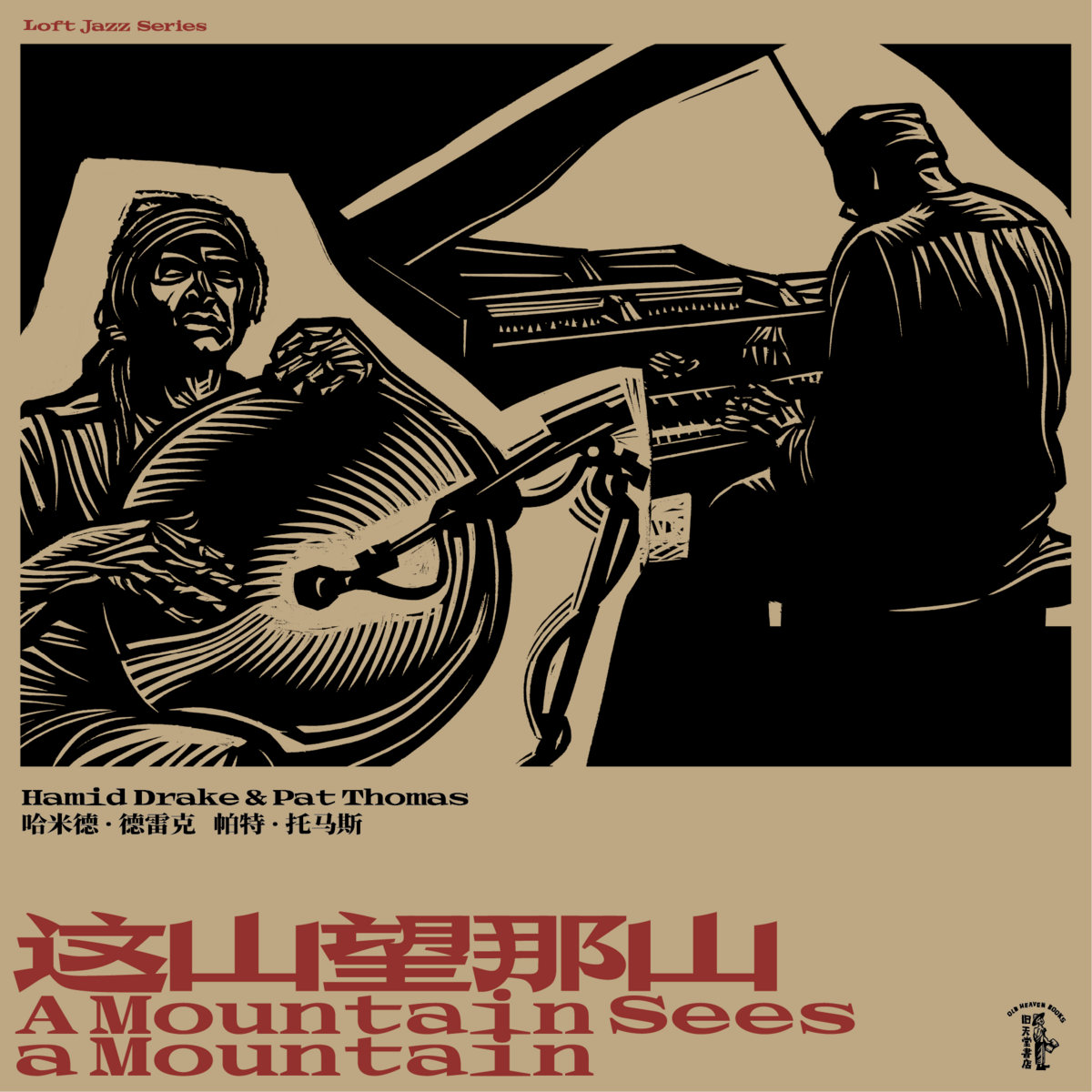
A Mountain Sees A Mountain: Game recognizes game. Pianist Pat Thomas and drummer Hamid Drake may have grown up on different continents, but they’re kindred souls. Thomas is the son of West Indian parents who was born and raised in Cambridge, England; Drake’s earthly arrival took place in Louisiana, and he spent his youth in Evanston, Ill., a suburb just north of Chicago. Both are identified with free jazz and total improvisation, but each understands his music springs from centuries-deep artistic and spiritual lineages that are rooted in Africa and wrap around the world. Drake is an aggregator and synthesizer of global rhythmic practices, and Thomas is determined to illuminate jazz’s Arabic and North African underpinning.
A Mountain Sees A Mountain isn’t the only occasion on which they have played together. But it is their only duo recording, and they had to go to the Oct-Loft Jazz Festival in Shenzhen, China, to make it happen. It opens with cheers that attest to the size and enthusiasm of the audiences the fest attracts. Thomas rejoins with a dense but strategically directed barrage of tone clusters, which are elaborated by Drake’s thunderous inaugural beats. Within seconds, they shift from withering storm to quiet mystery, clearing for themselves the broadest possible zone in which to co-create. Thomas and Drake then spend the ensuing hour filling that space in.
The pianist ducks under the hood to pluck out subaquatic sonorities and slams down Monk-ish chunks of sound, while the drummer shuffles ceremonial cadences and hurtling, constantly morphing patterns. More than once they alight as one upon Caribbean grooves, as playful as they are deep. At one point Drake intones words that John Coltrane once chanted on the album Cosmic Music, making explicit the music’s inclusive divinity. The final encore dissolves into the musicians’ shared laughter and more audience cheers. Maybe you’ll wish you were there, but the human exultation of this performance transfers quite fluently to the record. [Old Heaven Books]
—Bill Meyer