
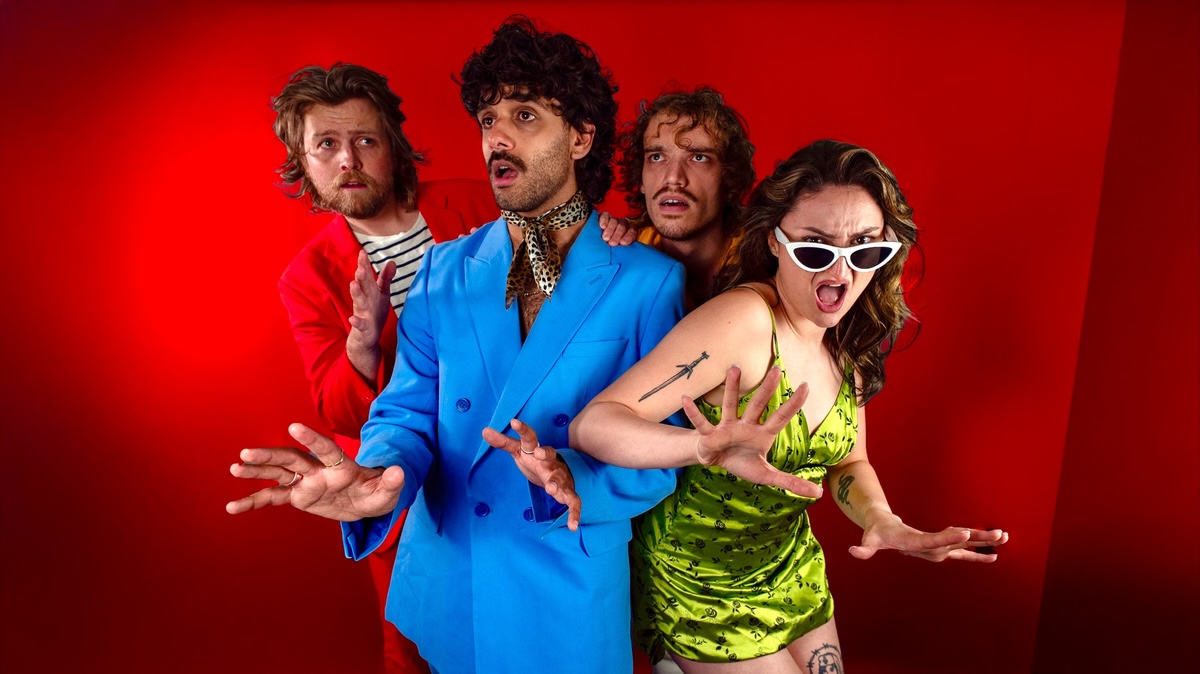
congratulations were part of a minor wave of luminous, gender-fluid indie-pop acts that lent a glittery sheen to this year’s SXSW music showcases. Also worth noting were Brooklyn’s Endearments, who ditched the lush keyboards altogether and morphed into a formidable guitar-driven trio for their SX set.
congratulations have always been more sinewy dance grooves than chunky power chords, which suits their flamboyant constitution just fine. The Brighton, England, quartet played six high-energy shows in support of its debut LP, Join Hands (Bella Union), in Austin, Texas. That’s where MAGNET’s Hobart Rowland cornered guitarist Jamie Chellar for the usual 5Q interrogation.
How did congratulations come together as a band?
We bonded over a shared love of Keane. We never looked back after that.
How does your passion for ’80s music inform your sound?
Our parents had impeccable taste. (Vocalist) Leah (Stanhope)’s parents are super into Erasure and Depeche Mode. Overall, her niche is goth rock—bands like the Cult. I was brought up with Prince and Madonna from my mum, and Duran Duran from my dad. (Bassist) Greg (Burns) and I really got into Talking Heads around the time we formed the band, and that was where our sound started to gel into something more cohesive—a blend of all the above.
I’d argue we don’t sound specifically like any one of those artists, but we have flavors of all of them. The beautiful thing about music from the ’80s is that the songwriting was so flawless—creative yet catchy, a lot of new boundaries being pushed and technology being explored. Pre-computers, people were really forced to be as creative as possible. All the best ’80s bands have verses as catchy as the choruses. That’s something we’re always trying to think about.
You went from 40-some demos to the 10 tracks on Join Hands. What was the vetting process like?
What’s the expression, “You have your whole life to write your first album”? Greg and I trawled through years of demos and scraps of songs looking for nuggets of gold we might’ve missed. We ended up with about 20 each. It’s worth noting that my earlier work was truly terrible; none of it made the cut. Then it was important to take it to Leah and (drummer) James (Gillingham). Between us, we got it down to 20. That process was interesting, because our lists were so different initially.
We actually ended up with 14 songs as we recorded our EP, Slap, at the same time. For a while, it was a revolving door as to which tracks were for the EP and which would be saved for the album. We found Slap had a darker edge, and the album tracks were a little more upbeat and colorful. I think it worked well in the end.
Tell us about “fifth member” Luke Phillips. What role does he play in the band?
Luke (a.k.a. Icebeing) produced and mixed the album. He’s the funniest person I’ve ever met. He kept morale so high in the studio and was a constant, unwavering positive force. He’s also a true musical genius—no one’s brain works like his. But he totally understood what we wanted to do and added all the “candy” to the album—the extra flourishes and moments we wouldn’t hear. He loves music so totally that he’s perfect for a band like us—where there are a lot of ideas jammed into a song. I’m not sure what we’d do without him.
Take us behind the scenes at the recording sessions.
They took a really long time—about two years overall from initial demoing to getting the masters back. We self-recorded everything with Luke, who was involved at every stage. We spent a week at a studio, where we had the initial desire to record live as a band to try and capture the energy of our live shows. Surprisingly, that didn’t work at all. No one liked their performances, and there was pressure to get it right and work quickly. Ultimately, this album is characterized by its level of detail and the layers. Everyone had to spend a lot of time on their parts to get them just so. That sometimes meant doing it ourselves over and over again, which we ended up doing at home.
Join Hands was recorded about 30 percent in the studio and 70 percent at my house. When the pressure of the studio disappeared, we could relax and experiment more. When Greg and I write, the demos are sonically quite realized, so the production is already there. In fact, a lot of the final album is original takes from the demos. For the funk guitar on “Dr. Doctor,” I had it in my head that I must record it again “properly.” But I found I was just chasing the sound from the demo. That was a big lesson—a classic “if it ain’t broke” moment. It’s funny how unfussy some of the album is, but how labored other parts were.