
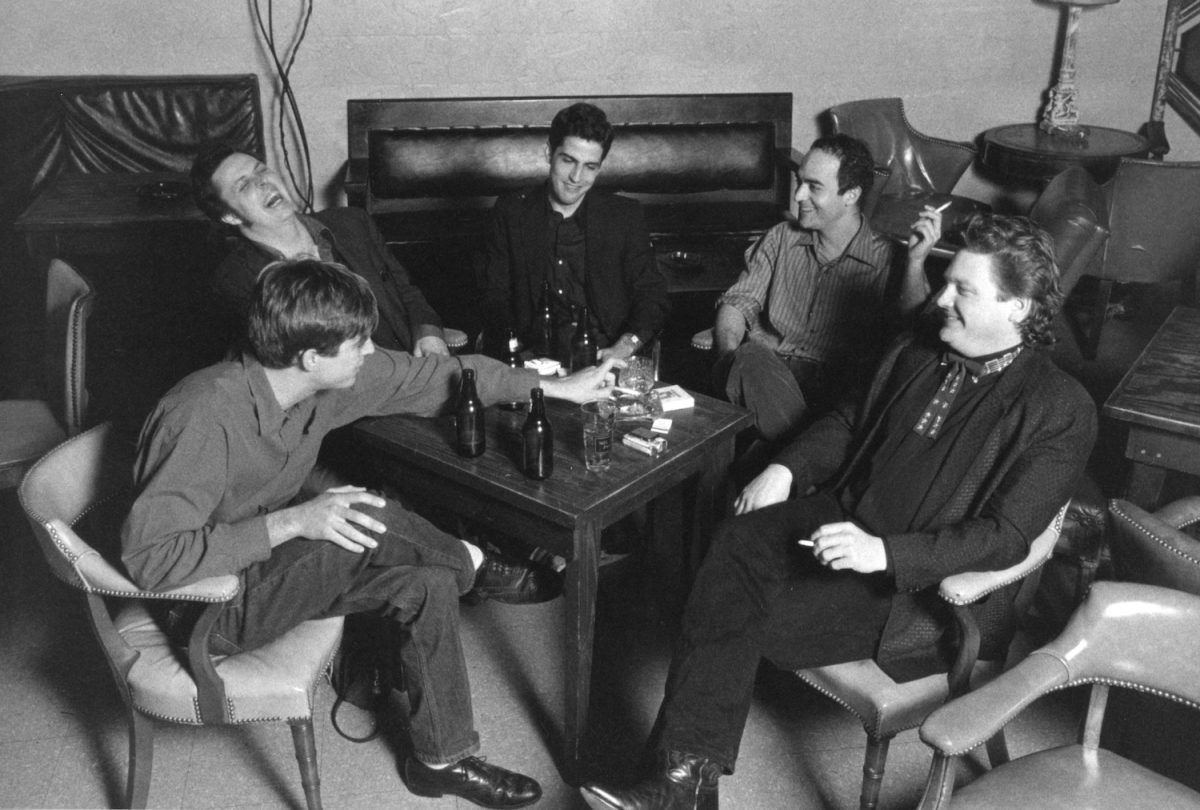
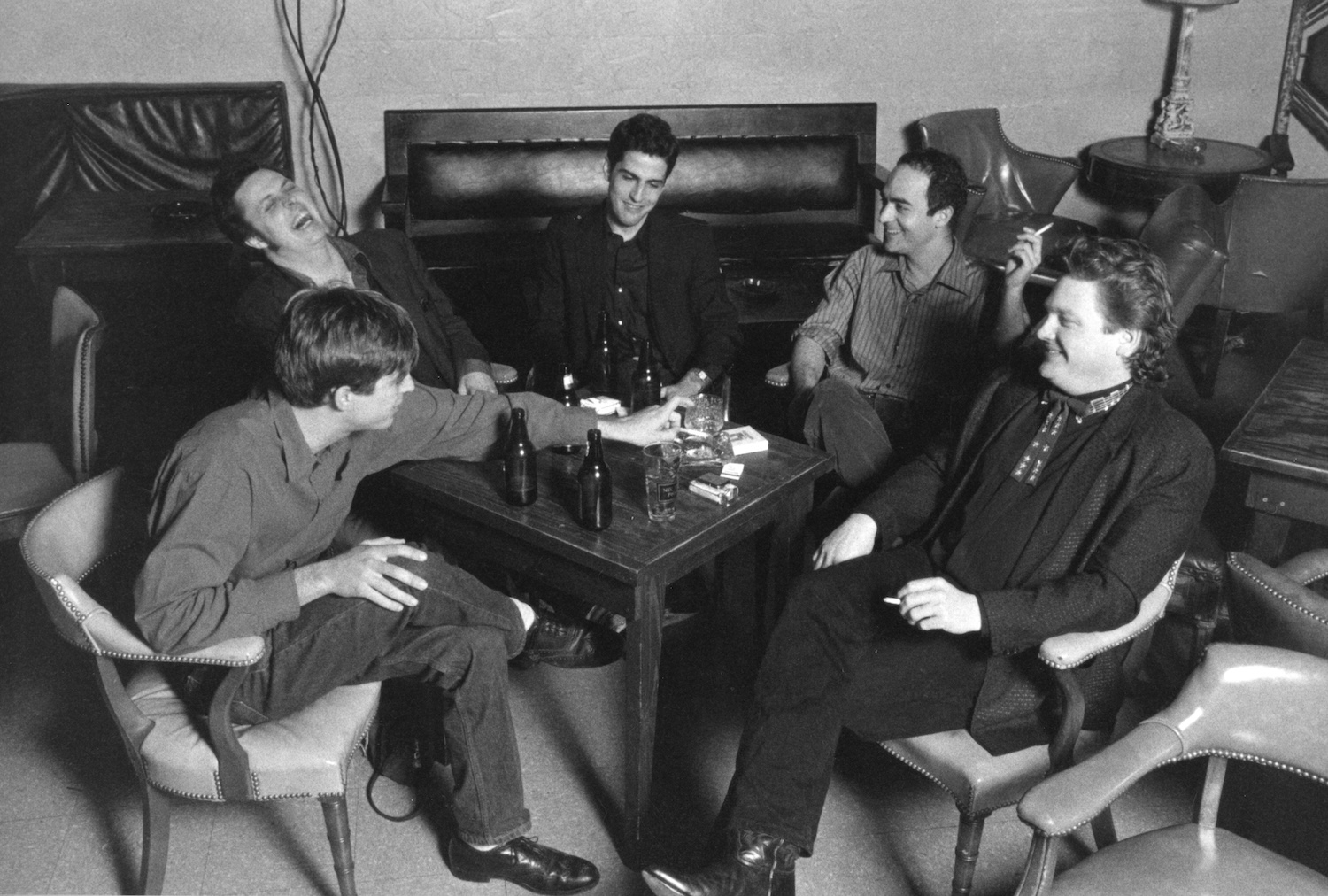
The Star Room Boys weren’t raised on country music, coming to it as young adults in Athens, Ga., via legends like Lefty Frizzell, Buck Owens and Merle Haggard. By the time they released Why Do Lonely Men And Women Want To Break Each Other’s Hearts?, primary songwriter Dave Marr, co-founding guitarist Doug Hollingsworth and the rest of the group had locked into a distinctive hardscrabble C&W groove. With one of the longest album titles in recent memory, the Star Room Boys’ impressive 1999 debut is populated by busted relationships, bar binges and long drives in vehicles of all conditions and axle sizes. More often than not, the ear is drawn to the easy interplay between Hollingsworth, second guitarist Philip McArdle and pedal-steel player John Neff, with drummer Bob Fernandez and bassist John McMahon holding it down with session-caliber subtlety.
Marr and Hollingsworth named the Star Room Boys after their practice space, a second-floor hideaway not far from the legendary 40 Watt Club. It proved to be an optimal homebase for the sextet as they made the rounds at local venues, honing their craft through country covers and a series of infamous Merle Haggard birthday tributes. They even backed iconic Athens singer/songwriter Vic Chesnutt on a 1996 split single.
By the time the Star Room Boys entered David Barbe’s Chase Park Transduction to make Why Do Lonely Men And Women, the songs had been thoroughly road-tested. They tracked mostly live with few overdubs, capturing essentially what fans had been hearing while making full use of Barbe’s massive plate reverb. The album was originally released on CD by the small Checkered Past imprint before slipping out print. Nearly three decades later, the LP is getting fresh life as a deluxe reissue via Strolling Bones.
McArdle and Marr walk us through the album.
—Hobart Rowland
1) “Gastonia”
McArdle: “A hopeless shot at reuniting with a lover who’s already too far gone, viewed through a windshield in the dark.”
Marr: “It was one of my earliest ballads and has the feel of those classic George Jones slow-dance shuffles. But we stripped away some of the frills and sentiment. I had a girlfriend who was from Gastonia, N.C., and I wrote it for her. We hadn’t even broken up at that point. I just loved the name of the town.”
2) “Was There Something In Her Eye?”
McArdle: “A man proudly proclaims he’s left his old self and his old love behind, but Dave’s lyrics open up just enough of a crack in the narrator’s story to show that he’s still drawn back despite his protestations. The speediest rocker in the band’s catalog and the closest we ever got to ’70s Stones, this tune pushes our country sound into a hard, straight line bound on either side by walls of trebly pedal steel and electric guitar.
Marr: “I was very much trying to write a song like Billy Joe Shaver, which is honestly pretty fun to do.”
3) “Both Our Towns”
McArdle: “Featuring the most quoted couplet in the Star Room Boys’ catalog (“And all your pretty little lies were like the sweat upon your thighs”), “Both Our Towns” opens with a cold minor chord that foreshadows the bitter story ahead. This is country music at its most jaded, shuffling slowly across the floor like someone who woke up to a wrecked coffee table and doesn’t want to deal with it until tomorrow.”
Marr: “A guy named John Thompson really gave me a car in New Orleans. I’d just met him. We were shooting pool. He heard I didn’t have a car. And he said, ‘I’m gonna give you a car!’—like he was a game-show host. I drove it back to Athens with McMahon riding along to keep me calm. It was uninsured and had no brakes.”
4) “It Belongs To You”
McArdle: “A 6/8 country-soul ballad hovering between the Teddy Bears and Solomon Burke in its hushed, idolizing love of someone missing. This tune transplants Lou Reed’s ‘I Found A Reason’ innocence into a lush nighttime setting, paced by the delicate rhythm section.”
Marr: “I’ve always loved songs that sound like this—jaunty and sad. When I wrote it, Doug said it sounded like the ‘pyramids along the Nile’ song, ‘You Belong To Me.’ It’s got the feel of an early-’50s pop song. McMahon and Bob were the solid foundation that gave this a convincing frame, which is hard to do.”
5) “Why Do Lonely Men And Women Want To Break Each Other’s Hearts?”
McArdle: “‘Tear in my beer’ is the hoariest cliché anyone can use when talking about 20th-century country music, and we’ve heard it more than most. But look past the barstool, and you’ll find a fully modern story of being broken and needing community to heal.”
Marr: “I’ve told this story a lot, but I wanted to come up with a title that was like a really obscure, super-specific proverb or axiom. It ended up being a rhetorical question that’s about as general as can be and has no answer—but it’s got the kind of resonance I was looking for. What the band does with the arrangement really makes it. They’re just swinging so hard and absolutely nailing all those little stops and spaces.”
6) “Souvenir”
McArdle: “Like the self-effacing, heartbroken-but-humorous ’60s singles from Buck Owens, ‘Souvenir’ sets off with a hard-country spring in its step, introducing a worried man who’s trying to stay just cool enough for his woman to keep him on, even if we know she’s going to drop him. One of the oldest songs in the Star Room Boys catalog, it’s a trifle you can dance to.”
Marr: “After I wrote it, I learned that ‘volunteer’ is something a flower does when it grows without being intentionally planted. So the line about a ‘volunteer forget-me-not’ is cleverer than I actually meant it to be.”
7) “New York City Isn’t Going Anywhere”
McArdle: “You’re setting out with a map for a new life in a new town tomorrow, but the boundaries between hearts are being drawn tonight. A stately country ballad in the tender and clear-eyed mode of Kris Kristofferson, tracing a route from hurt to healing and hoping for the strength to make it there.”
Marr: “Bob and I lived together for a few years, and one time he’d been planning a trip to New York and had to cancel it. I figured he was disappointed, and I told him I was sorry. The title here was his response. I liked the sound of it enough to write a whole song around it. This is something I’ve done a lot.”
8) “The Liar In My Heart”
McArdle: “A train-beat tune sung by a man who’s lived with himself long enough to know when and how he’ll fail his new woman—and he figures he may as well own it. A musical cousin to Merle Haggard’s “If You Want To Be My Woman,” if Merle went ahead and told her she did not, in fact, want to be his woman if she knew what was good for her.”
Marr: “My god, the arrogance of this guy … ha-ha. I guess I can be excused for these lyrics because I was, like, 26 and drunk as hell all the time. But, boy, the band just ripped through it—and Bob’s vibraslap at the end!”
9) “Foolish”
Marr: “This song didn’t have a name for the first few months we played it. I was asking audiences if they had any good ideas. I might be wrong, but I think the singer from this Seattle band called the Picketts finally identified it. This song is also like ‘It Belongs To You’ in that it has a little thing where the last verse calls back to a lyric in each of the earlier verses. I guess I was trusting people to be listening really closely.”
10) “Tell Me About The Blues”
McArdle: “A one-sided barroom conversation … And by the end of the first chorus, you realize the other person may not get a word in.”
Marr: “This almost sounds to me like somebody else wrote it. Philip’s tremolo guitar and John’s pedal steel coda echo the Everly Brothers’ early ballads, while the story is classic Star Room Boys—an elliptical account of loss told over a glass of bourbon.”
11) “Almost Doesn’t Count”
McArdle: “A country song as a heartbreak almanac, cluttered with all the towns, the distances and the dates that make up a man’s search for rest—an Odyssey traveled in truck cabs. ‘Almost Doesn’t Count’ crosses Gary Stewart’s bar-fight spirit with the gone-electric Dylan’s cutting sneer.”
Marr: “So this guy is so notorious that he jokes about the police hearing he’s on his way home and trying to intercept him on the highway. But he turns around and makes himself an exile because this woman has finally told him she’s sick of him. He’s telling his buddy all of this from a pay phone. This is probably my favorite song on the album. Everything the band does is exciting, and Philip’s solo at the end is like he’s tearing his strings off.”
12) “Blue Marie”
McArdle: “A stark ballad featuring only Dave on vocals and guitar and John on pedal steel. This song is Dave’s final addition to the album, and it may be the clearest distillation of Merle Haggard’s influence on the band, from the dignified longing of ‘Today I Started Loving You Again’ to the distanced stoicism of ‘Kern River.’”
Marr: “This song was around for a little while, but I’d just played it at a solo show or two. I don’t think we originally planned for Johnny to play on it in the studio, but I’m really glad he did. His stuff on this is so haunting and so, so sad. I think I recorded my guitar and vocals in the bathroom.”
13) “Someone’s Playing Our Song”
McArdle: “A half-laughing, half-crying testament to how a single song on the radio can be freighted with a lifetime of memories. The band tempers its usual honky-tonk edge with the swing of early Sam Cooke and Don Covay, building the perfect soundtrack for dancing through heartbreak. Please, Mr. DJ, keep those records playing.”
Marr: “This is where we decided not to send everyone to bed miserable by ending the album with ‘Blue Marie.’ It’s kind of a goofy song, in that same Buck Owens style as ‘Souvenir’ and another one or two we used to do. I thought it was a poignant way to end an album, too. This shattered guy insists he’s comforted by imagining that their song is being heard by someone, somewhere. He’s theatrically shrugging and going, ‘It’s not so bad’—like Ray Davies onstage, balancing a beer bottle on top of his head.”