
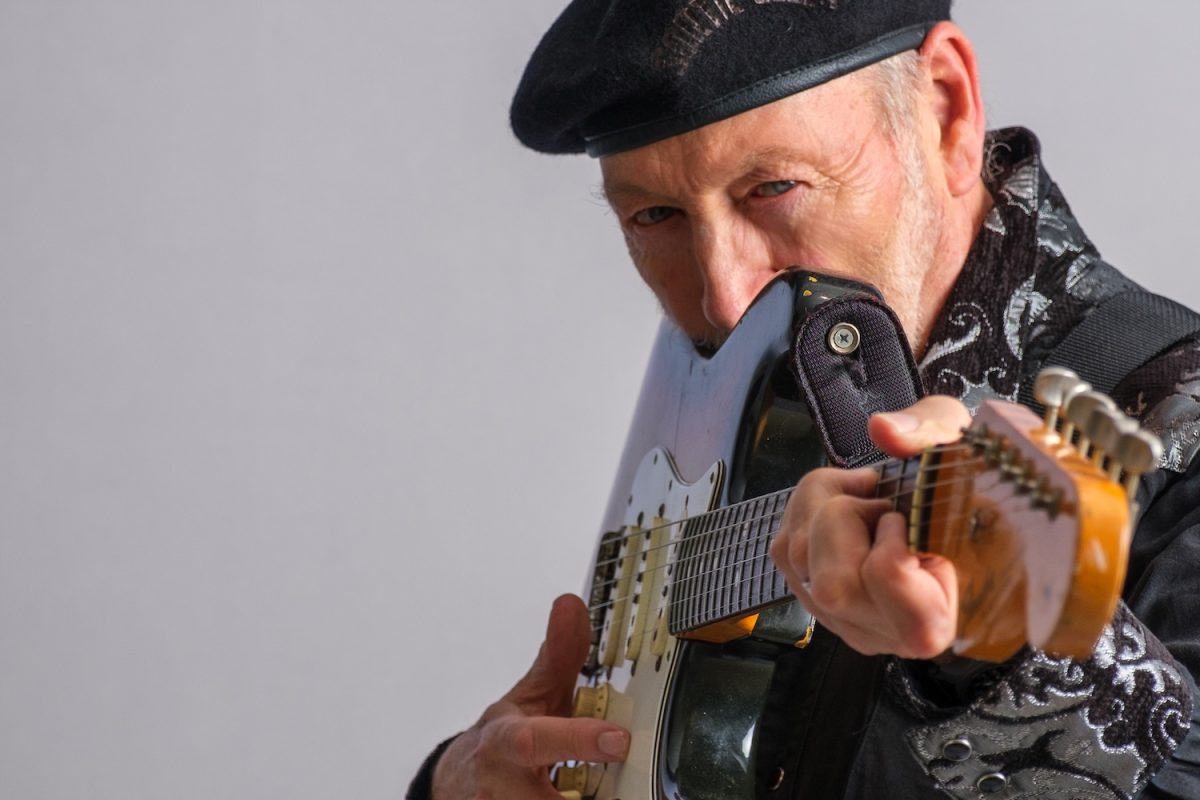
A restless preoccupation with the human condition runs throughout Hippies, Thugs And Heroes (New West). But that’s built into any Richard Thompson album to some extent. This happens to be his 20th LP, and its motley assortment of characters supply stories that stretch from post-war Britain to the excesses of the ’60s and ’70s. Some are fictional, others are drawn from memory, and a few contain traces of people Thompson has known.
Produced by the 77-year-old Thompson and Grammy winner James Frazee at Hobo Sound studio in Weehawken, N.J., the 12-song collection owes a least some of its immediacy to a change in Thompson’s own recording habits. Working with a new drum kit, he assembled unusually elaborate home demos, providing bassist Taras Prodaniuk and drummer Michael Jerome with more fleshed-out arrangements. The three have worked with Thompson for 15 years, so they quickly found their footing. With significant input from multi-instrumentalist David Mansfield and backing vocals from Thompson’s wife, Zara Phillips, they finished their scheduled five-day recording sessions in just three. They tracked most of the material live, including many of Thompson’s lead vocals.
MAGNET’s Hobart Rowland recently connected with Thompson via Zoom in the U.K., where he was kicking off his first string of live shows to promote Hippies, Thugs And Heroes.
You’ve said that when you’re putting together an album, you look for songs that are “kindred spirits.” What connects the characters and stories on Hippies, Thugs And Heroes?
I think a lot of the songs are retrospective. In the case of the song “Stringer,” I’m remembering a conversation between my father and my uncle Frank. My father was a London policeman; my uncle Frank worked on the railways. After the war, there was a big gang scene in Brighton. There’s a famous novel by Graham Greene called Brighton Rock, which became a film, as well. I’m recalling this conversation from when I was about 17, between Dad and Uncle Frank. So I wrote this outlaw ballad about a fictional character from that Brighton gangster mob.
Sort of like the mods and rockers of Quadrophenia?
A little bit like that, but this was a decade earlier. It was postwar until the end of the ’50s and early ’60s, so it was slightly different business. I’m just writing a ballad like “Pretty Boy Floyd” or one of those kinds of songs—Jesse James, Billy The Kid, whatever. He’s a heartless, mean, awful character, but people still write songs about him and celebrate him.
“Cocaine Walking, Booze Talking” is also rooted in memories of an earlier era. Were you thinking about someone in particular when you wrote it?
It’s about certain people who almost contain two people inside them, pulling in polar-opposite directions. There’s the sweet-natured person, and there’s the aggressive, violent person. I think John Lennon was one of those people, in a sense. He went from one extreme to another. John Martyn, one of my contemporaries, was a bit like that, as well—the sweet kid or the absolute thug. The woman in the first verse imagines that this guy is really much nicer than he is. She kind of blurs over his faults and his aggression and thinks he’s just wonderful. It was a good time for people misunderstanding people because they were drug addled.
Have you become more sympathetic toward the characters you write about as you’ve gotten older?
I’m not trying to open people’s eyes to some social issue. Charles Dickens was—but I’m just trying to be sympathetic, really. When people are more desperate, sometimes they’re more interesting—more revealing of themselves. You put a guy hanging onto a cliff—that gets interesting. How does he react? What does he do? You put people in a battle, with bullets whizzing around them. What are they doing? How are they reacting?
The demos for Hippies, Thugs And Heroes were more elaborate than usual. What prompted you to take a more hands-on approach to the arrangements?
It started from really having too much time on my hands. I had all these American Express points, so I put them on Amazon and bought myself a Pearl drum kit. I’ve got low ceilings, but if I get the mics all the way up there, it sounds pretty good. Initially, I did the whole thing for my own enjoyment—but also so I could send a more complete version of a song out to the boys. Usually, I just send an acoustic guitar, and that can lead to misunderstandings and a much looser version of how you’re going to interpret it—so it did save time. You could say it’s much more my vision of how the song should sound, which is a good thing sometimes. I wouldn’t do it all the time, but I think this time it worked very well.
How would you rate yourself as a drummer?
Pretty bad, I should think. I can play along to a click. And if I keep it simple, you might even be convinced I can play. Like McCartney … I noticed that when he was hiring drummers for Wings, they had to be worse than him. [Laughs] It’s kind of true actually … when you think about it.
The album was tracked so quickly.
Having the demos helped. But the person I didn’t send the demos to was David Mansfield. I didn’t know he was going to be on the record. He’s a wonderful fiddle player, guitarist, pedal-steel player … He plays everything. He has a little corner in Hobo Sound. So I said, “David, if you’re not doing anything this week, come and play with us.” And he did. Everything just gelled immediately, and that saved us a lot of time.
How does that compare with the way you’ve made records in the past?
Quicker, quicker, quicker. In the ’60s, we recorded pretty much live as well. In the ’70s, I Want To See The Bright Lights Tonight was recorded with acoustic guitar, bass, drums, and everything else is overdubbed. People seem to like that one. They say, “That’s your best record.” Oh, thanks a lot. What about the last three? I enjoy the live process, but in terms of results, I think you can succeed in various ways.
Your guitar playing remains instantly recognizable. Do you still manage to surprise yourself?
If you don’t get surprised, you might as well give up. I’m always a student of music—that never ends.
You’ve witnessed enormous changes in the music business over the past half-century. Do you value the simplicity of making music more as the industry becomes increasingly complicated?
The landscape has changed drastically, and we just have to live with it, really. I kind of resent Spotify because that’s your intellectual property they’re basically giving away for nothing, and they’re compensating you with absolute peanuts. They might as well physically give you peanuts for all the money you get. It would be nice if records sold more and ticket prices came down for live shows. I think live shows are overpriced, and not enough money is going to the artist for a lot of these shows. My youngest son (Jack) is in a band (Synesthetic Spectrum). They’re a bit goth, and they literally sleep on fans’ floors. They can’t afford hotels. The fans are paying for the gas to get them to the next gig. It’s very hard if you’re a not-well-known band or individual musician at this point.
Technology has also made it easier for musicians to reach audiences. Do you see that as a meaningful counterbalance?
But how do you get people’s attention on the internet? It’s great if it works for you—absolutely great. But you have to slide down a razor blade for 200 meters or do some other absurd stunt to get people’s attention. An interesting point about the ’60s in Britain was that everybody survived, to some extent, on playing colleges and universities. All those universities had an entertainment grant from the government. So Pink Floyd, Soft Machine, all these anarchistic bands were, in some ways, subsidized by the British government. They may not have existed without that.
Looking back to your early days with Fairport Convention, what’s the most important lesson you learned?
How to be a band, how to play as a band, how to mesh as a band. Every band is a little different. Maybe the rhythm guitarist is a little behind and the bass is a little in front, but they figure out how to make it into a whole thing. The Searchers, a classic ’60s Liverpool band, weren’t a great band, but they had a thing they did together that was kind of unique. The Kinks had a thing, a kind of sound to what they did. It was distinctive. In Fairport, we had to learn how to play with each other for the first time. We’d been in other school bands, but this was our first real band. Being a young band and playing a lot of gigs with other bands, we’d listen to the Crazy World Of Arthur Brown and Blossom Toes and Family. We’d listen to Jefferson Airplane and figure out what it was that made them good. It was learning how to learn, in some ways—and that’s something you apply to your whole life.
See Richard Thompson live.