
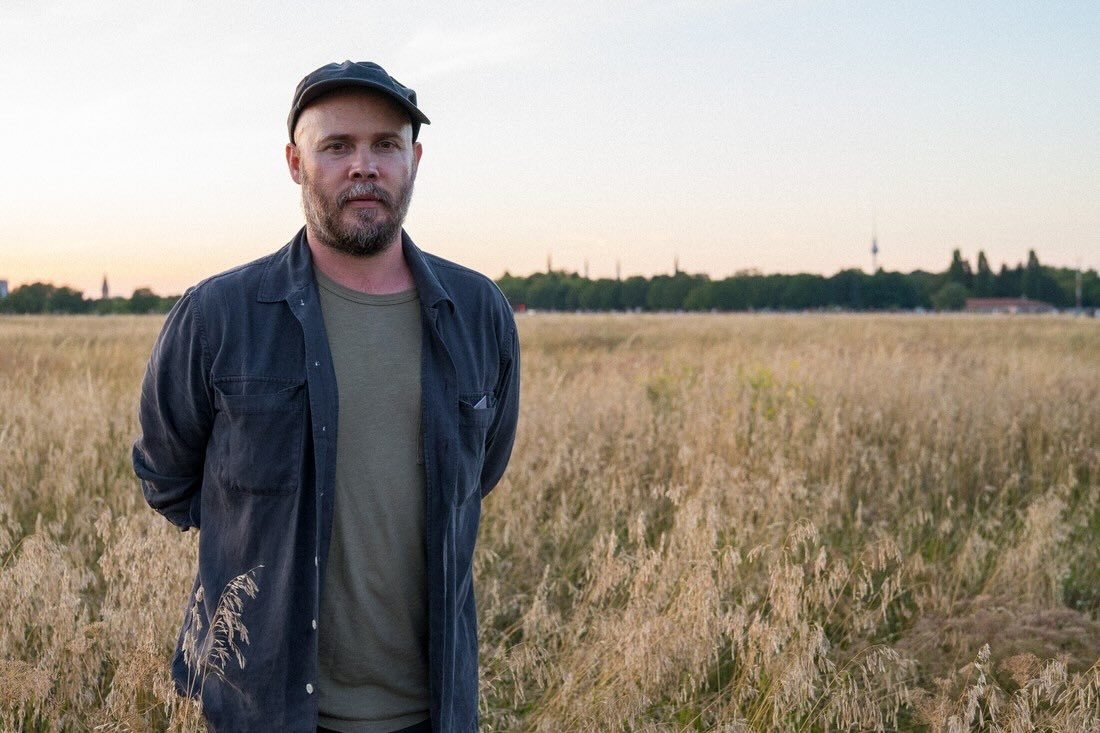
Aaron Hodges had more downsized exceptions for Howling World (Black Meadow), originally envisioning Kin Hana’s second album as his version of Nick Drake’s subtle acoustic masterpiece, Pink Moon. But what began as a pandemic exercise in restraint snowballed into something considerably more substantial, with strings, horns, otherworldly harmonies and eruptions of doom-metal distortion. The Hudson Valley, N.Y.-based singer/songwriter adopted his latest alias after eight years of recording as Longshoreman and another five or so with Brooklyn psych-folk outfit Nighttime. Not one to burn bridges, Hodges recruited Nighttime frontwoman Eva Louise Goodman, along with cellist Kristen Drymala, bassist Miles Hewitt and other guests, to help transform his mostly solitary recordings into fully realized arrangements that veer from delicate to apocalyptic.
Howling Wind took considerable inspiration from René Magritte’s infamous 1927 painting Young Girl Eating A Bird, an image Hodges sees as a response to a world capable of inspiring both wonder and despair. It’s an unsettling contradiction that runs throughout the LP.
“The songs each create a different environment, but they still feel like they belong to one world,” Hodges told MAGNET’s Hobart Rowland in a recent interview. “There’s unease in it—but also awe. The painting brought those feelings together for me, and the title came to describe the album as a whole.”
Here’s more from Hodges.
What happened along the way that made you realize that Howling World began needed a vaster sonic world?
I wanted to make a distilled voice-and-guitar record and not go down the rabbit hole of arrangement. The trouble is, it’s very much in my nature to layer, edit and arrange. I first attempted to record the songs live at a friend’s cabin during COVID, but the results were disappointing. I tried again at a studio upstate but canceled after one session because I hated feeling on the clock. Eventually, I figured out how to capture the performances the way I wanted—most of the songs are still tracked live. But by then, I’d exhausted my patience for the rules I’d imposed on myself and began layering and arranging.
How did bringing Eva, Kristen, Miles and others into the process change your understanding of songs you’d spent so much time developing on your own?
“Maze Of Dreams” was a revelation when Eva sent her vocal and string parts back to me. She’d brought this spectral quality to the song that opened up another dimension to the arrangement. Everything else was still fairly skeletal at that point, and I began hearing more possibilities for the album. Kristen’s precision as a cellist was essential to the parts we developed for “Earthrise” and “Shōmetsu/Kodō.” By then, I realized that Miles could bring a much warmer and more intuitive approach to the bass than I would have. As for the horns played by Jared (Ashdown) and Gabe (Birnbaum), they completely transformed the heavy section of “Shōmetsu/Kodō”—and ultimately the song itself.
What attracts you to placing such fragile sounds alongside something as overwhelming as doom metal?
I guess I just don’t feel that those two genres need to be separated. My two favorite expressive energies in music are the intimacy of folk guitar and voice and the immense, defiant sound of doom and drone metal. It’s satisfying—almost necessary—to have these two worlds exist together. I also like when something abrasive comes out of a quieter space.
“Shōmetsu/Kodō” begins as a relatively solitary meditation before building to an epic instrumental conclusion. Did you envision that transformation from the beginning?
I didn’t know at the time that the loud section was coming. The voice-and-piano meditation was a spontaneous recording, but once I played it back, I quickly heard what could follow. I’d been wanting to make something that doomy and expansive again, and I think I’d been looking for somewhere to put that sound on the record. The piano recording turned out to be the opening for it. It was the last piece I recorded.
Why did René Magritte’s Young Girl Eating A Bird ultimately become the defining metaphor for the album?
I never looked into why Magritte made that painting, but I found it existentially arresting. There are times when I feel like I’m doing everything I’m supposed to, keeping everything together, while internally the most authentic thing would be to do something drastic or explosive with my life. To me, the girl lives in a “howling world”—one that has driven her to such behavior. Savagely eating the bird feels like her way of howling back. I saw someone turning away from the world while simultaneously devouring it. I can relate to that impulse.