MAGNET contributing editor Jud Cost is sharing some of the wealth of classic films he’s been lucky enough to see over the past 40 years. Trolling the backwaters of cinema, he has worked up a list of more than 100 titles—from the ’30s through the ’70s—that you may have missed. A new selection, all currently available on DVD, appears every Friday.
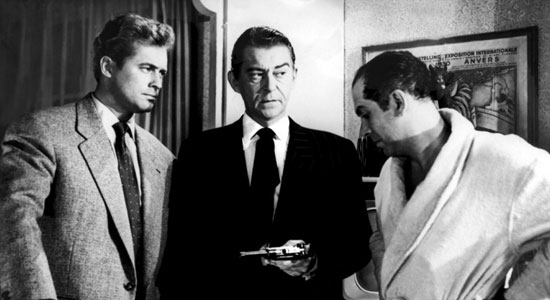
Rififi (1955, in French with English subtitles, 118 minutes)
Although both films take place in the wee hours of the morning, the loving color postcard from the Jazz Age of Fitzgerald, Hemingway and Cole Porter depicted in Woody Allen’s recent Midnight In Paris bears scant resemblance to the ominous mean streets of the City Of Light shown in Jules Dassin’s film-noir crime thriller Rififi. Taken from a cabaret song, the word meaning “rough and tumble” is a good fit for the four men about to pull the caper of their lives by breaking into Mappin & Webb, a high-end Paris jewelry purveyor.
“They let me out for good behavior,” Tony le Stephanois (Jean Servais), a man with that haunted, hundred-yard prison stare, tells former girlfriend Mado (Marie Sabouret) before severely whipping her for taking up with rival thug Louis Grutter (Pierre Grasset). Le Stephanois joins forces on the big heist with old pal Jo le Suedois (Carl Möhner) along with Mario Farrati (Robert Manuel) and safe-cracker César le Milanois (Dassin himself).
After thoroughly casing the joint, they have a window that closes at 5 a.m. to drill through the floor of the vacant flat above the store, disarm a foolproof alarm system with foam from a fire-extinguisher, then drill through the door of the safe. It’s a nail-biting 25-minute scene by men working in ballet shoes with no dialogue, no soundtrack music, no sound at all other than the careful tapping of chisels and the muffled whir of a power drill.
“240 Million: Biggest Take Since The Sabine Women,” shouts the corner newsboy from next morning’s screamer headlines. “Che bella cosa,” César warbles to the tune of “O Sole Mio” as the foursome dumps the precious loot onto Mario’s dining-room table before stowing it in the base of a lamp. No sooner does Jo fly off to London to arrange the fencing of the jewelry, than the noose begins to tighten on le Stephanois’ gang. Now certain who pulled the job, Grutter and his boys ruthlessly begin to muscle in on the big take.
After he made Streets Of New York in 1948, Connecticut-born Dassin was caught in the web of “McCarthyism,” a communist witch hunt that swept like wildfire through post-war America. Due to the efforts of Wisconsin senator Joseph McCarthy, F.B.I. director J. Edgar Hoover and the House Un-American Activities Committee, Dassin was black-listed, unable to work again until he made Rififi in Paris in 1955. McCarthy proved to be his own worst enemy, cracking up on the nationally televised Army-McCarthy hearings in 1954, much like Humphrey Bogart did as Captain Queeg in The Caine Mutiny, made that same year. McCarthy was soon retired, back in Wisconsin, no doubt still wondering whatever happened to those missing strawberries, while Dassin went on to make the Oscar-nominated Never On Sunday in 1960.


 Amor de Días—the duo of Alasdair Maclean (Clientele) and Lupe Núñez-Fernández (Pipas)—just released debut album Street Of The Love Of Days via Merge. (Those of you who speak Spanish know that the band’s moniker translates to “love of days,” hence the album title.) Maclean and Núñez-Fernández worked on the 15-track LP for more than three years, and it features guest spots by the likes of Louis Philippe, Damon & Naomi, Gary Olson (Ladybug Transistor) and Danny Manners. Maclean and Núñez-Fernández will also be guest editing magnetmagazine.com all week. Read our brand new Q&A with them.