


George Usher left his mark on New York City’s fabled late-’70s music scene with power-pop bands the Decoys, Beat Rodeo and the Schramms. Though the ’90s were a bit murkier for the Ohio native, a highlight was Stevensonville, his 1996 collaboration with artist Laurie Webber. What could be seen as a darker spin on The Kinks Are The Village Green Preservation Society, the illustrated song cycle delves into the complex, often unsavory characters in a fictional town of Stevensonville. At the time, Usher’s handlers were put off by the cost of both recording and packaging an image-heavy concept album that would likely go the way of Ray Davies’ 1968 commercial flop.
Stevensonville was performed live a few times, but that’s as far as it went until Usher finally found some support and backing from Ahoy Larry Pursuits and Strothard Bulldog Productions. Available now, Stevensonville was produced by Tony Shanahan (Patti Smith Group) with an impressive studio band that includes guitarist Andy York (John Mellencamp), drummer Brian Griffin (Brandi Carlile, Black Crowes) and keyboardist Andy Burton (Ian Hunter). Award-winning composer David Mansfield (Bob Dylan, Johnny Cash) provides strings.
“Stevensonville works on three levels,” says Usher. “As pure entertainment, as a piece describing a particular place in a particular time and as a tribute to my father, who I’d only recently learned had been an orphan with an Oliver Twistian upbringing in a family of Stevensons.”
Here’s more from Usher on each track.
—Hobart Rowland
1) “Stevensonville”
“A dreamy, pastoral opener that belies the ugliness and misery that lurks in town. It draws the listener in, setting the stage for everything that follows. The illustration shows a low-rent carnival entering town and the village square down below.”
2) “Reverend Thomas Pardee”
“A bombastic preacher’s fire-and-brimstone sermon, complete with a congregation’s response in the chorus. It falls somewhere between folk music and doo-wop. The reverend is bony faced and mean-spirited in the illustration. James Strothard, the next track’s focus, can be seen in the congregation.”
3) “James Strothard”
“Musically written to be a Who track, this goes through various parts and sections like an old Townshend song. It’s focused on James Strothard and his memories of being mistreated as a child by a malevolent ‘church lady’ named Marjorie Hayes. Marjorie herself shows up later in the song cycle.”
4) “Mitch Kunkel”
“Great riff—fat and wonderful, like the illustration of Mitch himself. The track has lots of swagger, as the local youth sing to Judge John Bailey, the star of the next track. Mitch has seduced the judge’s daughter, stolen from the judge’s wife and is off to the big city. It’s a potboiler track with a great guitar solo from Andy York.”
5) “Judge John Bailey”
“A melancholy lament capturing the judge’s dismay over how Stevensonville’s youth have turned to violence against the town and its populace. The music is delivered in a nightmarish minor key, and the dark mood never lets up. The town doctor, who delivered all the children, has been reduced to babbling in a highchair.”
6) “Annie Dunn”
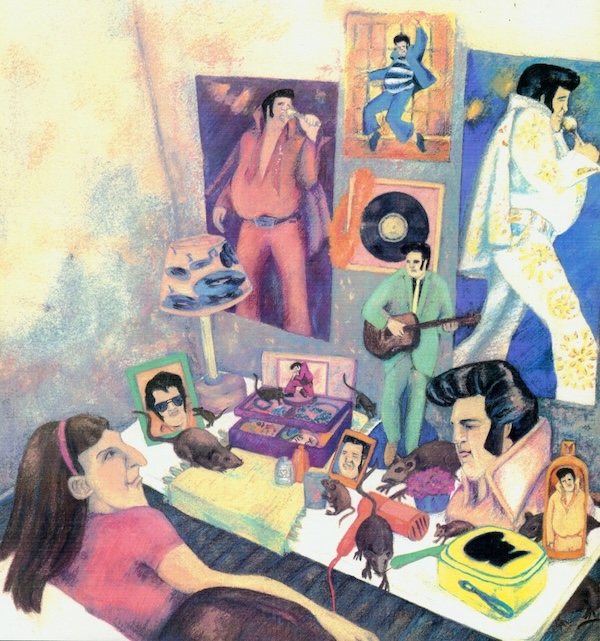
“A change of pace musically, this piano ballad is a love song, for all intents and purposes. Annie is an Elvis Presley fan, but she only loves ‘Fat Elvis.’ Even the photo on her wall from ‘Jailhouse Rock’ is of ‘Fat Elvis,’ and he wasn’t even fat in that movie. The love so perfectly represented by her song is actually born of something distorted and unreal.”


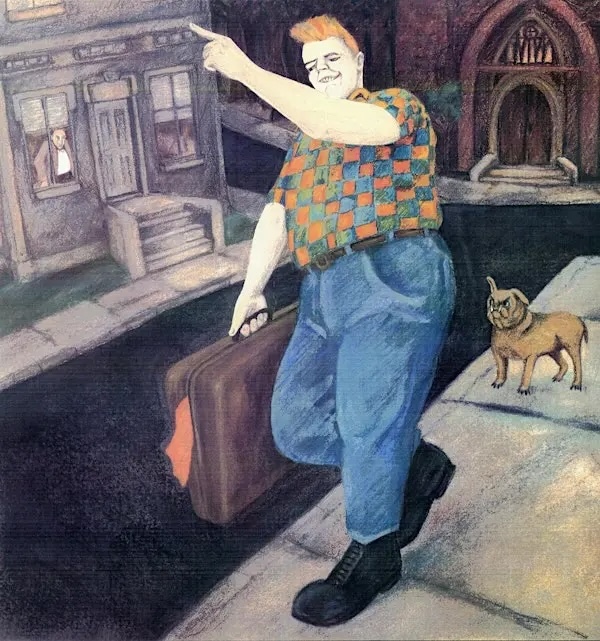

7) “Martin Godfrey”
“This is a power-pop track disguised as a cry for help. Martin wants nothing more than to be left alone. But the world is always knocking on his door, disturbing the ‘sanctuary in this little room.’ The illustration portrays a disturbed individual surrounded by small, red, demon figures. ‘Leave me alone,’ says Martin. ‘I’m not gonna buy.’”
8) “Mary Beth Merriwether”
“Mary has different issues from Martin. Over a quiet, gentle folk backing, she questions the choices she’s made in life that have gotten her no further than Stevensonville. She acknowledges that time is passing, without any answers: ‘It’s so lonely, it’s so lonely, it’s so lonely waiting on the sand.’ ‘Waiting on the sand’ is an image I borrowed from the I Ching. The illustration of Mary has a waif of a small girl sitting on a porch swing, who looks as if a strong wind could blow her away.”
9) “Jack Greene”
“With Andy Burton’s New Orleans barrelhouse piano, this is rollicking from start to finish. Jack has his whole family in his backyard bomb shelter, and he’s singing that he’s not letting anyone else in. I based this on a famous Twilight Zone episode involving a bomb shelter and neighbors all fighting each other to get in. But this Stevensonville bomb shelter is different, as the illustration shows. It’s all in Jack’s head. The circus-like piano is mocking him.”
10) “Marjorie Hayes”
“Like her illustration, Marjorie Hayes is a sad, depressing piece. This is what has become of the malevolent ‘church lady’ from the James Strothard song. Over piano and organ, she tells of a solitary existence far removed from the days she wreaked havoc in church. Sunlight ‘strokes her grave,’ and her gravestone has been ‘painted with childish scrawl’—perhaps by all the children she’s abused through the years.”
11) “Town Elders”
“I channeled some Neil Young on this track. It’s a rocker from the townspeople of Stevensonville, warning everyone about selling their souls to ‘the miser’ who will ‘promise you things you won’t believe.’ Since buying a 45 of ‘Ohio’ after the Kent State killings in 1970, I’ve always been able to look to Neil for a suitable protest sound. The illustration also graces the album cover.”
12) “Stevensonville Reprise”
“This is a brief nightmarish return to the title song—for those who’ve given their soul to the miser.”
13) “Benny Weed”
“Benny Weed is a small, unassuming character, standing on the outskirts of town, looking in the opposite direction and planning his escape. It’s a defiant, freedom march that points the character toward making necessary life changes that, hell or high water, will improve his circumstances. This ends the song cycle on a beat of personal triumph, no matter what may come next.”