
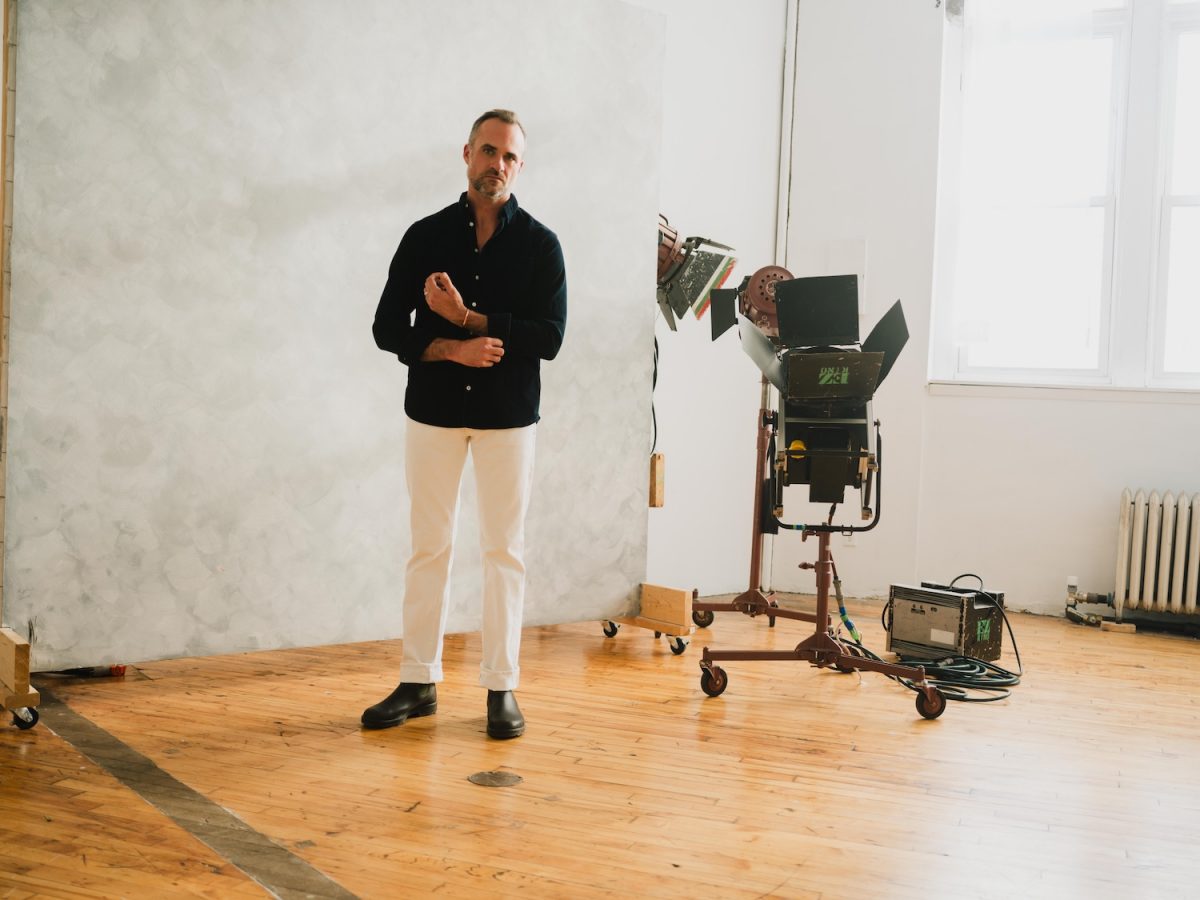

Releasing a self-titled LP in the thick of one’s career can mean different things. Sometimes, it’s a revitalizing reboot. Other times, it’s a refinement of purpose. Still other times, it may be a desperate stab at relevance. For Matthew Stevens, it feels more like a line in the sand drawn by a Grammy-winning guitarist, producer and composer who’s now fully settled into his own language after two decades of wending his way through jazz, Americana, experimental music and straight-up songcraft.
On Matthew Stevens (Candid), acoustic and electric textures smear together, compositions unfold with patient confidence, and improvisation serves emotion rather than virtuosity. Given Stevens’ stellar reputation, the cast surrounding him is predictably stacked with seasoned pros, including drummer Terri Lyne Carrington (Herbie Hancock, Dizzy Gillepsie), guitarist Jeff Parker (Tortoise) and saxophonist/co-producer Josh Johnson (Leon Bridges, Meshell Ndegeocello). But the songs, written during a period of personal recalibration that involved remarrying and relocating from New York City to Boston, are pushing toward something more direct and emotionally resonant. The result is music that feels simultaneously exploratory and grounded, intricate and deeply human.
Stevens walks us through each track.
—Hobart Rowland
1) “Take Heart”
“When you have the right people around you and even the simplest idea with a spark, real conversation can happen. For me, rhythm and momentum are everything. That undeniable sense of groove, the feeling that something is alive. I don’t think music can really take flight without that foundation. There’s something grounding about remembering that the simplest things are often the most important ones. And that’s really what this song is about.”
2) “Hazy (Intro)” and 2) “Hazy”
“I wrote this right in the middle of a lot of upheaval and facing more uncertainty than I’d ever known. What caught my attention immediately was how it felt like waking up and returning to my own artistic practice. The music itself was different, because so much had changed—and so had I. In a lot of ways, it was the bellwether for the language of the record. I was influenced by time spent in Rio de Janeiro working with Milton Nascimento and Esperanza Spalding. That hyper-melodicism, those adventurous harmonies that never feel self-conscious—all carried by a feel so deep it makes you squint. That energy definitely found its way into this song and the album as a whole.”
4) “SLMS”
“I ended up recording it on a fretted guitar, but the fretless was essential to the idea. Those instruments sound incredible when you’re playing one or two notes at a time. But once you go beyond that, the intonation gets tricky. I probably wouldn’t have written it the same way on a standard guitar. The whole thing was recorded on a Yamaha Dreadnought that I was told Elliott Smith gave to Jon Brion, who later gifted it to Kyle Hoffmann, who engineered the album. I really think playing that guitar shaped the performance. I named it in honor of my wife, Sarah, who, like the song, is nuanced, intentional, understated and full of life.”
5) “1000 Times”
“This song slowly reveals itself over its entire length. The changes aren’t overt or obvious. Themes are transposed, stretched and compressed, and the supporting harmonies get reordered along the way. It creates this feeling of constant suspension. Then finally, in the coda, there’s space to exhale.”
6) “Edgewood”
“This came out of a period when I was home alone on weekends a lot. Usually, I’d either be out playing or at home with my son. On one hand, there was a deep loneliness. On the other, there’s a sense of relief in having time to myself during a period of pain and loss. The main theme started as something I kept repeating, almost in a self-soothing way. When I recorded the demo, I played both accompaniment guitar parts and the slide lead myself. Knowing that isn’t my specialty, I started thinking about who I could ask. A while back, my friend Emily Elbert told me about a younger guitarist named Dylan Day whose playing she thought I’d love. Later, I heard him on a live record by Sam Wilkes, playing a solo on ‘I Wanna Be Loved’ that nearly brought me to tears. That was it. I asked him to play on this track. The title comes from the street I live on. As is often the case with places, this street and this house mean something entirely different to me now.”
7) “Who Does She Hope To Be”
“I used to play this song in ERIMAJ, the band led by Jamire Williams. And through that, I discovered Sonny Sharrock’s Ask The Ages. I immediately connected with the songs, the playing and Bill Laswell’s production. There’s something about this piece that always helps me find myself quickly when I play it, and I’d been excited for a long time to eventually record it. On the original, Sonny layers a lot of guitars, so it felt like the perfect opportunity to have Jeff Parker join me. I’ve always admired the breadth of his musicianship, how he brings together so many guitar and musical traditions in a way that feels completely honest and singular. Terri Lyne Carrington’s playing on this track is just as special to me. Few people play in a way that feels so directly connected to the originators of this music.”
8) “Born Of Silence”
“This was close to being the title of the album. After a time of not writing much at all, once things started moving again, most of the album came together quickly with a new sense of purpose. This song feels closely related to ‘Edgewood.’ They came from the same burst of energy on the same weekend. I like how it feels like an empty vessel, able to hold whatever emotion you bring to it—and how the second half unfolds as a long, unhurried conversation.”
9) “Alberta”
“‘Alberta’ is a traditional song recorded by Lead Belly, Odetta, Bob Dylan, Doc Watson and many others. I first encountered it while producing I Am A Pilgrim: Doc Watson At 100. Jeff and I recorded a version for that project, and I’ve continued to revisit it in different settings ever since. Like so many great songs, it keeps revealing deeper layers over time.
“I first heard Anna B Savage in Banff in 2017, when she played a few songs for a group of artists we were working with that week. I was completely taken by her writing, her guitar playing and especially her voice. I’ve never heard anyone who sounds like her. During the pandemic, we recorded ‘Always On My Mind’ together, and I loved how it turned out. When I started thinking about revisiting ‘Alberta’ for this record, it suddenly felt obvious to ask Anna to sing it. Josh’s playing adds this otherworldly quality, and the way Anna delivers the song makes me imagine a young person 150 years ago, singing it quietly to themselves, far from home, what they know and who they love—in a way that somehow feels timeless.”
10) “The Air Is Thick”
“I had a strong feeling early on that the bones of this song were solid—that, with the right treatment, it could put you into a kind of trance. Because of that, it required the most delicate and considered production. Anything heavy-handed risked pushing it in the wrong direction. At its core, ‘The Air Is Thick” is built around a feeling that’s deeply familiar: Even when you can’t see how something is going to turn out, you still know when it’s worth pursuing, and there’s real pleasure in staying with the process of figuring it out. I love that the dense harmony and uneven structure are almost smuggled in through a more recognizable pulse. I learned that from Wayne Shorter—that you can get away with a lot of harmonic complexity if the music immediately makes you want to move.”