
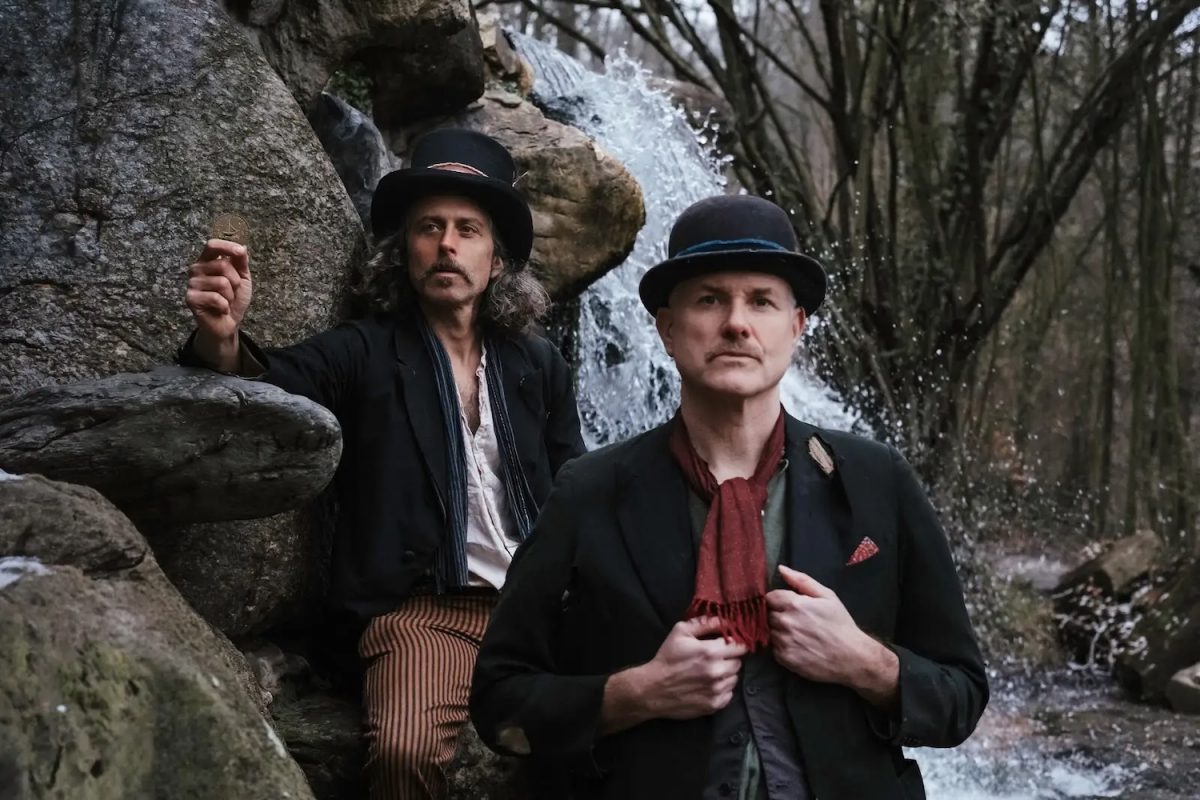

For Santa Fe, N.M.’s David Berkeley and Londoner Ben Parker, life had become a bit of a slog. So they quite literally rewrote the narrative. As Sons Of Town Hall, they called on their considerable songwriting talents and seemingly limitless imaginations as they traded song ideas across the Atlantic. Their internet woodshedding eventually led to full-on fictional personas: Josiah Chester Jones and George Ulysses Brown are two 19th-century vagabonds who travel the world in a hand-built boat to escape their troubled pasts and satisfy a perpetual thirst for adventure. (It’s no coincidence that “Sons Of Town Hall” is also the name of the refuse raft Poppa Neutrino sailed across the Atlantic in 1997-1998.)
A companion piece to Sons Of Town Hall’s acclaimed Madmen Cross The Water podcast, the self-released Of Ghosts And Gods is part concept album, part performance art. Recorded live mostly around shared microphones with only acoustic instrumentation, it’s a rich and immersive song cycle informed by nautical imagery, myth-making and fables.
Here’s more on each track from the Sons.
—Hobart Rowland
1) “Gods”
“It was common in Greek mythology for poets and storytellers to begin by appealing to the muses. We wanted to start our album the same way. The arrangement introduces most of the elements we use on other songs one by one, beginning with a piano and layering in strings, woodwinds, guitars and, eventually, our voices, though we sing this one in breathier, more ethereal or ghostly tones than on the rest of our songs. The first words we sing to start this song are, ‘Oh, when you find love, the world will open up.’ That’s a big theme for this whole project.”
2) “How To Build A Boat”
“We had a wild few days in Madrid where we wrote three of the songs on this album. ‘How To Build A Boat’ was the first. A lot of our show walks the line between comic theater and concert. Typically, the songs are serious, and the story setups are funny. This song, however, dips an oar into both pools. The arrangement features some very creative instrumentation by percussionist Mathias Kunzli to develop a rhythmic part out of sounds that conjure up a shipbuilding factory.”
3) “Wild Winds”
“It seemed important to have an autobiographical song in our repertoire—one that introduces who each of us is and how we met. This is that song. It also introduces our voices in isolation. We often start shows with this one, and we almost started the album with it, as it sets the scene that we’re leaving behind our pasts and our troubles for some unknown future. The trumpet that enters in the second chorus, and then the martial snare, cymbal swells and full brass in the break, hint that the future may be far brighter than those pasts.”
4) “The Lion’s Paw”
“We love how this one turned out. The low end in the guitars. The darkness. The relaxed singing. Jerome is, of course, the saint who pulled the thorn from the lion’s paw. There are some incredible paintings of him by Caravaggio and El Greco, among others. We’ve always been drawn to his story—someone who showed compassion and kindness in the face of a potential threatening enemy. It seemed a parable that more of us in today’s world should be thinking about. This is a song about trying to be a better man.”
5) “Whalebone”
“This saga about whaling is the centerpiece of the first side. The fragile classical guitar that starts ‘Whalebone’ brings you right into the dark hold of a whaling ship. The barely audible ghostly voices singing ‘40 fathoms down’ almost appear through the mist. The build in this track is really exhilarating. It starts so quietly and gets so chaotic, much like in Moby Dick, where nothing goes on until it really does and all hell breaks out.”
6) “The Rocky Shores Of England”
“‘Rocky Shores’ is like a palette cleanser. It’s the only track on the record where the arrangement is true to how we perform it live: two guitars and two voices. Like all the songs on this album and our debut, we record together, playing and singing at the same time, around one vocal mic with a mic on each of our guitars and some room mics. This creates an old-school magic often lost in the isolated recording so common today. It also requires us to listen and blend like we do onstage as we record, creating an authenticity of performance and an intimacy often lost in separation or through pasting together different sections of the song from different takes. The lovely interplay of guitars seemed interesting enough that we didn’t need any of the other elements we used on other songs.”
7) “Antarctica”
“This is an anthem about going to Antarctica, which may not seem relevant to today’s issues. And yet finding something to believe in when hope feels lost couldn’t be more relevant now. We threw everything we had into the arrangement. It starts quietly and naked, with just our voices and guitars. By the end, we have a gang of singers, a doubled string quartet, woodwinds, brass and big, booming drums. It’s hard for us not to smile listening to how this came out. It captures so much of the spirit of our band—somehow managing to be very serious and emotional despite the absurd framing.”
8) “Sirens”
“We first tried singing the three-part chorus in falsetto, playing the parts of the sirens ourselves. But that cast the song into a more comic space than we wanted, so we looked for a trio of women who could capture the haunting, angelic sound of the temptresses. We met Canadian trio the Pairs at the International Folk Alliance conference several years back and taught them the parts in a hotel room. We recorded them the same day in that room. They linked arms and sang their harmonies a cappella.”
9) “New Orleans”
“Also written in Madrid, this one begins and ends almost like a murder ballad in a minor key. But then it opens into a raucous circus song with accordion, brass and percussion. All these songs have fictional backstories told in episodes of our podcast, Madmen Cross The Water. This song is actually a double episode telling of our ill-fated love affair with the stunning circus acrobat Ella. If you really want to dive deep, give it a listen.”
10) “Mutiny”
“This is the third song written during the Madrid session and one of the sparest arrangements on the record—just voices, guitars, a simple piano and a lone trumpet. Initially, it was a song about the fear of a relationship falling apart and the uncertainty of what would be left to live for if it did. But given the current political situation in America, the meaning of the song has shifted to question when it might be appropriate to overthrow your captain.”
11) “In My Arms Once More”
“This is a kind of hobo song meant to be sung around the fire. Sara Watkins plays the fiddle on this tune, and it really helps conjure the western landscape and lifestyle. She lent her wizardry to a few tracks on our first album, as well. It’s a song for a past love, a song of regret and maybe a plea for a second chance.”
12) “Ghosts”
“Here’s our coda to ‘Gods.’ No vocals here—just that lovely piano, lush strings and tender woodwinds. It’s a closing of the adventure, a gentle return from our world to yours.”