

Ethan Gold’s life story has taken on a mythic hue. He was raised in San Francisco by his mother, Melissa Dilworth, who perished in the same 1991 helicopter crash that killed legendary promoter Bill Graham. His father, Herbert Gold, was among the last of the Beat writers. Moving east, their son set about making his mark on New York City’s indie scene, producing Elvis Perkins’ acclaimed 2007 LP, Ash Wednesday, and playing bass alongside his brother Ari and Entourage star Adrian Grenier in the Honey Brothers. A decade later, Gold finally got around to releasing his debut album, Songs From A Toxic Apartment, which earned glowing reviews.
Gold was working on a follow-up when he suffered a head injury that sidelined him for several years, leaving him unable to perform and struggling to speak. His gradual return has produced increasingly experimental and intimate work, from lo-fi synth meditations to film scores to poetry performances. His latest LP, Earth City 2: Nightfolk, is the second installment in an ambitious trilogy. Recorded in Glasgow, Berlin, Nashville, Manhattan and his kitchen in Silver Lake, Calif., it’s an album built for outsiders and insomniacs.
“It’s a nightlife record—for introverts anyway—going from the early evening to the middle of the night,” says Gold. “Trains, subways, unions, connection, electricity. Searching, riding, rushing, trying, failing, kissing, drinking … Some don’t make it to morning.”
Gold stays out of trouble long enough to run us through Earth City 2 song by song.
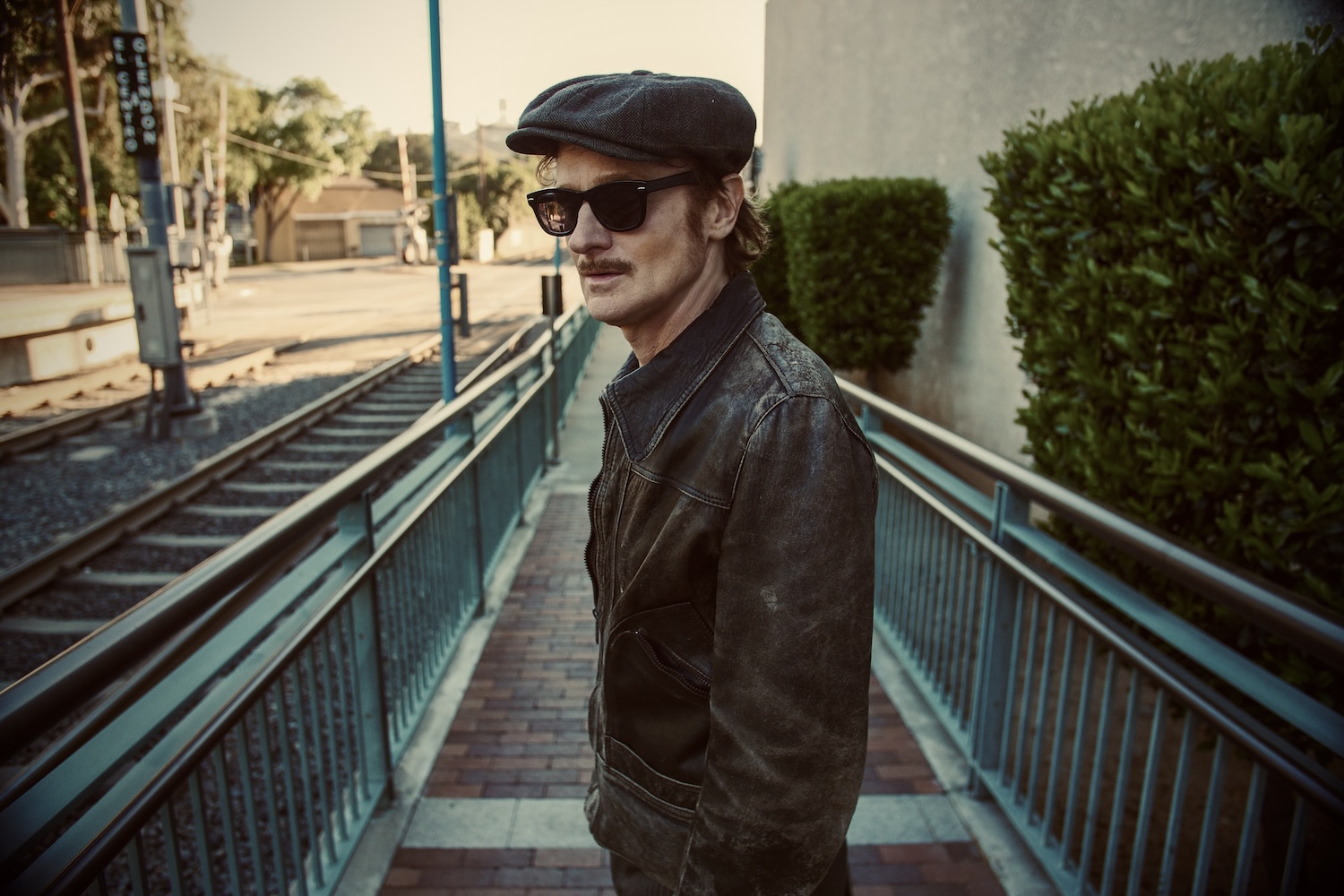
—Hobart Rowland; photo by Travis Keller
1) “When The Evening Comes”
“Inspired by my grandfather’s relationship with my grandmother. He rode the train 90 minutes each way from New Jersey to New York every day his whole working life. This is a song for Friday, when everyone is riding home on trains and subways to their beloveds, where magic returns after night falls and the weekend begins. It’s a celebration of romance and an ode to that old workhorse, monogamy. The song is also a dialogue between the masculine and feminine in all of us. I put the ‘feminine’ in German to honor how Berlin welcomed me—and also to honor the old poetic soul of that people and language, from a time before Bismarck and the 20th century, changed the world’s view of them—and their view of themselves.”
2) “I’m In The Moon”
“Those of us with a tendency to introversion and depression aren’t always going somewhere terrible when we escape from people and from the noise of the world. We might retreat in defiance. It might be where we remake ourselves to shine our soft light.”
3) “The Inhibitionists”
“I’ve made up at least one word in each of my albums—and this time, the new word got a song title. This is about the thrill of a city under moonlight with another awkward weirdo. It was inspired by a love affair with someone who also liked to sneak around the strange areas of Los Angeles at night, making polluted fields and industrial wastelands a playground. Inspired by French cafe culture and Berlin energy, I made a video running through the streets of Berlin—where I’m not one of the lovers.”
4) “Mirror Don’t Have Any Feelings”
“This is a howl for a friend who ended her life—and a howl for all the artists whose families don’t understand them. We keep moving forward, finding our way, fighting our self-image, fighting our beauty’s decay, trying to make beauty in other forms. This is sort of a lyrical sequel to a song called ‘Firefly’ from Earth City 1: The Longing.”
5) “I’ll Dance If You’ll Dance”
“A thematic pair with ‘The Inhibitionists,’ this is a romance around a gypsy campfire, where the shy people might sneak off in the dark together. I was inspired by the more hushed early-’80s music of the Stranglers, even though it sounds nothing like them. But I wanted that cafe flavor on an imagined European beach. I played a mess of acoustic guitars one night in my kitchen, mixing that with Jeff Taylor on accordion and Derek Pell on violin—recorded by my buddy Cal Campbell in Nashville—along with some vocals from two women (Julia Austin and Lynn Marie) we met at the cafe.”
6) “That’s A Start”
“Four micro-stories about trying to make it in the big city. Run through the subway, sweat through the street, try to make a life in the mess of the city where everyone struggles. Just trying—and that’s something.”
7) “Coulda Been Love”
“The city makes us blow opportunities for love, all for the dubious thrill of sleeping around and the desperation in the last hour before the bars close. This is the moment in the night that was avoided in ‘When The Evening Comes.’ The bars are almost closed. Whatever city it’s in, it’s in the East. Factory wind blows east.”
8) “Camera”
“A nearly live recording: loud, hazy, fuzzy and sick. One side of the night is splitting off … A young woman sells herself in all ways. A cameraman—or the camera—and the woman dance, preserving her beauty like a butterfly in formaldehyde.”
9) “The Last Dive”
“An homage to dive bars and the people keeping them open. For all the neighborhood haunts, for all the pubs in the U.K. and Germany who remain a place you can go … and New York, before gentrification. I’m tipping my hat to Iggy, David, Lou and sleaze. The first time I went to New York as a kid, the city was more dangerous. Artists could afford it, my hair was spiked, I was small and very underage, and I was sucked into a gaggle of models and junkie musicians. Older teenagers … big kids. We wandered to bars in Alphabet City, and I played the upright piano until the regulars sang of slitting our throats. One of the musicians didn’t make it to morning. The dark stupid glory of the night. The low path can be a path of transcendence. Ask Bukowski.”
10) “The Party’s Over”
“The stragglers are still awake. The night’s almost over. Between drunk and hungover. Hazy hope. The stomach moves. But at least it’s still night.”
11) “I’m Always Sad”
“Written on a train ride from Berlin to the Netherlands, early winter, alienated from the beautiful and far from home. War again in Europe, disconnection from community and self throughout the world, social insecurity from social media, no relationship with earth—this is my lullaby to the black current running under the tracks. ‘I sleep on trains when I don’t have a place to go/When you come in laughing with friends, it’s embarrassing, I know.’ But this is the world now. ‘There was a heaven—a billion, billion birds were born/Someone ground it down, now there’re no more angels to mourn.’ Into the black night we all barrel. I’ll try to answer this on Earth City 3.”
See Ethan Gold live.