
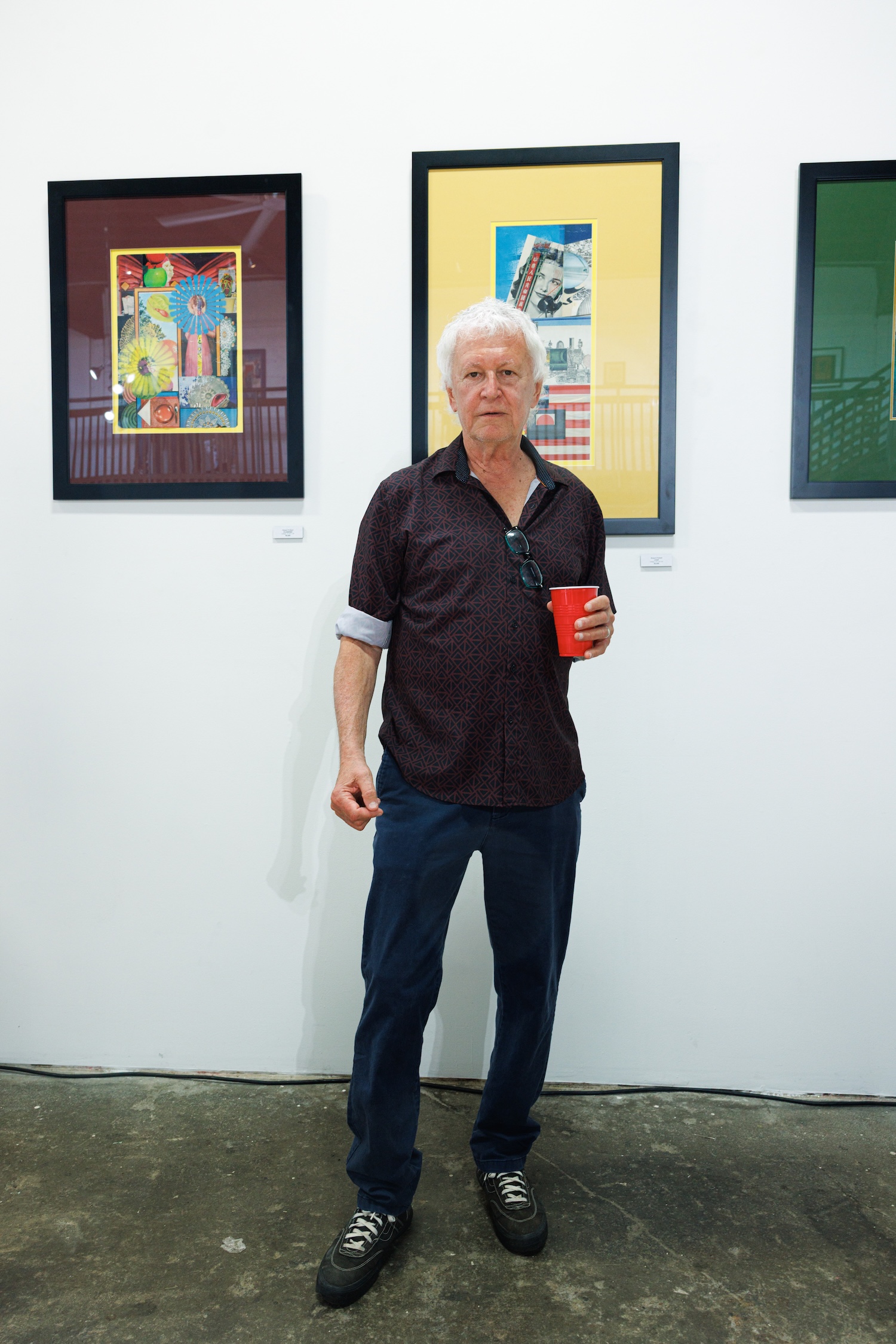
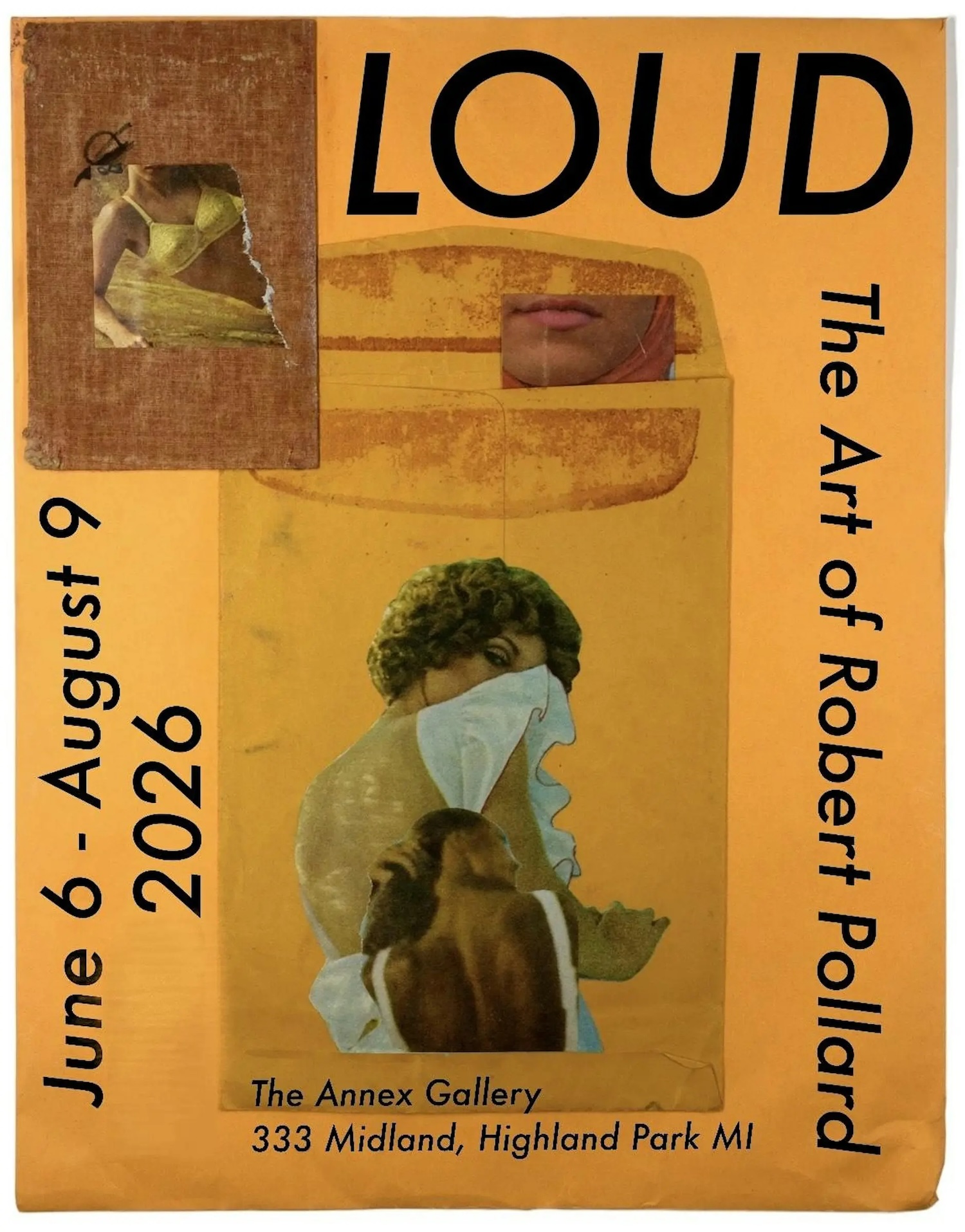
LOUD: The Art Of Robert Pollard temporarily dissolves the line dividing art show from live gig.
By Matthew Cutter
Photos by Tim Bugbee/Tinnitus Photography
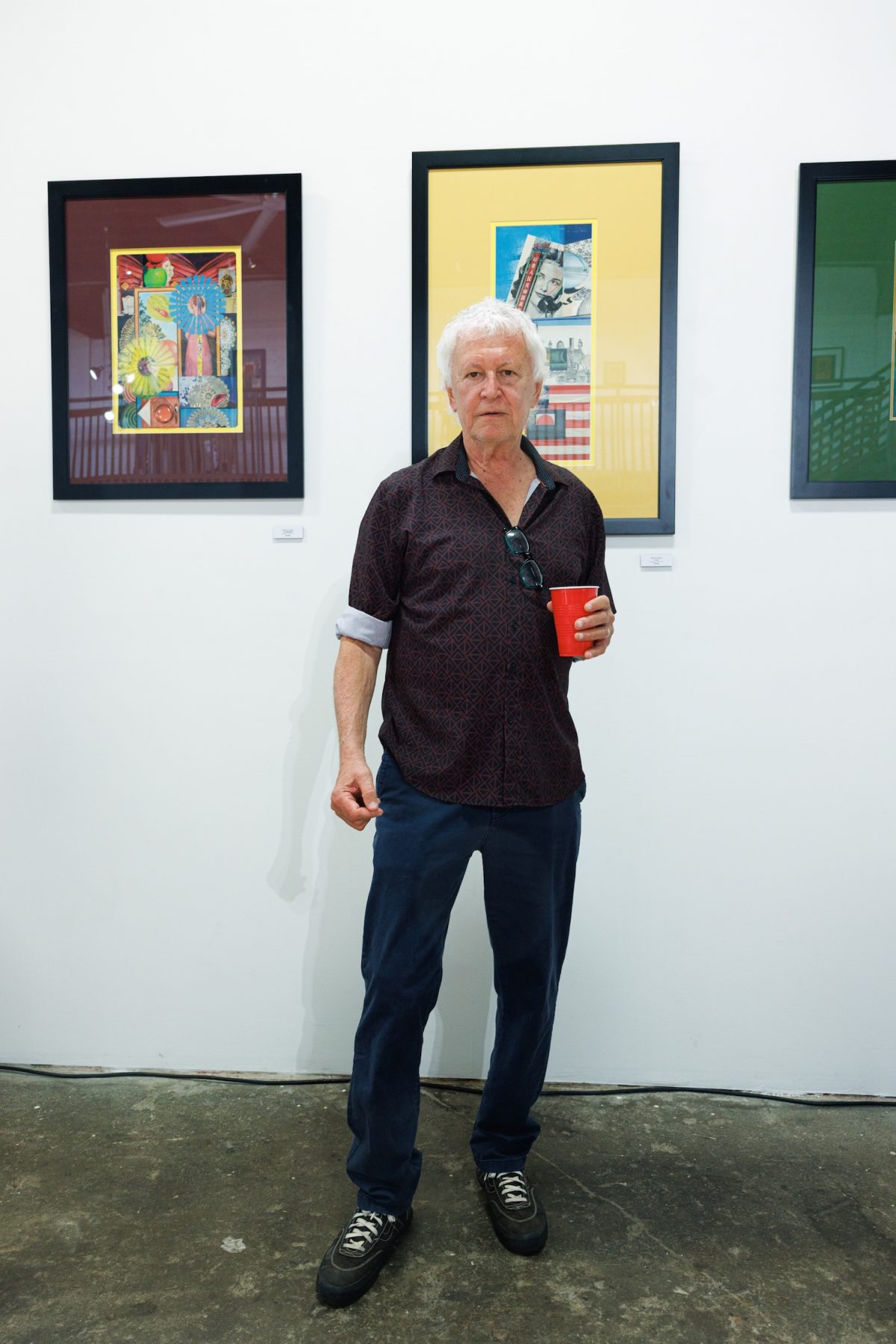
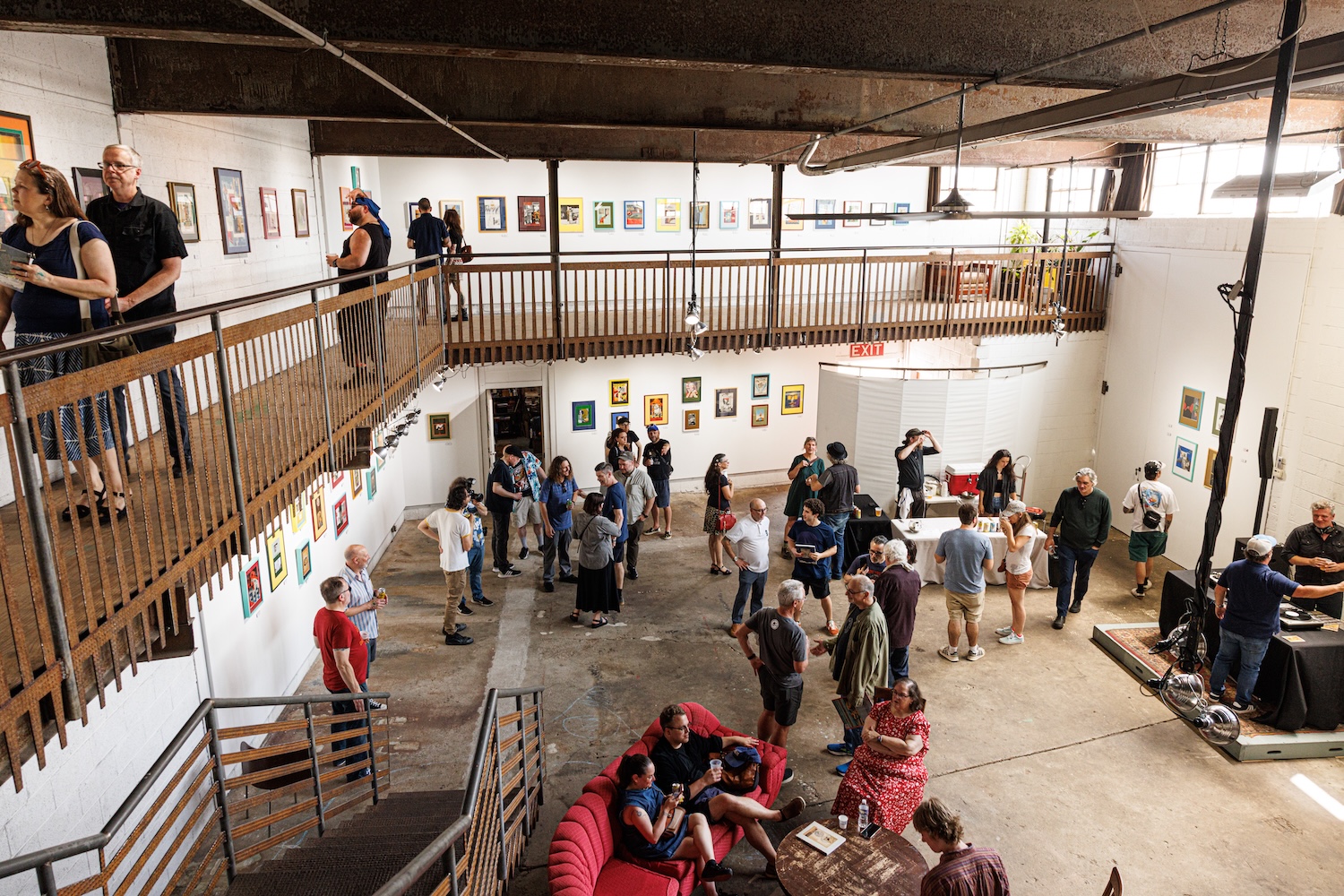
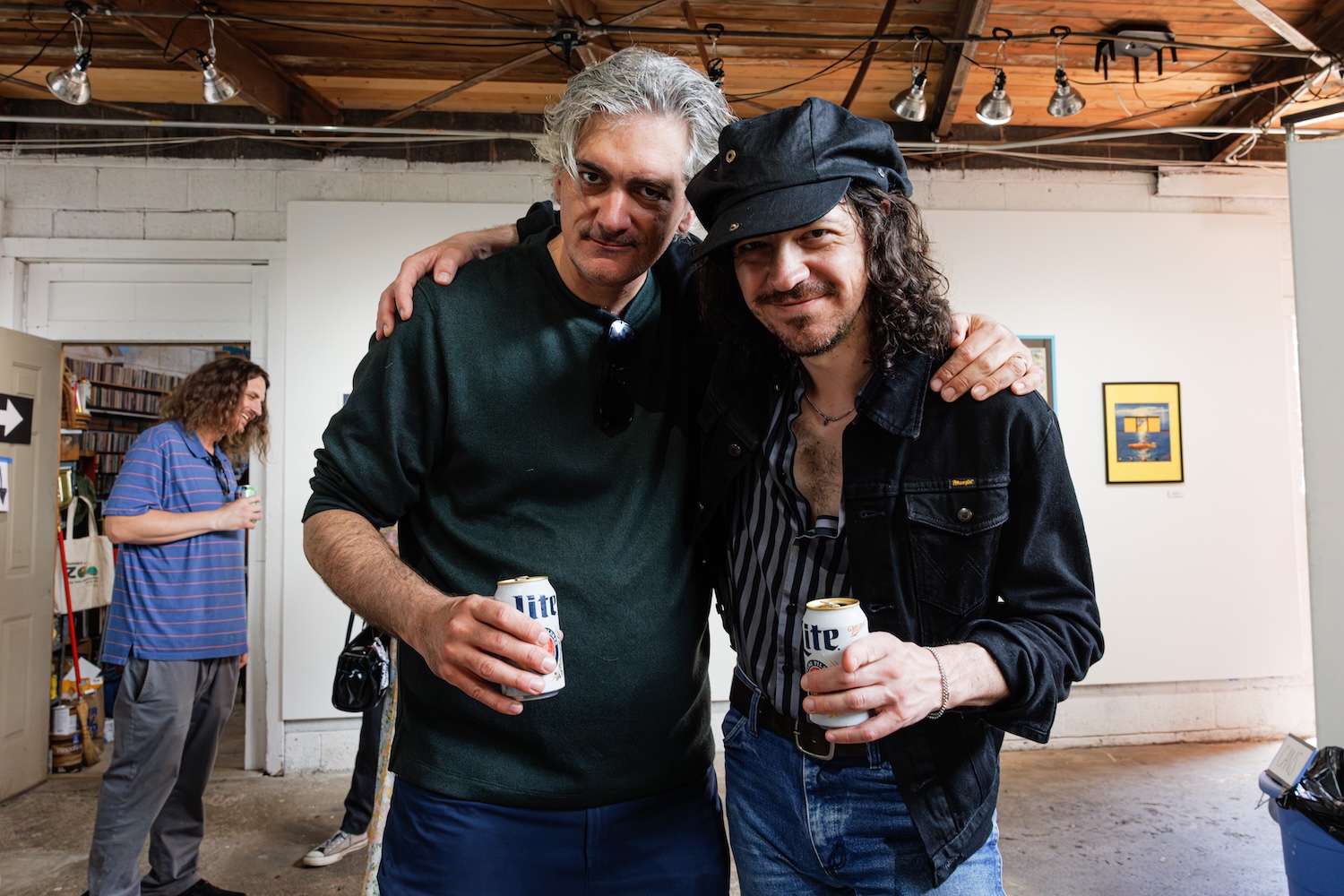
The Annex Gallery in Highland Park, Mich., is hot. Not merely hot. Baking. Its two-story ceiling isn’t high enough to contain the expanding heat, even as taller windows spill in sunlight, illuminating a veritable explosion of recombined art precisely arrayed on the walls. While temperatures outside ratchet into the 80s, fans queue up in sweat-pocked Guided By Voices shirts, access tickets on rune-imprinted smartphones and file in to be enfolded by a second skin of heat, eliciting beads and trickles. A bartender serves ice-cold beverages, primarily Miller Lite. Rock songs blast from the DJ pedestal, while nearby, a merch table holds ready stacks of T-shirts, stickers, compact discs and sleek vinyl.
Meanwhile, Robert Pollard and members of the GBV gang circulate among attendees. Pollard alone is perfectly acclimated to the environment, chatting amiably and explaining the finer points of his collages, as GBV’s sixth man and high rise of a producer, Travis Harrison, looks on. Bassist Mark Shue emerges from behind the water cooler gripping a bottle of Cuervo by its profusely sweating neck, grinning like a great white, and proceeds to filch several red party cups before submerging again. Given this scene, you might be tempted to think Guided By Voices is back on the road. But no band will play this afternoon.
This unavoidable fact is of little consequence to Pollard. For months, he’s been keen with anticipation for, as he put it, “Seeing people I haven’t seen in a while and looking at my crazy shit on the wall with them.”
One thing’s certain: Pollard is digging this.
A June art show in Michigan wasn’t originally part of Pollard’s 2026 plans. It took some persuasion on the part of Annex co-founder Mike Ross, an accomplished visual artist and painter in his own right.
Over the years, Pollard has spoken of making art primarily for his own entertainment—and if other people like it, too, all the better. As curator for the Annex, Ross shared Pollard’s philosophy in the form of a desire to bring in artists whose work he loves. As a longtime GBV fan and admirer of Pollard’s collages, it seemed a natural fit.
“It’s kind of like the old days of putting together a bill of bands,” says Ross. “And thinking about what bands would complement each other and also juxtapose enough.”
Following a pep talk with photographer Trevor Naud—whose work graces the cover of GBV’s It’s Not Them. It Couldn’t Be Them. It Is Them!—Ross sent Pollard a brief email to gauge interest. Ross was a little crestfallen to find his missive politely but succinctly rebuffed.
If only two certainties are to be found in this life, they are surely the value of persistence and the possibility that Pollard may very well change his mind on a subject—if he digs it. Ross laid his chips on both and took a gamble.
“He said I could have more than 100 pieces and an entire wall of 45 covers by imaginary bands,” says Pollard of Ross’ message. “That’s a lot of volume and one of the reasons I’m calling the show LOUD. He also reduced the labor aspect and had the gallery do the framing. He made it hard to turn down.”
“We framed 96 pieces, and there are 11 more that were already framed,” says Ross. “On top of that, there were just less than 100 of the fake 45s and LPs, plus the big Astral City Slicker canvas print (better known to GBV fans as the cover of Mag Earwhig!). So ballpark is around 200 pieces.”
“When I decided to accept the offer, I was inspired to do a bunch of recombinations of collages I had yet to sell,” says Pollard. “A lot of them larger pieces.”
Planning culminated in a meeting that felt like a hotel-room arms deal, Naud says, where Pollard laid an oversized portfolio on the bed and flipped through the goods. “‘Yeah, try this one. You got the money?’” says Naud. “He took us through these portfolio cases, and we were just floored. We love his work. He walked us through everything and what he wanted and doubled down on the LOUD. He’s like. ‘Go wild with the frame colors and mat colors.’ So we just took that cue.”
“The music is loud, the artwork is loud, the colors are loud,” says Ross.
Located on a former industrial site, the Annex exudes a certain Rust Belt ambience appropriate to the event. Throughout the afternoon, more than 300 art lovers and Pollard acolytes view the exhibit. Merchandise flies off the table, including T-shirts and posters dedicated to the art show itself. At one point, the DJ’s thundering set of GBV standards veers meta, as attendees momentarily find themselves listening to “The Annex” inside the Annex.
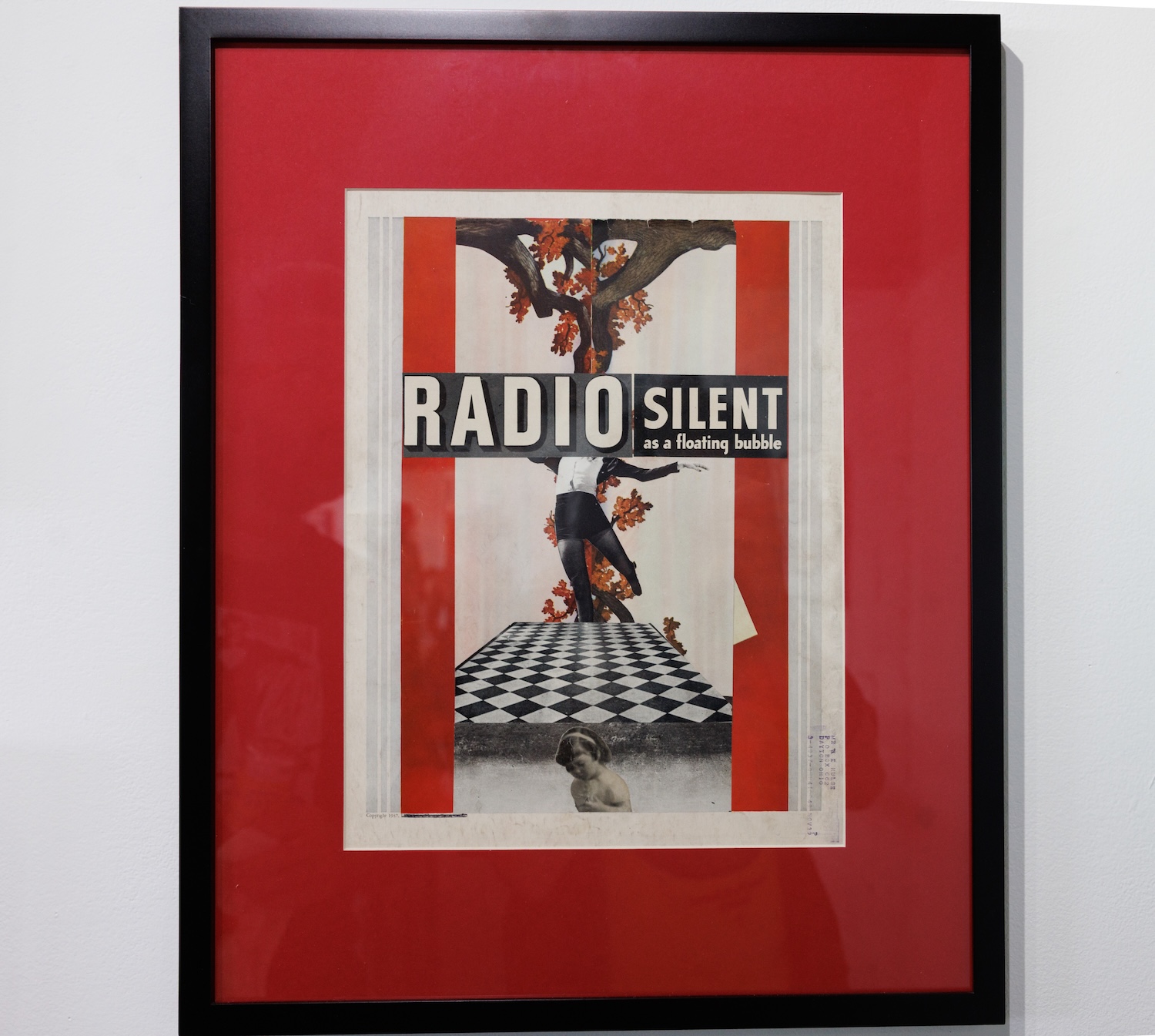
According to Naud, it took a few months to pull everything together—custom-painted frames, meticulously chosen mat colors—and the final presentation shines with the light of their efforts. Pollard’s work has rarely been shown in a setting so calibrated to its qualities, in clear natural light backgrounded by eggshell white. Colors pop, and shapes stand out in high relief.
“LOUD, baby,” emphasizes Pollard.
Where his early work often hinged on surprising juxtapositions—Mao Zedong’s head stuck on a professional basketball player, a businessman endowed with a hand of oversized playing cards and a medieval sun for a face—Pollard’s newest pieces reach for unprecedented refinement and complexity. Found colors and forms synthesize into entirely new images and concepts.
“I’ve become more interested in abstractions,” says Pollard. “Also color schemes and shadowing. I think I’ve become more branched-out in the types of collages I’m making.”
Seemingly no item is out of bounds, as his recent works have included bits of household detritus—an “unfurled” pink paper clip, a paint-encrusted ruler—repurposed to underline a theme or satisfy the design’s demands.
“I’m actually doing more fake 45 and LP covers,” says Pollard. “A lot of times, if it doesn’t quite work as a full-scale collage, it can be given a band name and title, broken down to a record cover. That’s where amateur graphics and groups of people in vintage high-school and college yearbooks come in handy.”
The fake records’ mylar-sleeved covers are stacked on thin shelves to block the ones leaning behind, demanding a tactile strategy. Seeing them all requires holding, rearranging and manipulating the works, a thematically appropriate experience for art that appears, and indeed is, so very handmade. Fictional releases by real-world artists (e.g., Jim Morrison) share space with real releases by fictional bands (such as Crawlspace Of The Pantheon’s semi-autobiographical Ivory Gate).
“I’ve incorporated the imaginary record-store concept at shows I’ve done before,” says Pollard. “I had one set up at a show I did in Manhattan (at Michael Imperioli’s Studio Dante in 2007) with an actual clerk sitting there, reading a magazine and being an asshole. It was portrayed by our good friend Marc Beck of Philadelphia.”
Delving into the creative conundrum of Robert Pollard—how does he conjure such brainchildren into reality?—takes the miner down a tortuous tunnel, where hazy mathematical properties seem to be at play. If Pollard’s music is akin to collage, and his collage art incorporates filmic imagery and even backstories, then by the transitive property, his albums are films, too. By the commutative property, whether a composition begins as image, melody, lyrics or title, when assembled, the same work of art may result.
It’s with such mathematical precision that Pollard goes about his daily work, whose routines and processes haven’t changed much since Guided By Voices played its final concert in October 2024. Live shows may have ceased, but the music remains always in motion.
“In the cave zone, I have notebooks, magazines, scissors and glue, an acoustic guitar and a boombox,” says Pollard. “It’s just about everything I need.”
But despite the manifold media through which Pollard expresses himself, all of it, in one way or another, goes back to “collage” in its original sense of “to stick things together.” Or to quote dear friend Mike “The Heed” Lipps’ oft-cited aphorism, “It’s all one thing.”
Harrison, the first to receive each GBV album as a new batch of boombox demos, describes the process: “Sometimes Bob writes songs like any other person, where he sits down with the guitar and summons the song, and it flows through him. And it just comes out. But there’s other times when he is reassembling pieces from his past. His mind is like a vault for melodies. Everything he’s ever heard in his life is in there. Obviously, new things come to him, too. Sometimes he does reshuffle those pieces. He might take a piece from an old recording—or recording that is just in his mind, from the past—and then combine it with new stuff. It’s so rarely a straight presentation. There’s always some twist.”
“I think there’s such a correlation between Bob’s artwork and the music,” says Shue. “There’s a lot in his art, so many themes that come up again and again in the songs and in the album’s themes. Some of his collage art can be quite stripped down and make a really bold statement with just two or three pieces. And then there are pieces that are incredibly ornate and complex. He’s a really good judge of when a piece is complete. I think he approaches songwriting in that way. So you’ll have a song that’s 45 seconds long, and it doesn’t need anything else. It’s a complete, fully baked idea. And then you’ll have an opus that’s six-and-a-half minutes long, that’s incredibly progressive and ambitious.” Shue smiles. “Yeah—it’s kind of cool seeing that in a visual sense. There’s also the physical aspect of taking a snippet that was meant for something else completely and throwing it into the middle of a new composition—the way he’ll throw pieces together from collages.”
Ross, too, notes the link between Pollard’s process and results. “You can look at his collages and you can see the way he writes songs, and vice versa, you know?” he says. “It’s interesting. It’s cool.” Recalling a moment from the previous day’s shopping excursion with Pollard, Ross adds, “Another thing that he does, while he’s flipping through records, he’ll pick up any random record and be like, ‘I want to cut this part out, add it to this one over here.’ His brain is just constantly making collages in his mind.”
“Basically, the brainstorming and recording of ideas in a somewhat random fashion and then moving elements around to create an entire picture or song,” says Pollard, “Something new or interesting and, hopefully, somewhat original.”
Naud summarizes Pollard’s appeal simply: “I think he’s the Max Ernst of my generation.”
In the ouroboros-twisted-into-an-infinity-symbol that is Pollard’s art, ever developing and never ceasing, music feeds collage just as collage feeds back into music. Sometimes this occurs in unpredictable ways. Whenever Harrison receives a new album’s batch of boombox demos, for example, his first task is to “launder” them: cut the files apart, remove clicks and pauses, then reassemble the pieces so they flow together in consistent rhythm.
He’s currently at work on the demos for GBV’s upcoming album, Speculation & Gossip, while prepping Cash Rivers And The Sinners’ High Flyin’ UFOs for imminent release.
“It’s more like cleaning,” says Harrison, “just to have the songs always be the idealized version of the demo.” Again we find collage at play, in its most general sense of sticking things together.
The band, too, has stuck together, even as the time since its last live outing grows longer. How has Pollard encouraged this solidarity?
“Keep working actively together,” he says. “One project after another. Discussing ideas and plans of attack on the phone. Occasionally, try to get together in a city of mutual choice.”
Back in the touring days of 2019, it wasn’t unusual to find the members of GBV crammed into a van, creating new music impulsively, compulsively, while they crisscrossed the U.S. Most of GBV’s Warp And Woof was recorded in such a studio on wheels, as were portions of Cash Rivers And The Sinners’ Loose Shoes.
“I think there’s a concerted effort from everyone to maintain it,” says Harrison of the band’s tightness. “We’ve had these crazy moments of doing stuff on the road. As it went along, it wasn’t that intensive moment, on site. And post-pandemic, we were physically removed. Then things just changed … but we still always maintain that at any moment we could throw down and do a track for an album, right now.”
“We’re all such great friends, first and foremost,” says Shue. “So we all keep in touch. The hardest thing is that we miss each other a lot, so we’re constantly in contact. Working on albums, in a remote sense, is not new to us, since we’ve done it during the pandemic and since we live in separate places. But for us, it’s a great way to just keep being creative and being in touch—having a reason to be in touch.”
“To be in touch”—as all of Pollard’s art modes touch and impinge upon one another. Perhaps it’s a fool’s errand to try to disentangle that which can never be separated. Some Gordian knots, after all, don’t need untying.
“I always see in Bob’s songs so many colors and textures and themes,” says Shue. “There are characters that appear. Sometimes there’s a narrative throughout the whole record. Maybe it presents itself like a musical or a storyline, or various characters in a movie. It’s cinematic, in a way.”
Pollard doesn’t disagree. “Yeah, sometimes I’ll say that’s a horror film or autobiographical,” he says. “I think Crawlspace is somewhat autobiographical. Thick, Rich And Delicious was a comedy. Our next one is animated. Choose your director.”
But that director could be no one else but Pollard. “Sometimes, we’ll get an instruction on the song,” says Shue. “And he just says, ‘This is a number-one hit in Scandinavia in 1982.’ And then you’re like, ‘OK. Yeah, sure. Got it.’ Or he’ll just say, for a section, ‘Heavy, pound ass,’ and that’s it. And you know what to do.”
As for the conundrum of Pollard’s creativity? How he does it?
“He’s his own man,” says Harrison. “He’s his only answer.”
LOUD: The Art Of Robert Pollard will remain on display until Aug. 9, 2026 (Friday-Sunday, 12-5 p.m.), at The Annex Gallery, 333 Midland St., Highland Park, Mich. Pieces may be purchased at the gallery or via email to Mike Ross.