
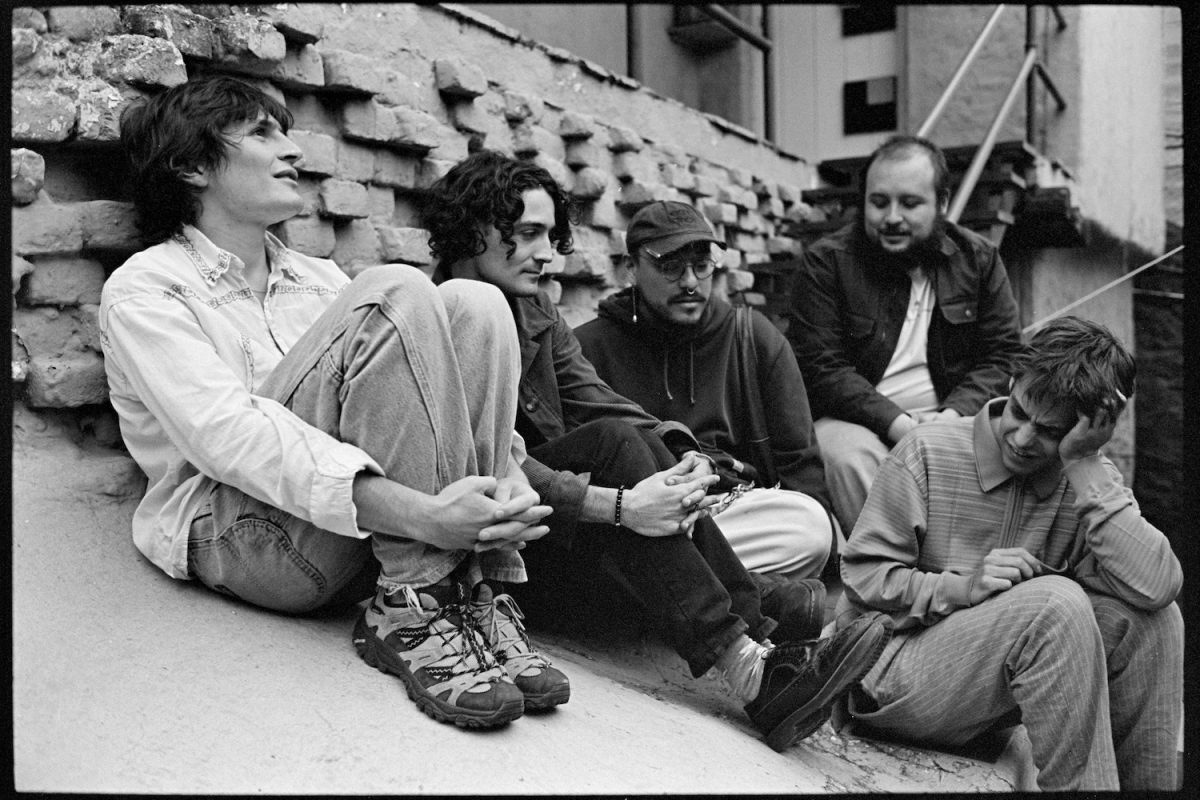

Diles Que No Me Maten fully buys into the belief that improvisation can lead to something transcendent if it embodies the unsullied spirit of discovery. The band’s exploratory jaunts into krautrock repetition, arty adventure-seeking and bluesy, poetic mysticism are the head-spinning byproduct of an outfit always in motion—one that stayed put long enough this past March for a breakout week at SXSW 2026.
Out now via Moonlight Activities, Escrito En Agua was tracked in a makeshift studio in Mexico City’s vibrant Santa María La Ribera neighborhood with longtime collaborator Sebastián Rojas. Retaining their improvisational DNA as they embraced a more deliberate and refined approach to songwriting, vocalist/lyricist Jonás Derbez and the rest of the group draw inspiration from sources as varied as indigenous Mexican mythology, the poetry of Mahmoud Darwish and the epitaph of John Keats.
MAGNET’s Hobart Rowland found some time with Derbez in the midst of the band’s extensive North American tour.
A central theme on Escrito En Agua is surrendering certainty and embracing transformation. What did the title “Writ In Water” come to represent for you during the making of the album?
It came at the very last, but it made total sense once it popped up. The album circles around changing structures and different landscapes. The lyrics are about adapting and embracing the drifting. We saw a picture of Keats’ grave. It doesn’t say his name; it only says, “Here lies one whose name was writ in water.” It was perfect.
Diles Que No Me Maten has always embraced an exploratory, jam-based approach, but this album may be your most crafted work to date. How did you balance spontaneity with refinement?
It was hard at the beginning, but we used the second day in the studio to record a completely jammed song: “Tunuwame,” the last one on the album. That helped a lot to relieve the stress of mental composition. After that, we made the songs through a more normal process. It wasn’t that hard then. We’d made so many jams that we were craving sheet music and bridges. I think the stiffer structure was the perfect bed for the wandering lyrics.
“Hiriku” draws inspiration from the poem “Híkuri” by José Vicente Anaya. What was it about that work that resonated so deeply with you?
José Vicente Anaya is a great spiritual poet—or at least “Híkuri” is a deeply spiritual poem … like “Canción Huichola” from Mario Santiago Papasquiaro. These are poems that, in a respectful and brilliant way, talk about the ancient Mexican tradition to connect with clarity of vision and a lush life. I read this poem and scraped away the third chorus of the song because I think it’s a piece of information that should continue to be heard. This is the purpose of every song, in my opinion: to extend the life of an important soul.“La mitad que soy no existe, y la mitad que existe no soy”—that’s what the poem says: “The half of what I am does not exist, and the half that exists I’m not.”
The album is dedicated in part to Tunuwame, the morning star and patron of singers and musicians in western Mexican indigenous mythology. What does that symbol mean to you?
It was around two years ago that I started to pay attention to the stars, constellations and their movement. The morning star is a point of reference, time wise and space wise. It’s the starting point for star watching and linking up to the sky. So I’d say Tunuwame is the starting point for wandering, and that’s why it watches over the singers as the singers watch for it.
Your music often embraces uncertainty rather than some sort of quest for answers. Now that you’ve completed Escrito En Agua, what mysteries or possibilities are you still exploring as artists?
To keep on going, touring and making a home—to find the songs that fit us as we grow and move around.
See Diles Que No Me Maten live.