
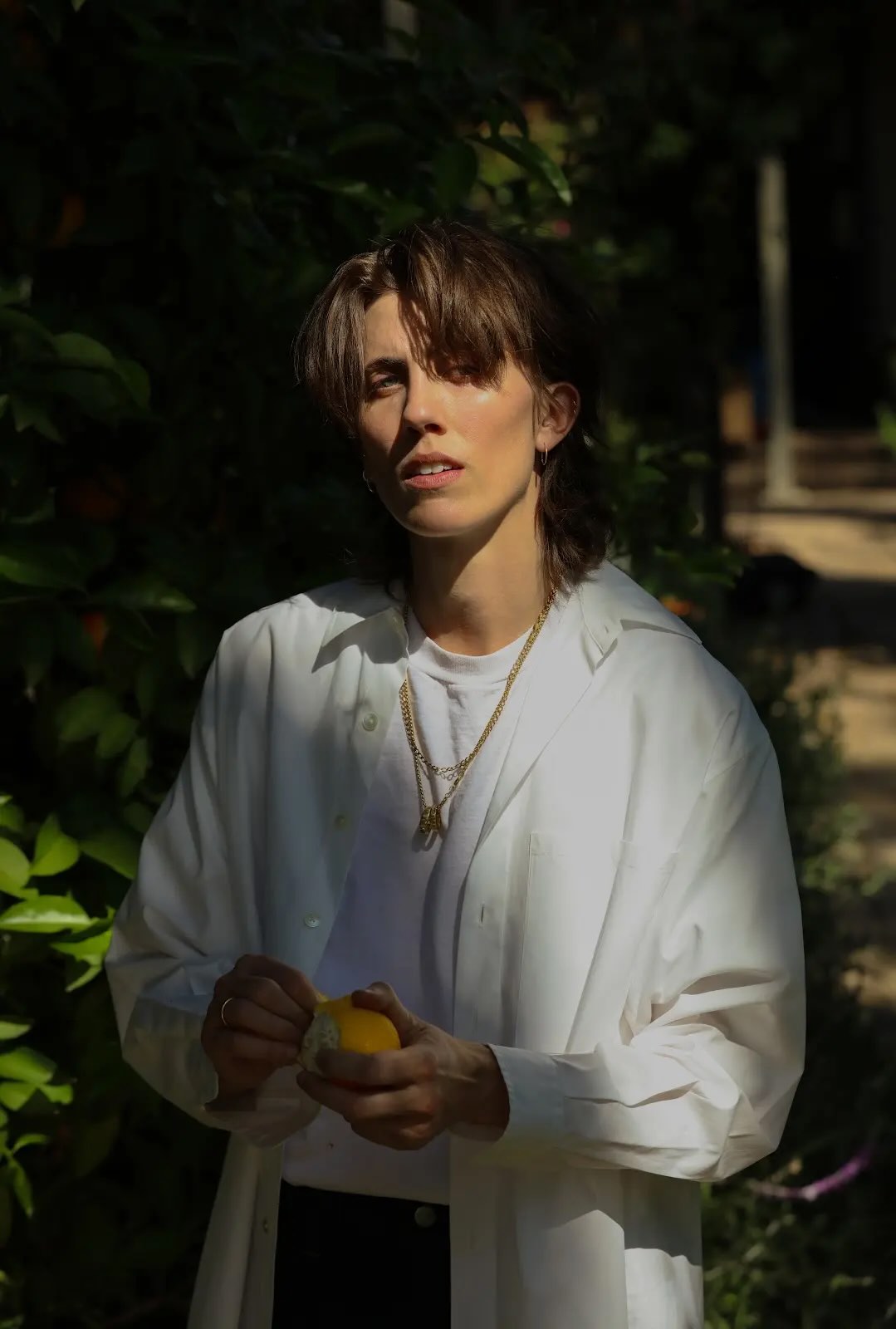
With Tolerance (Fightmaster Industries/Many Hats), E.R. Fightmaster delivers the most personal music of their career, peeling away some pretty thick skin to examine the recurring patterns that shape love, friendship and identity. Produced with a wide circle of collaborators and informed by a fresh hands-on approach to recording, the official “Fightmaster”debut alleviates the discomfort that often accompanies self-examination with a hooky, synth-driven salve.
Best known by many for their role as Kai Bartley, the first non-binary doctor in Grey’s Anatomy history, Fightmaster has already found a compelling musical voice through a pair of EPs. They recently spoke with MAGNET’s Hobart Rowland about songwriting as an act of connection, giving yourself permission to be imperfect and what it means to be a visible nonbinary artist.
You’ve described Tolerance as the most deliberate thing you’ve ever done. What changed creatively or personally that allowed you to be more vulnerable?
I’m more curious about myself and others than I’ve ever been. When I was younger, I avoided pain because I didn’t have the tools to handle it, which made for a lot of protective black-and-white thinking. But all the major growth in my life has happened because I was brave enough to handle something uncomfortable. Sometimes that painful thing is the key to the next phase of being. Sometimes the painful thing is acknowledging that you and the people you love are doing their best—and your best is not perfect. There’s a lot of grace and empathy that comes with the lessons pain provides, and grace and empathy are better tools for creativity than avoidance.
Much of the LP focuses on recognizing recurring patterns in love, friendship and relationships. Have there been any patterns in your own life that surprised you once you started examining them through songwriting?
I used to think of myself as a tough guy because I thought that being stoic made me brave. But trauma will force its way through the tightest of seams, and the parts of me that weren’t healed were creating landmines for my loved ones. As I’ve gotten older, I’ve realized that actual bravery is the willingness to look at yourself and others with an honest kindness. I explored that honesty and kindness a lot on this album. What does it look like to leave with kindness, to process pain with kindness, to handle disappointment with kindness? I think kindness is a lot more honest than rage when it comes to love. But don’t get me wrong—rage has its place.
You’ve spoken about wanting to remove the wall between yourself and the audience. Do you ever wonder if you’re sharing too much?
The really cool thing about songwriting is that the more specific you get, the more universal it feels to the audience. I love the process of taking this secret that feels so precious to me and handing it to an audience with my tail between my legs, just to watch them turn it into an anthem for their own life. Talk about a process of killing your terminal uniqueness. We’re in this together, baby!
Building your own studio was a crash course in production and engineering. How did that change the way you approached songwriting?
It’s slowed me down quite a bit, which is a good thing in a lot of ways. I’ve always heard the song as a complete piece in my head and then taken it to the studio and translated the idea to whoever I was working with. Now that I’ve moved from iPhone recordings to making full demos in my studio, I spend a little more time privately subverting my first idea to make sure there isn’t something more interesting behind door number two. A lot of these songs ended up surprising me.
The other thing worth noting is that I’ve learned a lot more of the language required to have a conversation with other producers about what I’m hoping to accomplish. For women, queer and trans artists, I recommend learning any kind of DAW, even just the basics. It’s too easy to get steamrolled in music spaces if you’re not a white dude. We have to work a little harder to make sure our vision is honored and our presence is respected. Learn the lingo, protect your art.
How does songwriting allow you to reveal parts of yourself that acting doesn’t?
I’m first and foremost a storyteller. Some of my ideas have worked better as scripts. Some of my memories worked best as inspiration for an acting moment. Some of my stories found their shine as songs. But I’m finding that there’s way less separation between them than I thought. If I’m doing a good job acting, I’m present and dropped in. If I’m writing a good song, I’m present and dropped in. Making art is about being present enough to render a moment in time as beautifully complex as you experienced it.
Tolerance is full of empathy, even when it addresses heartbreak, disappointment and personal flaws. Has your relationship with yourself changed as you’ve gotten older?
Absolutely. I used to think toughness meant shutting things down and moving through them. What I’ve learned is that being honest about your hurt, your mistakes and your limitations actually takes a lot more courage. The older I get, the more interested I am in approaching myself with the same compassion I’d offer somebody I love.
You’ve spoken about the responsibility you feel as a nonbinary artist. How do you balance being a role model with allowing yourself to be imperfect?
A good role model has no connection to the idea of perfection. I get to interact with people all the time who found me through acting or comedy or music, and they never come to me and say, “You look like you have it all figured out.” They come to me and tell me which parts of my imperfect journey they saw themselves in. All my mistakes have led to opportunities to get back up and try again. It’s the messing up and trying again that makes me a role model. I’m doing my best. I’m trying to be kind. I’m learning all the time. I think the people who feel drawn to me are hoping they’re allowed to like these things about themselves. You are allowed. You are doing a really good job.
See Fightmaster live.