

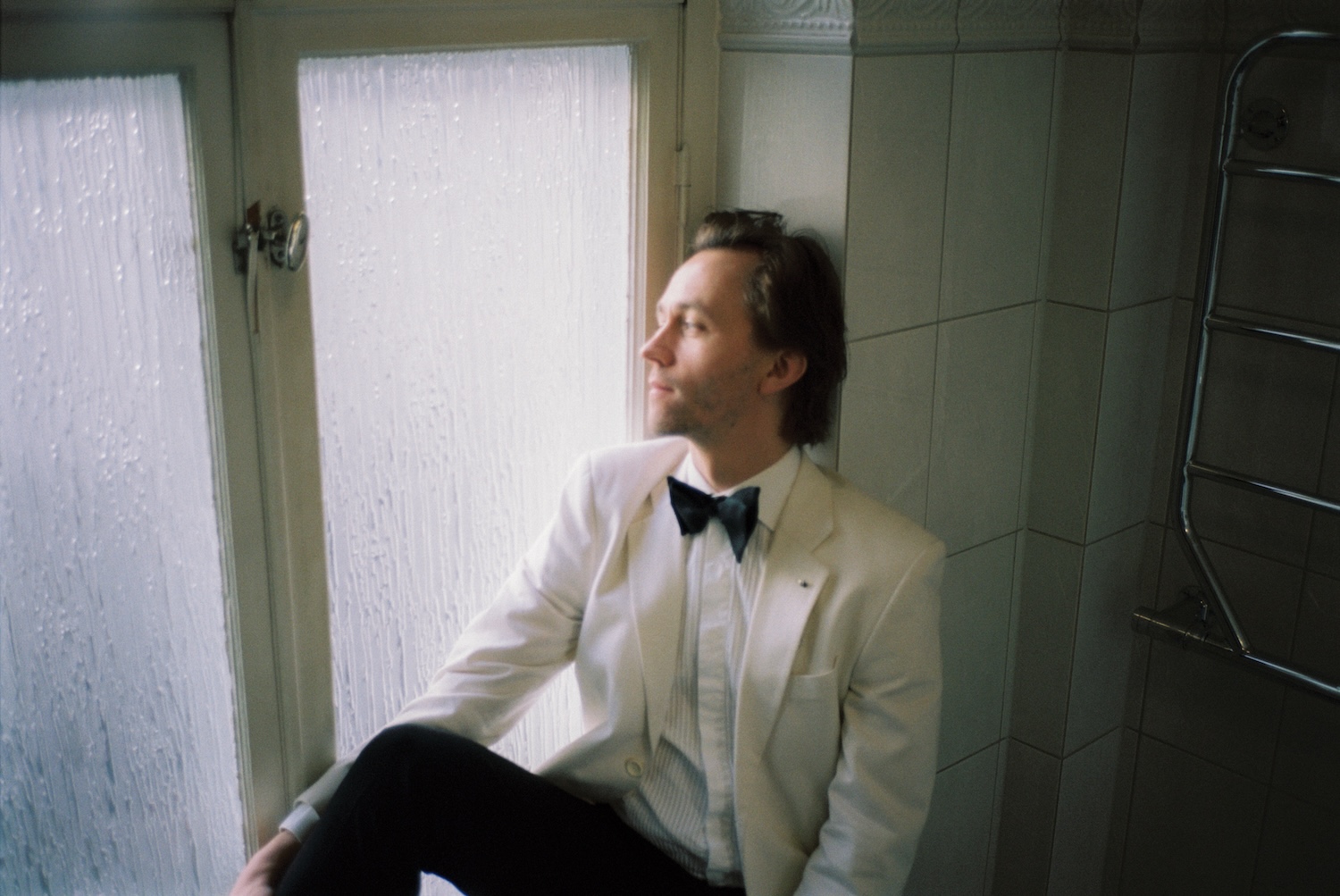
Though Sondre Lerche has spent much of his 25-year career writing about romance, the love songs on Acrobats (PLZ/Virgin) arrive with considerably more baggage than the ones he crafted as a teenage indie-pop sensation. The Norwegian singer/songwriter, who turns 44 today, finds himself experiencing something new: stability—not to mention “meaningful, fearless love.” But domestic bliss hasn’t made it any easier to ignore what’s happening beyond his front door. In fact, quite the opposite is true.
That emotional dissonance is what feeds Lerche’s 11th studio album, which was recorded in no less than nine different studios with a slew of longtime collaborators and some newer voices. Co-producers include Matias Tellez, Alexander von Mehren, Kato Ådland, Jørgen Træen and Vetle Junker. And Sean O’Hagan (High Llamas, Stereolab, Microdisney) returns with his sublime string arrangements. Following the 14-song, two-LP expanse that was 2022’s willfully ambitious Avatars Of Love, Lerche distilled the ungainly raw material from the Acrobats sessions into eight tracks, two of them nine minutes in length.
After a few false starts, MAGNET’s Hobart Rowland finally sat down with Lerche via Zoom from his home in Oslo.
Was keeping Acrobats concise intentional from the start?
It was intentional to try to keep it on one vinyl. There was enough material to make a double album, maybe even a triple album. But I wanted it to feel different from Avatars as much as it could. I don’t think I’ve ever done an album that has fewer songs than 10, so it was kind of exotic to me. It felt like Steely Dan’s Aja or a prog-rock band. It made me feel kind of cool. And, of course, there are a couple of long songs.
And sequencing is its own art form.
Up until the very last moment while we were mixing, I was testing different endings to the record.“Life Changing Love” ended up being the final track—and that was kind of a last-minute switch I made. I spent easily three months sequencing the record. It’s like you’re curating an exhibition. Where this picture going to hang? When people come in the door, what’s the first thing they see? What does it lead to? Is there enough air here? Is there enough space? This room is a little crammed, so maybe the next one should be a bit more spacious. It’s the last point of this journey where I have agency over my work, so it really matters to me.
And vinyl imposes its own parameters.
I think of vinyl as the ultimate format because it gives me some limitations. It also means finding ways of having even sequencing on both sides of the vinyl. That’s another challenge. If I was free of that, I probably would’ve sequenced it differently. In the end, because I have two songs that are nine minutes, I just ended up having them at the center of the album instead of trying to hide them in plain sight. One ends side-a, and one opens side-b. That’s when it felt like, “OK, there’s balance in this universe.”
You worked across nine studios with musicians, producers and arrangers who weren’t necessarily aware of what everyone else was doing. How do you keep it from sounding fragmented?
I have all these different ways of working with different people. There’s sort of a core band I use for a lot of the recordings—but not all of it. I think, “Who do I want to take this song to? How do I want to work it? Is it a classic type of song composition that I want to approach more postmodern? Or is it a more postmodern song structure that I want to record in a more classic way?” There are songs where I know I want to do strings—and I know I want to work with Sean O’Hagan. He’s been with me since the first album (2002’s Faces Down). When I got signed to Virgin Records, I was 16 or 17 years old, and it was a dream come true working with him.
So you’re the only person who knows what the whole album is becoming while you’re making it?
Exactly. I juggle all these collaborations—producers, arrangers, musicians—and try to get the most out of each one. But they have no clue what the other songs are or whatever else is going on. A lot of my work becomes keeping an overview of what I have and what I need. That shapes the songs I write, too. Halfway into the album, I’ll start thinking, “OK, well, I have this, but it would be fun to have something like that. And this theme I’ve been thinking about would go well with the overall theme that’s developing in what’s been recorded.” I just love making records—and I’ve found a way to do it using all these fantastic talents that I’m surrounded with.
Does it surprise you that the album sounds cohesive?
Obviously, it is kind of a fragmented album. But I have this blind faith that I can tie it all together just by it coming from me. It feels so real and true to me that I feel like I can. I just trust that the songs are strong enough—that it’s the thing that ties it together … And then my voice, or whatever is characteristic to it. I have blind faith that it’s like, “Well, it’s coming from me, and I’m one person.”
The emotional contrast on Acrobats is striking. You’re in a place of private happiness while the world outside feels increasingly unstable.
It’s strange how it almost makes you feel guilty for experiencing happiness. There’s the contrast between everything that we’re exposed to—all the endless wars and the endless killings and genocide and the things we’re doing to the planet—and then this media environment of creating distrust. For a lot of our leaders, it seems like the main tool they wield is to create separation and have everybody distrust each other. And that’s kind of the opposite of what this record is about. Acrobats is about the joy of finding real, fearless love in a world that wants to instill fear in you.
Even the album title suggests a sort of balancing act.
I found that when I didn’t try to write about the world, for better or worse, that’s when it seeped into the narrative or the context of the song. If the whole record was like “Follow The River”—just euphoric, not a cloud in the sky, this happened and then that happened and she said this and I did that and we’re so happy—it would be insanity in 2026. It would be like, “What planet are you living on?”
“Little Kids” looks backward at youthful relationships and mistakes with considerably more compassion than we often extend to our younger selves. Could you only write that song from where you are now?
Definitely. It’s not just age—it’s where you are, regardless of age. And I couldn’t have written that song any sooner. “Little Kids” was a very tricky song to write. It took me a lot of rewrites and a lot of different attempts at various themes or ideas. Toward the end, I was worried that I’d made it sort of a problem child.
What unlocked it?
I’d written this in my notebook a couple of years ago: “Then again, we’re just kids, little kids, you and I.” It corresponded with this chorus that I had—and that was the biggest moment of the record for me, because I thought I was going to lose this song. Then it just came together. It feels really good to be able to go back in time and zoom in on these little scenes and kind of forgive yourself. Forgive who you were with. It’s like extending empathy inward—empathy toward your younger self and toward all these attempts at partnership, friendship or love. For me, it’s one scene at 17, one at 18 and one in my early 20s when I lived in New York. I think it resonates because we’ve all been there. When you look at pictures of yourself now from that age, you remember that you felt so adult, and now it looks like you were just a child. How was I even let out alone into this world?
And now you’ve returned to that sense of romantic wonder after everything that came in between.
That’s what I’m getting at on “Drive Me Away From You.” It feels like meeting yourself in the doorway in a way. You’re back to that sense of immense infatuation and excitement, and at the same time realizing, “OK, I’ve been here before. Now I’m 43, and I’m again sitting here trying to write a song about it.” How do I reconcile what’s the same and what’s different? That song is almost a little humorous. It tries to poke a little fun at the idea of that feeling, yet again: “I can’t prove it, but I think I just invented love.”
See Sondre Lerche live.