
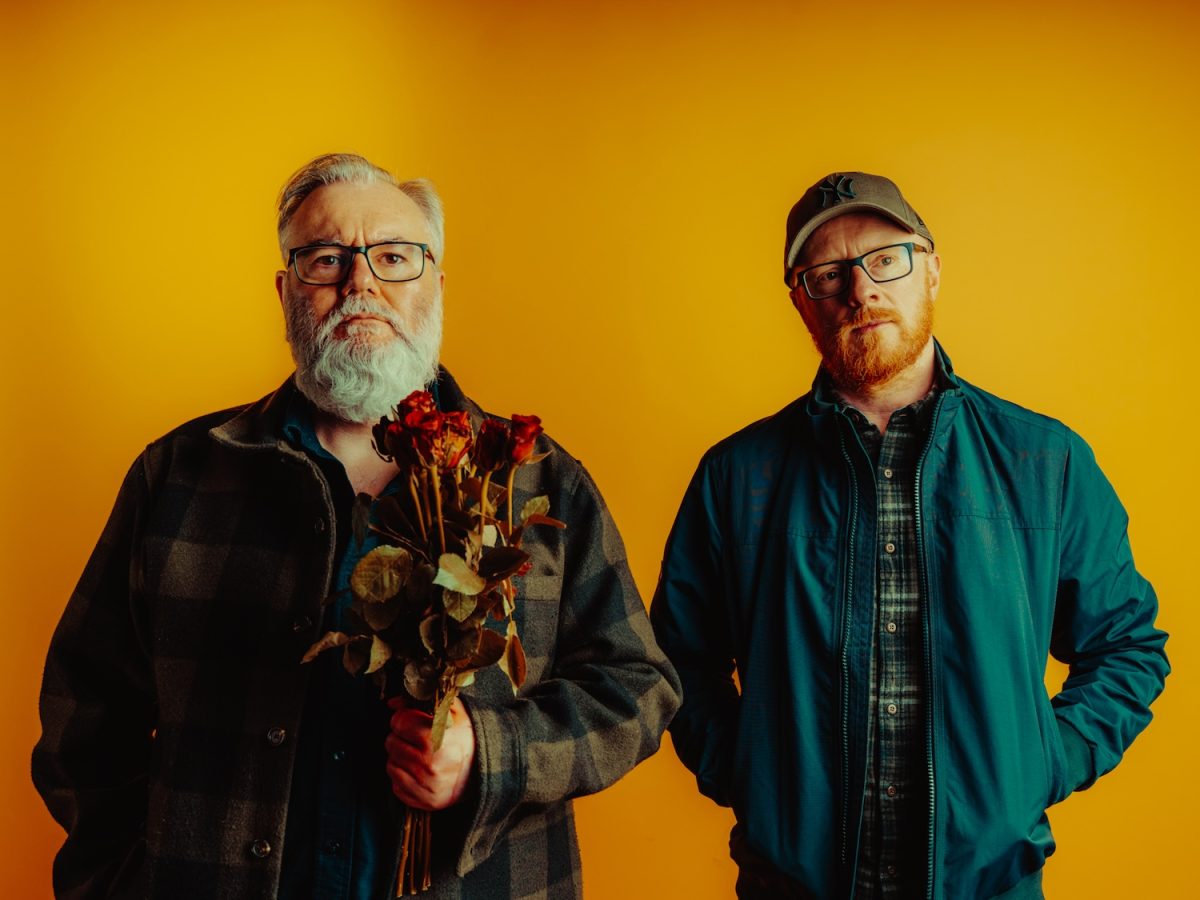

Almost 30 years to the day after Arab Strap released its first single, Aidan Moffat and Malcolm Middleton marked the occasion this month with the release of Half-Told Tales (Rock Action). While the two men may share a long history, they don’t share the same musical tastes—an incompatibility that may be one of Arab Strap’s greatest assets. The esteemed Scottish post-rock duo brings Half-Told Tales kicking and screaming to life with disco rhythms, electronic textures, spoken-word narratives and guitars capable of tearing a hole through all of it. Lyrical concerns range from war, economic anxiety and mental/physical decay to tyranny, disinformation and the numbing lack of human decency in public life. But Middleton and Moffat aren’t waving a white flag. They see their ninth album as an invocation of hope and solidarity—and a stirring reminder that we’re all confronting the same obstacles.
MAGNET’s Hobart Rowland linked up with Moffat to discuss three decades of Arab Strap, the creative disparity that continues to sustain the partnership and the technology that’s transformed the duo’s working methods.
Malcolm has said that one of the things he loves about Half-Told Tales is that it’s not the sort of album either of you would have made on your own. How is that different from any Arab Strap effort?
It’s just that we bring different ideas from different musical places. We don’t really listen to the same music, and we never really have. I suppose it’s a pretty good way to work. It can still surprise us both—and I expect that’s what keeps us going.
Was there a conscious effort to venture into new territory on this LP, or did the songs dictate the direction?
I don’t think it’s a case of new territory—just that we’ve gotten better at doing it over the years. Our first-ever single had a disco beat. It’s just that now we can afford the right equipment to make it sound good, rather than using cheap, borrowed drum machines. And all the sounds we couldn’t afford to use in the 1990s are now free. Technology really opened up in the last 15 years.
Half-Told Tales seems to suggest that human connection might be the antidote to modern despair. Have you become more hopeful as a songwriter?
I think I’ve always been hopeful—even on all those old sad songs. Just sharing those feelings and expressing them to other people is a hopeful act. It’s a way to share your experience and find kindred spirits and find comfort in community. It’s probably more pronounced on the new album, though. There’s a little anger, a little confusion and a little sadness, but hopefully it all comes across as it’s intended—to reach out and share.
You’ve described “Fighting For You” as a direct response to the rise of demagogues, nationalism and political disinformation. What’s the secret to writing about politics without sacrificing the ambiguity and humanity that define Arab Strap?
I honestly don’t know. I suppose the secret is that there is no secret. I only work on instinct and don’t think too deeply about these things. It’s better to just get on with it and work it all out later. I think keeping it personal helps though. “Glamour Magick” would’ve been a pretty nasty song, for instance, if I was singing about other people’s beauty routines … So maybe that’s the key. By keeping it personal and putting myself in the action, it avoids being too judgmental. That worked in my old lyrics about relationships, too—I was always the worst character in the song.
You’ve both evolved as musicians over the years, but the chemistry between your voices and playing remains intact. What’s changed the most about the way you collaborate, and what’s remained the same?
It’s fundamentally exactly the same. We work on ideas independently, then share our work and hammer it into shape. All that’s really changed is the technology. In the old days, we gave each other cassettes recorded on Dictaphones. Now we have a Dropbox to share ideas. And we can do so much more of the work at home than we could back then, with much better, professional results. I do kind of miss the old lo-fi days sometimes. I still love the intimacy of those old bedroom tape sounds and the hissy results of a Tascam four-track. Maybe we could try that again one day, but I think I sold the Tascam to some Russian punk girls a few years ago. Oh well, there are plug-ins for that kind of thing now.
See Arab Strap live.