
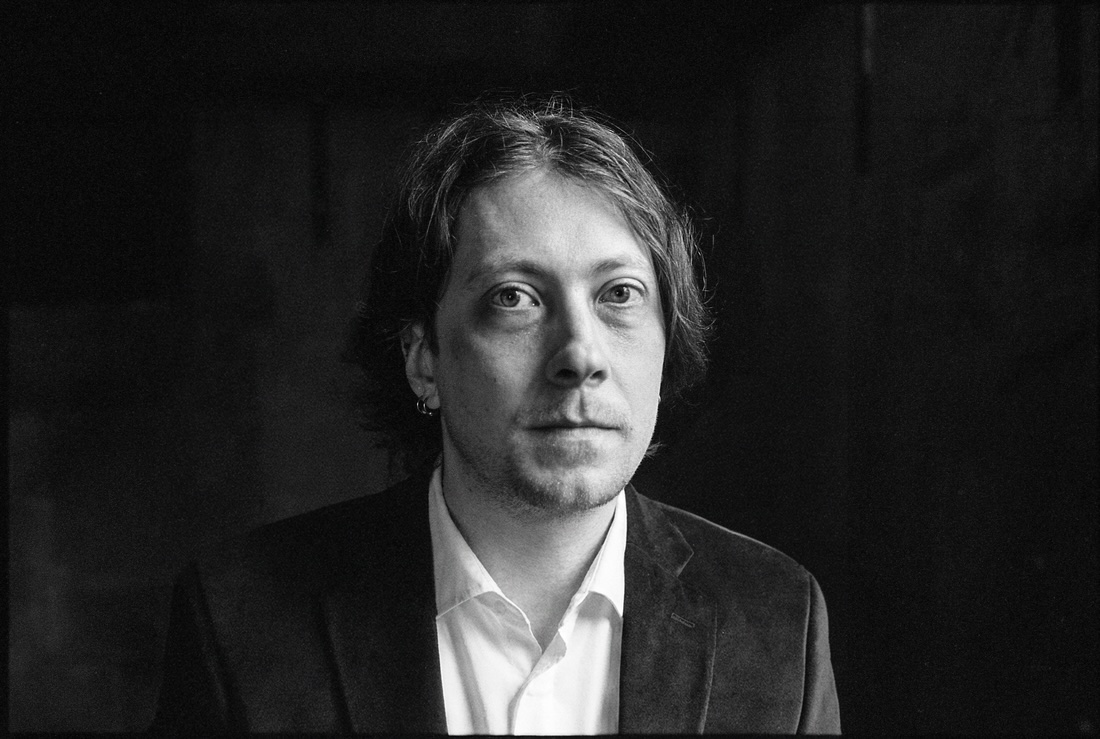
For Henry James House, tradition only becomes problematic when we decide it belongs in the past. The Cincinnati-based singer, songwriter and producer may be best known as the lead singer and main songwriter for the psych-rock band Pop Empire. He’s also a freelance audio engineer and video editor, collaborating with his father, photographer/videographer Michael Wilson, as Cincinnati Recording Service. Through those outlets, he’s spent years absorbing blues, Appalachian folk, early rock ’n’ roll and music that stretches considerably further back: plainchant, early polyphony, English broadsides and Scottish and Irish airs. In his relentlessly cerebral way, he describes the music on his solo debut, Last Lights Off The Black West (Pop Empire), as “post-Americana,” though he’s careful to label it a continuation and not a dismissal of the oft-overused term.
That distinction matters. House embraces Americana’s emphasis on emotionally direct songwriting while acknowledging that the aforementioned genres can coexist fluidly with trip hop, deep house, neo-psychedelia and the fuzz and swagger of Marc Bolan and J.J. Cale. That approach makes Last Lights Off The Black West a bit like a conversation across centuries. What connects it all is House’s belief that music stays alive through active use, not preservation.
MAGNET’s Hobart Rowland grilled House on breaking free from the past, the unlikely connection between Memphis Slim and the Jesus And Mary Chain and why musical vitality matters more than originality.
How do you think your music departs from what’s typically thought of as Americana?
Although I’m not aware of “post-Americana” having been used before, there are examples of music in the wild that I’d call to rally under the banner. Silver Apples and Suicide are artists I consider pioneers here. Certain music by artists like Tom Waits, Sam Amidon and Bill Callahan I think also fits my definition. There are others, but if I started trying to list them, I’d regret forgetting crucial artists.
Last Lights Off The Black West draws from traditions that have been revisited countless times, yet you argue that they’re “never spent.” What keeps the best blues and folk music from becoming a historical artifact?
That phrase “never spent” is a nod to the Gerard Manley Hopkins sonnet “God’s Grandeur,” which also provided the title of the album. I turned that poem into a blues song on this album, and I wrote a prose reflection on it that I’ll be sharing in a companion book to the album I’m releasing in collaboration with my father. Although a Jesuit priest writing in a Christian context, Hopkins was giving expression to a revelation that’s much older than Christianity. In the poem, Hopkins says that despite human greed, suffering, violence and ecological catastrophe, “nature is never spent.” I think the case is similar for blues and folk music. Just like the natural world, these have been parceled out, colonized, commodified—and when it seems like all the juice has been sucked dry, what remains is often portrayed as merely cute or quaint. If blues and folk music remain within narrow cultural boundaries, they become like flora and fauna in parks and zoos, and they can indeed become historical artifacts.
In some cases, you pair traditional texts with new music. In others, you set fresh words to old melodies. What were some of the challenges of transforming these songs in a way that preserved what originally drew you to them?
This was a big part of the learning process for me in compiling and arranging the material that became this album. I’ve always felt that there’s great, untapped potential in pre-war blues and Appalachian folk music to shine out in the contemporary musical world. How to actually make that happen became the creative challenge. I feel like composition and musical writing are fundamentally a matter of listening very deeply, very intently. In this case, I had to return repeatedly to the music that inspired me—largely old recordings and sheet music, but recent and current music, too. Sometimes that meant keeping an old text and giving it a new melody, and sometimes it was the inverse.
You cover Memphis Slim, the Jesus And Mary Chain and Rev. Thomas Dorsey—a pretty disparate span of musical history. What connects “Mother Earth,” “The Living End” and “Rock Me” in your mind?
Foremost, the sense of personal connection I feel with them. These are all songs I’ve been moved by and feel like I’ve developed a personal relationship with. There was something about the skeleton or underlying logic of the song structure in all these tunes that I was excited by before any stylistic interpretation. This is what gave me the idea that I could take that underlying song structure and really do something that felt fun and creative with it—that perhaps expressed the way I saw my own personal connection to these songs.
What can the oldest songs teach us about where music might go next?
What I fully believe is that music is nowhere near its culmination. It’s a human activity that will continue for tens of thousands of years into the future. What we call innovation now will be recognized as the continuation of tradition for those who come after us. Musicians, like most artists, often become enamored of their own “originality.” In the case of music, I believe this is almost always a delusion. Music is built on top of endless layers of tradition. It’s 99 percent reusing and rearranging existing elements, and the last 1 percent is an inspiration that comes through us rather than out of our cleverness. The scales, instruments, rhythms and patterns we use are never fully original, nor do they need to be—originality, per se, is not what makes them good. Vitality is the important thing, and innovation is another important aspect of the musical tradition that’s been with us for thousands of years. Increasing complexity and new technology have never been what makes music compelling, but neither is nostalgia or commitment to stylistic conventions. The path lies through the middle of these.