
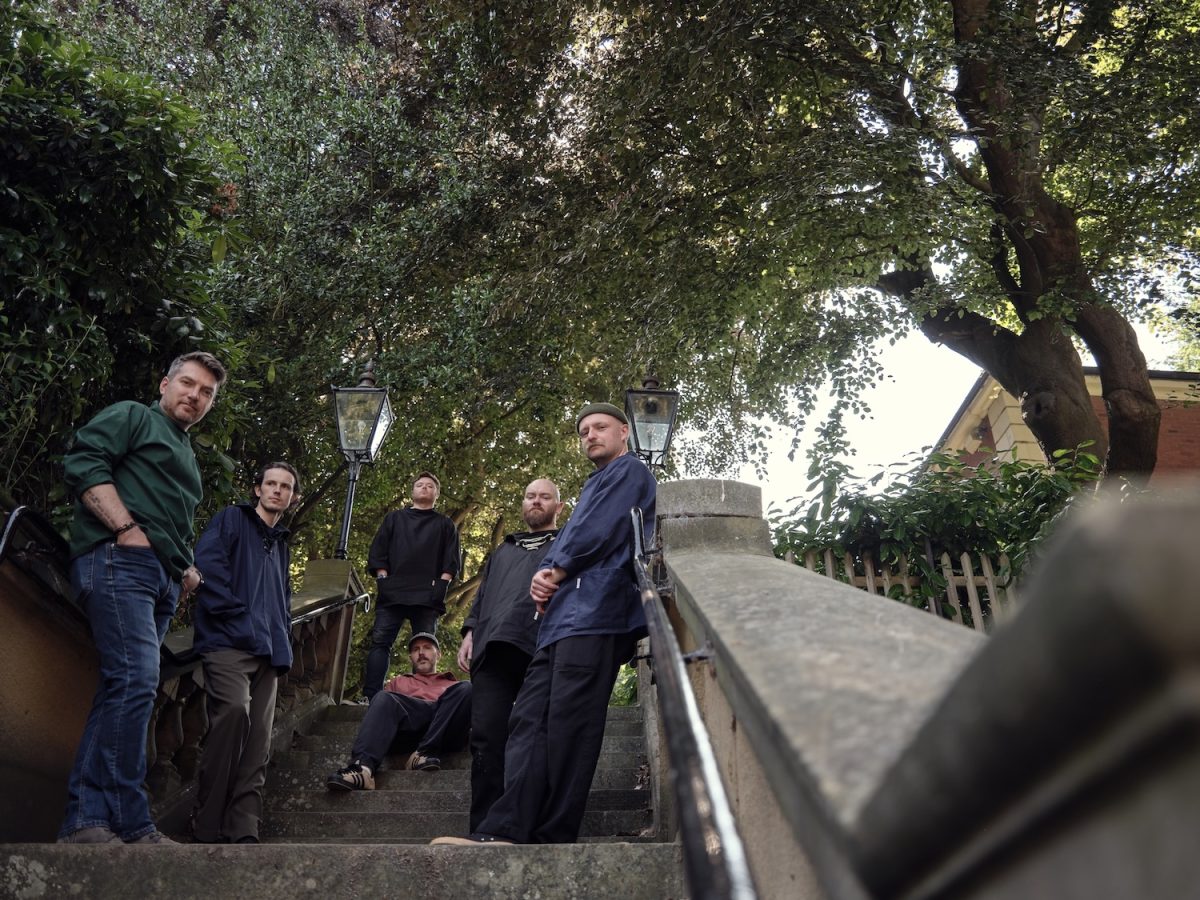
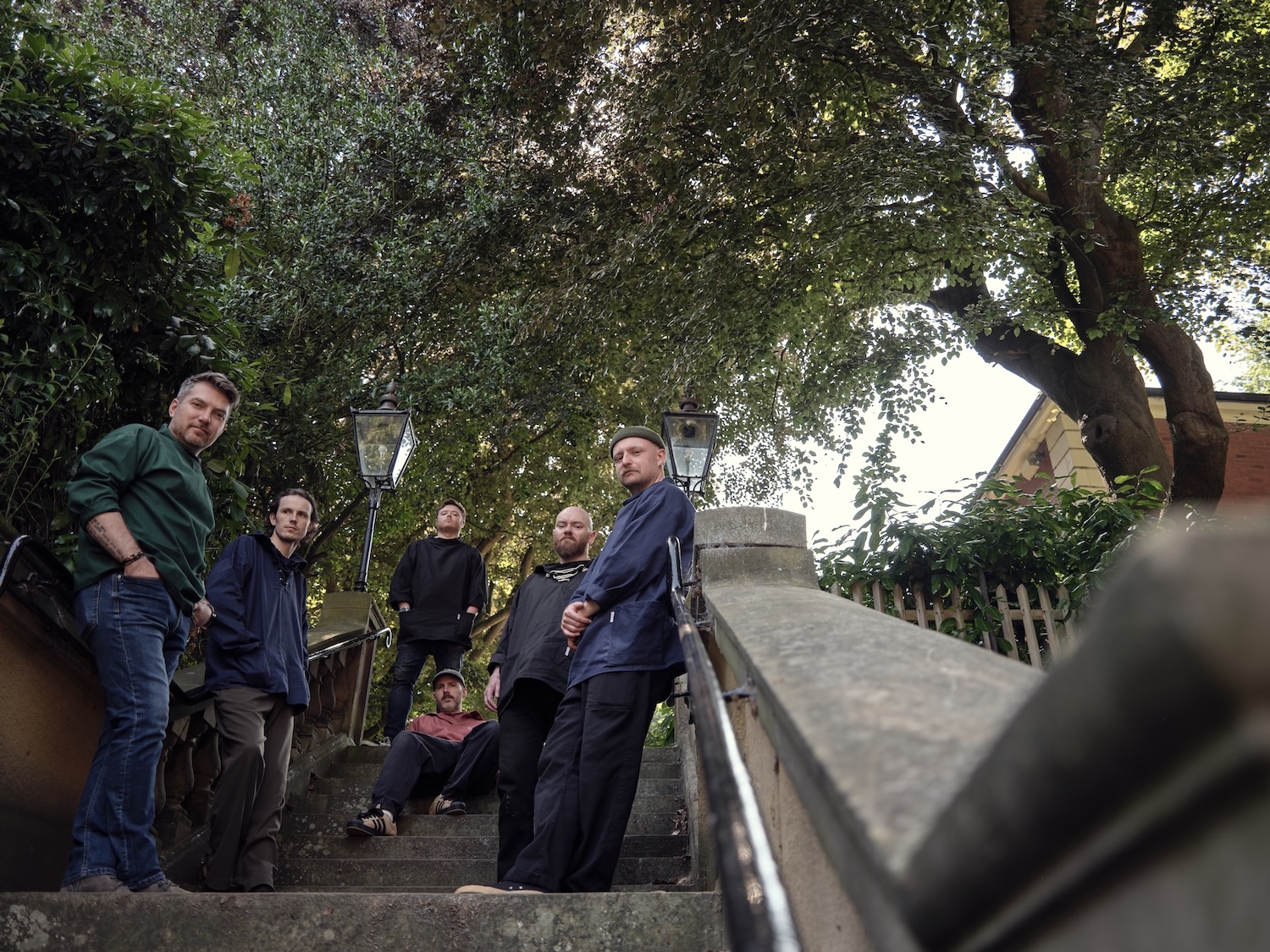
A native of North Shields near Newcastle, Aaron Duff has spent most of his life absorbing the history, language and character of England’s northeast coast. And while the region’s industrial past and fishing and shipbuilding traditions have always informed Duff’s songwriting, that sense of place widens in scope on The Great Shakedown (Guga), the third album from Hector Gannet, a project named for the converted fishing trawler Duff’s grandfather once sailed on.
For years, Duff has been a casualty of geography, he and his band earning accolades and prime opening slots at home for the likes of Sam Fender, Elbow and Richard Thompson. But so far, Hector Gannett is largely an unknown commodity in the United States—though its gritty-yet-arty, blue-color pub rock did turn quite a few heads (including ours) at this year’s SXSW conference in Austin. Back in the U.K., Duff’s connection to his hometown has spurred a high-profile collaboration with Newcastle United. He and The Great Shakedown co-producer Alex Blamire recently recorded a reimagined version of “The Blaydon Races,” a Tyneside folk anthem written by Geordie Ridley in 1862. The project marks the football club’s official entry into the digital music world, with Hector Gannet set to reap the benefits of its massive global fanbase.
Meanwhile, The Great Shakedown advances Hector Gannet’s musical evolution considerably. A three-piece horn section—with arrangements by Idaho-born trombonist Jason Holcomb—brings a soulful edge to songs that move fluidly between such influences as Dexys Midnight Runners, Van Morrison and Thompson.
“I’ve been asked quite a lot recently what ‘The Great Shakedown’ actually is,” says Duff. “What does it mean? What’s being shaken, and who’s doing the shaking? Well, I guess it can be taken either way.”
Here’s more from Duff on each track.
—Hobart Rowland
1) “The Great Shakedown”
“Right now in the U.K., there’s an awful lot of division. There are factions of the population who feel entirely disillusioned and who’d welcome a ‘great shakedown’ of sorts. But there are certain individuals who prey on that unrest. They point the finger at minorities, stir up hatred and propagate it for their own personal gain. History, for the most part, is written by the victors. But with any great shift, there will always be resistance. This is about holding both sides up to the light.”
2) “Let It Pour”
“While ‘The Great Shakedown’ speaks about politics on a wider scale, ‘Let It Pour’ brings it down to a domestic level. It’s about the wealth gap—the ordinary family feeling the pinch, the kids who go without, the old man yearning for the past as the world moves on. It was written a few years ago, when the term ‘trickle-down economics’ was being used a lot as a strategy for the cost-of-living crisis. This is the oldest song on the record. It was a year old before it was even recorded. I’m glad we held off, though. I knew it was going to be part of something bigger.”
3) “Seven Signs”
“You can’t escape them. Narcissists at every turn who are constantly enabled, constantly validated, constantly shifting blame and inflating their own image. Narcissism is one thing, but the God complex is another. I began to really think about how and why people follow certain leaders. From an outsider’s perspective, it can seem like sheer blind faith, with a disregard for reason. Jason really hit the nail on the head with the horn parts, and I see this track as paying homage to some of my biggest influences: Van Morrison and all those timeless American soul classics I’ve been hooked on since I first watched The Commitments as a young kid.”
4) “Boat In The Bottle”
“This song was really written about escapism—how music, literature and art can transport a person. One of the main references in the lyrics is the great J.M.W. Turner painting The Fighting Temeraire. The subject of the painting, a British warship, is famed for its part in the Battle Of Trafalgar. But in this 1839 painting, it’s depicted as a rather ghostly figure, being towed up the Thames to its final berth at the breaker’s yard. In front of it, almost towing the ship into focus, is a steam-powered tugboat—a metaphor, perhaps, for the Industrial Revolution displacing the ‘glorious’ past. In a bizarre coincidence, I’d just written the song when, only days later, the Laing Art Gallery in Newcastle announced a Turner exhibition with The Fighting Temeraire. So we went, and I found the whole experience incredibly moving. That painting speaks to me on a very intimate level: remembrance, sadness, happiness, hope, all the things that make us human. I saw it in the flesh, and now this song speaks to me differently because of it.”
5) “Full Circle”
“A lot of these songs exist in the same geographical location: at the mouth of the River Tyne. I don’t know why I go there so often in songs. It’s home, but it symbolizes more than that. There’s reassurance and grounding in the places most familiar to you—and down there I feel a deep sense of belonging. For all the buildings and structures that come and go and industries that have either evolved, dwindled or died, the essence of the place hasn’t changed much. I take my boy down there to watch the boats come in and out, and I know he feels connected, too. Really, that’s it—all coming full circle. So I guess this is a song of old and new … how they coexist and coalesce.”
6) “Big White Telephone”
“This song walks the fine line between prayer and ‘the drink.’ Many’s the time I’ve found myself talking to God on the big white telephone, not as often in the spiritual sense as in the material. Religion and alcohol often meet in the middle. For better or worse, the traditions and rituals that surround them are ingrained in our culture and identity here. It probably stems from a time when people had little else to get them through the day. I suppose that’s still the case for many. We all have our channels to either escape down or connect through.”
7) “The Mother Tongue”
“I have quite a strong regional accent, which I’ve never shied away from. It’s how I talk and how I sing. The Geordie dialect is a thing of its own, too. It’s crept into my lyrics from time to time. A hybrid of a language with Scandinavian, Celtic and Anglo-Saxon origins—to name a few—it’s considered the oldest surviving form of English in the country. But when it comes down to it, despite all this linguistic richness, we’re just not great at saying how we actually feel. And that’s really what I was trying to say with ‘The Mother Tongue.’ At its core, it’s a song about grief—the kind we don’t speak about, the things that go unspoken because sometimes we just don’t know how to do it.”
8) “The Jetty’s End”
“This song leads on from ‘The Mother Tongue,’ carrying that sense of community and belonging. It’s a theme that hangs over the whole record, and I was really trying to encapsulate that with ‘The Jetty’s End.’ It’s something we took into the recording process with the inclusion of a youth choir run by my old music teacher. It couldn’t have worked any better, and their voices lift the track so much. Another obvious inclusion is the church bells—something that runs through the whole album, both audibly and in lyrical references. The bells in question are rather special. We recorded them from the rooftop at Christ Church in North Shields, a building that’s stood in the heart of the town since 1668. The jetty in question is a feature of the River Tyne—the now-ruined Lloyd’s Hailing Station. At one time, it was responsible for logging the name, cargo and destination of every ship that came in and out of port. ‘What ship, where bound?’ was the question. Who are you, what lies behind you, and what’s beyond in the great unknown?”
9) “A Stitch In The Fold”
“Another song written in reaction to big personal change—or, rather, in anticipation of it. I was waiting to become a dad. I was consumed by all the mystery, joy, hopes and fears that come with it. Naturally, that influenced my songwriting. It’s a deeply personal song—but the whole record is, really.”
10) “No Money, No Time (The Great Reprise)”
“This takes a little something from each track on the record. I wanted it to feel like a real celebration—not only of the album itself, but of life and soul, of family and friendship. It’s a middle finger to all the worries, the hardships, the injustices. Despite having ‘no money, no time,’ we can sing and rejoice in the things that are entirely ours, the things that can’t be bought or sold: our humanity, the connections we share with one another. That’s really what ‘The Great Shakedown’ means to me. It’s a journey—at times very personal—through both the dark and the light, the physical and the metaphysical. It’s a shakedown of surroundings and self. For every walk of life, every love, every loss, ‘There is a bell to be rung.’”
See Hector Gannet live.