
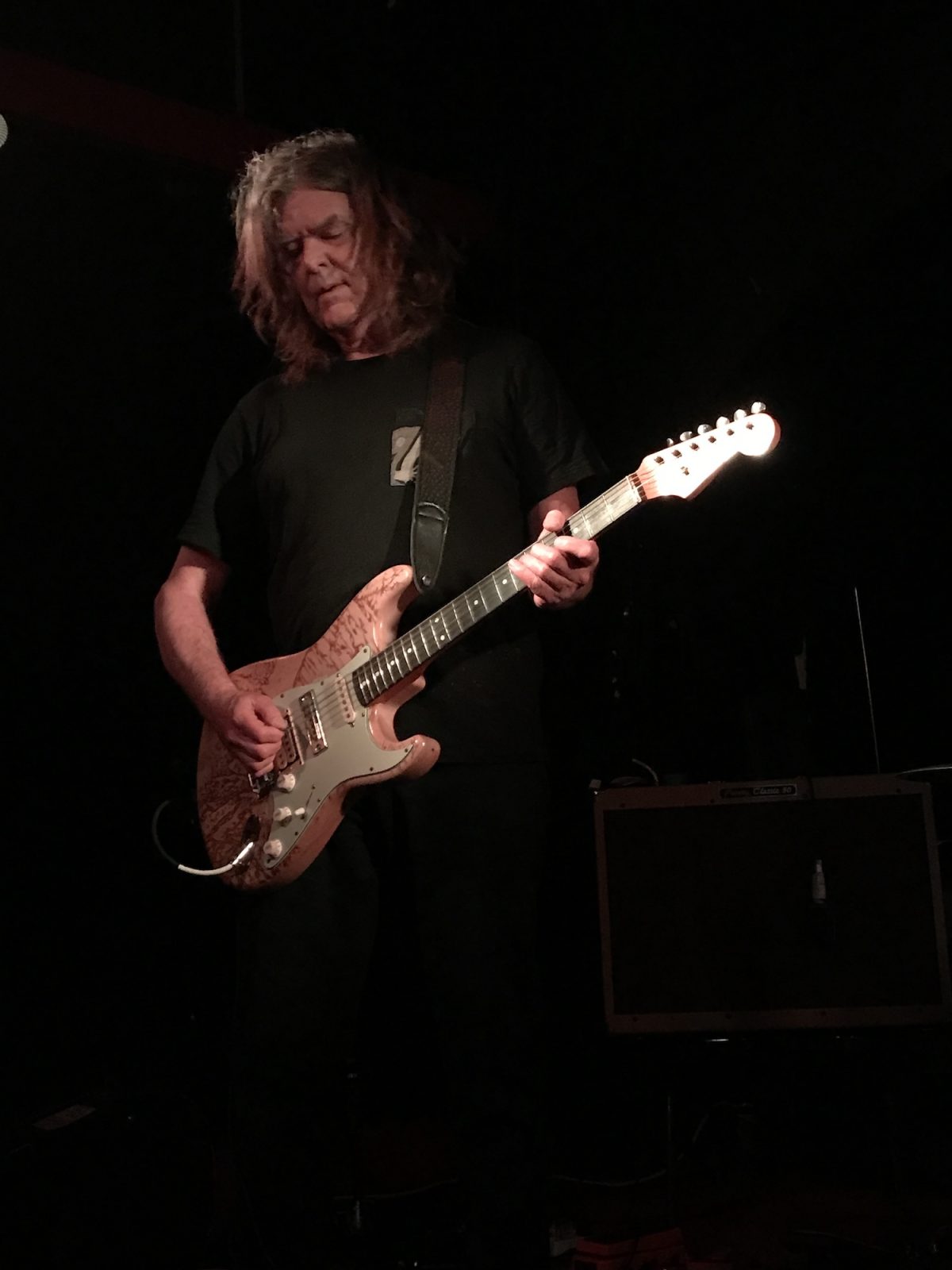
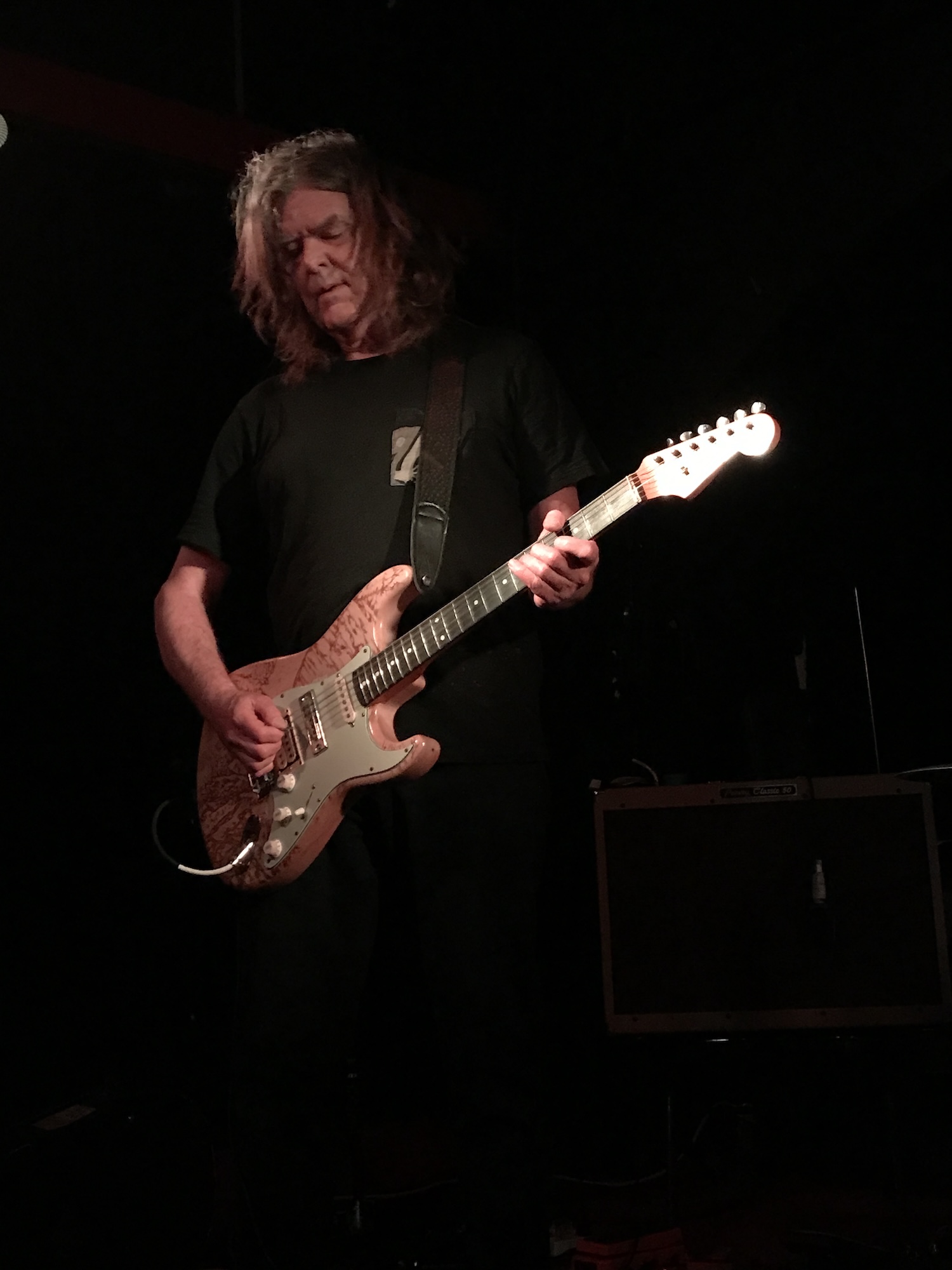
“Traditional” is a relative concept when it comes to Roger Clark Miller. As the guitarist, vocalist and co-leader of Mission Of Burma, Miller spent the early ’80s helping dismantle a fair number of rock’s conventions, deploying dissonance, harmonics and unpredictable tape loops in ways that continue to reverberate through independent music. His subsequent work has ranged from the improvisational psych-rock ensemble Trinary System to an elaborate instrumental series inspired by his dreams.
So when Miller describes The Green Man (Don Giovanni) as a return to more traditional songwriting, it essentially means he’s singing again. There are verses and choruses. Guitar solos are comparatively scarce—and when they do appear, they’re there to serve the songs. As his dream-interpretation pieces grew increasingly complex and difficult to perform, more conventional songs simply began showing up. And Miller followed their lead. In fact, he’s already written another album’s worth.
The shift coincides with another significant change. Priced out of Boston, Miller moved with partner Debra McLaughlin to southern Vermont, where sitting on the deck with an acoustic guitar amid the wildlife has become a regular routine. His solo setup uses loops created in real time to establish grooves and structures he can improvise against. On the other hand, some songs are loop-free. Miller’s approach to the guitar remains idiosyncratic. He often divides its six strings into separate bass and treble functions, thinking more like the pianist he also is.
MAGNET’s Hobart Rowland recently touched base with Miller amid the trees.
These new songs have been appearing with regularity since you started performing solo shows. How did that reopen the creative process for you?
I tend to follow when something opens up. I go, “Wow, look at that.” When I started writing a couple songs, I just thought it was a weird novelty. Then, all of a sudden, I hit one from the new album called “Evidence-Based Reality.” It was the first time I realized I was writing for a new format, which was me performing solo with minimal loops. After that, all I have to do is sit on the deck with Deb. Last night, I came up with a new riff, and it’s just a matter of time to turn it into something more concrete.
Your solo setup uses loops to mimic multiple musicians. How does that work?
There’s nothing prerecorded. It might be a bass line that continues throughout, because you can do a direct bass line and then come at it from five or six different angles and really change the meaning of it. Some of the songs have no loops at all. It’s just me playing guitar like I play it, which means I’m making the guitar do two or three different things anyway. Some songs have three different loops in them, and the songs morph and change in ways that regular songs don’t. They don’t sound like Beatles songs: verse, chorus, verse, chorus, middle eight, verse. I do that on occasion, but pretty rarely.
Mission Of Burma used tape loops to make things more unpredictable. Does what you’re doing now connect philosophically to that approach?
Occasionally, but mostly no. They establish a situation I can improvise off of. If I’m doing a guitar solo—and there are a fair amount of those—they’re very specific. There’s still improvisation in it, but it’s not like I’m doing endless, long solos. In general, the loops aren’t chaotic like the Burma loops were. We added those because we didn’t want to sound like a rock trio. We messed it up deliberately with that. Here, occasionally I’ll have a loop that adds a whole other dimension to it—out of time and stuff. But usually, it’s more traditional in the sense that you can bob your head through the entire song. There’s a chorus that sometimes comes around. You can sing along … that kind of stuff.
“I Live In A Forest” is literally a snapshot of your life right now. Has writing in the first person become more interesting to you as you’ve gotten older?
It’s always been about the same. In the Mission Of Burma era, I had very specific things that were going on, and I’d write about that. I’m writing so many songs now. In Burma, I’d have more songs than the other guys generally. But for an album, I’d only have four or five songs, maybe six. Now everything is my own songwriting—though I do I cover Syd Barrett on this album (“Golden Hair”). I’ve kept a journal since I was 19. Most of the time, I’ll write a lot of observations. One was that if you sit out and watch the wind in the trees, it could be seaweed underwater. I just jot those kinds of things down. Sometimes when I’m writing a new song, unless I have a very specific topic I’m writing about, I’ll go through my journal and see if there are any interesting things I wrote in there. That’s what happened with “I Live In A Forest.”
That song combines minimalism with unorthodox chord patterns. Is there an element of placing limitations on the music and then finding freedom within those limitations?
It’s been commented to me on occasion that I sometimes play guitar like a piano player. I divide it up in different ways, kind of like a piano—left hand, right hand. Instead of just strumming a G chord, I’ll make a line down there with an accent of something on the high strings. I’m trying to orchestrate with just one instrument—I’m not just strumming the old banjo. I’m thinking of orchestration while I’m playing just the guitar, even without loops.
You’ve spent much of your career exploring what the electric guitar can do outside a conventional rock vocabulary. Are there still things about the instrument that surprise you?
On Mission Of Burma’s Vs., there are three “epic guitar solos”—and on two of them, I don’t even press the strings down to the neck. So you can see that I had a bad attitude right from the get-go. There’s a lot of use of harmonics and stuff that I developed in Burma. But I’m also playing a lot of more linear stuff. I’ve learned a lot about modes. I like Middle Eastern music, so I tweak it all the time. I’m changing the notes. I try to come up with something that’s unusual because it amuses me. But as I’ve gotten older, I’m really interested in directly communicating with people. That’s the singing—and I think my singing has gotten a lot better, too.
There’s almost a strain of psychedelia running through The Green Man. What does that term mean to you these days?
My band Sproton Layer just released an album two months ago on 12XU Records. Side one is from 1969, and side two is from 1971. I grew up in psychedelia: Syd Barrett’s Pink Floyd, Are You Experienced, Silver Apples, the first Soft Machine. That was when I discovered who I was—that never goes away. But somewhere in the mid-’70s, when I went to music school, I realized that what I thought psychedelic meant was really experimental … that you just try to find new sounds any way you could. So I don’t know what psychedelia means. What does punk rock even mean? Or goth? What does any of that shit mean?
Mission Of Burma is now accepted as part of the American rock canon. Given how far outside the fringes you were originally, does that still feel strange?
I’ve gotten over the strangeness. I’ve just accepted it now. I shrug my shoulders and go, “All right, great. Maybe that’ll translate into some sales, and I can keep living as an artist.” That’s mostly what I think about. You don’t want to sit around thinking, “They told me I influenced these people, therefore I’m important.” That’s a joke to me. If they say we influenced people, it’s probably true because enough people say it. But what does that mean to me? I don’t know.
See Roger Clark Miller live.