
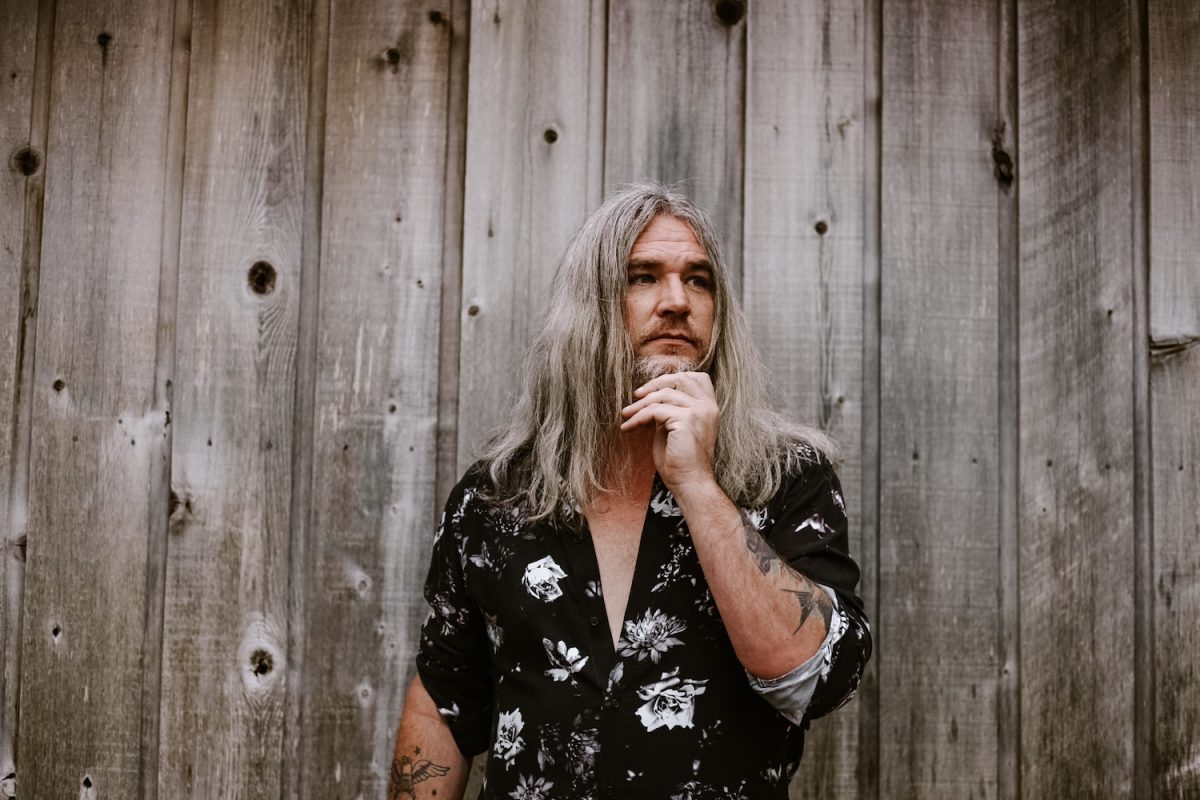
Staying within Americana’s so-called parameters has never been a priority for Israel Nash. Over the past dozen years or so, the Texas-based singer/songwriter has cycled through assorted evolutions of an unpredictable brand of cinematic cosmic country grounded in sturdy roots-rock songwriting and colored by the atmospheric pedal steel of loyal cohort Eric Swanson. Now he’s applied that same expansive approach to Sweetheart Of The Rodeo, the Byrds’ influential 1968 country-rock masterpiece, reimagining the songs with synthesizers, programmed percussion and the wide-open sonic sensibility that has defined Nash’s own work. He’s even shuffled the original track sequence. And the weird thing is, it works—once you roll with the fact that this isn’t an homage so much as a reinterpretation.
The project evolved in fits and starts during a season of significant change for Nash. As he worked to reclaim ownership of his back catalog and complete a studio on his property in the Texas Hill Country, he began reevaluating the usefulness of writing, recording, releasing and touring within the conventional industry cycle. This year’s expanded reissue of his acclaimed 2014 LP, Rain Plans, was part of that recalibration, along with Sweetheart Of The Rodeo.
The last time MAGNET’s Hobart Rowland sat down with Nash, he was hosting friends and collaborators at a rented home in Austin during 2023’s SXSW conference, where he debuted some early mixes of Sweetheart. He’s been largely off the grid ever since, so there was plenty to catch up on.
Before we get to Sweetheart Of The Rodeo, let’s talk about the expanded reissue of Rain Plans.
Rain Plans was the first album where I really started involving my demos more. With the earlier records, a lot of that production was putting the right people in the room and letting the songs develop. With Rain Plans, I’d moved to Texas. We were renting a place, and I had more gear and more space than I’d had in my Brooklyn apartment. I could have things permanently set up. The tools were getting better, so I could get more of the sounds coming from my head. It was a pretty makeshift studio. I had a little interface, a MIDI controller, a microphone and my guitars. But those demos were the beginning of the process I use now. Records are called records for a reason. They’re documents of a time and a reality. They’re good places—like photo albums—to look back at yourself and make comparisons, artistically and personally.
How much has that process changed now that you’ve built your own studio?
The biggest thing is how much the studio is part of my creative process. It’s almost like a notepad now. I’ve got dry-erase boards everywhere that get flooded with lyrics. It’s this living process where I record things, update them, have new ideas and chase them. With Rain Plans, I was beginning to exert more control over the recording process—and now it’s become central to everything I do. Albums get made in real places by real people, despite all this connectivity. Rain Plans is a strong reflection of that concept. It was very much about moving to Texas and that transition in my life.
You’ve reclaimed ownership of your catalog and established your own label and distribution arrangement. How difficult was that transition?
It was quite a legal engagement and quite an investment. It wasn’t easy; it took money and resources. My manager and I have been looking at these things for a long time. We’ve seen the landscape change in every facet of the industry. The idea of artist development is pretty much dead from an investment standpoint. The infrastructure that used to connect radio, publicity, labels and audiences just isn’t there in the same way. You can have an artist getting incredible press but only 5,000 monthly streams. There’s a massive disconnect between things that used to be much more connected. Getting my catalog back and establishing my own distribution has given me the opportunity to do things differently.
Was that independence part of what inspired you to revisit Sweetheart Of The Rodeo?
Absolutely. I wanted to make more music with my studio. It made sense to me spiritually, creatively and from a business standpoint. The more records I have, the more I’m doing what I love. But I can’t write three solo albums of new material every year, so I started looking for other projects. That’s why we did Moods, the pedal-steel record. I wanted to expand my production abilities and have different creative interests. But I quickly realized that labels weren’t particularly interested in that kind of release schedule. That was part of what led to getting the catalog back and figuring out how to release music in a way that feeds what I want to do. Sweetheart was the first proof of concept for me. Maybe I’ll do another project like it sometime—it doesn’t have to be next year. A lot of our ideas about album cycles followed the function of the physical medium. The industry has been very slow to update those ideas. Part of what I’m doing now is fighting that cycle and feeding the creative beast.
Why Sweetheart Of The Rodeo specifically? It’s a landmark record, but it wasn’t a commercial success for the Byrds when it came out.
I got into Gram Parsons first, like a lot of people. I fell in love with the lore, his story, his approach and how much he influenced that record. But Sweetheart has always been one of my favorite records in a different way from some of my other favorites. With a lot of those records, it’s the production and songcraft that make them favorites. With Sweetheart, I don’t necessarily love the production in the same way. It’s a record that just followed me around. I’ve had the vinyl for so long. At certain times in my life, I’d put it on and it would make its way back to the top of the pile. It became more of a reflection piece. That’s how a lot of favorite albums become favorites—it’s about the feelings and the moments you’ve had with them over time.
So you weren’t completely enamored with the original production. In your mind, did that give you more license to put your own stamp on the material?
I thought there was more to say with those songs. A lot of that record was recorded in Nashville. I’ve always gravitated more toward the Bakersfield sound. They wanted to get those players, but then the sound becomes very Nashville for that time. Imagine me trying to make one of my records in Nashville just because they had some pedal-steel players.
Was it difficult to find enough room in the material to make the album distinctly yours?
Some of it came really easily. Some of it was more like, “I’m just going to let this live. I’m not going to force something to be different just for the sake of being different.” Some tracks feel like they’re coming through my lens and naturally fit the album. “The Christian Life” sounds relatively similar in some ways, but then there’s a nice jam at the end. It’s like, “Let’s do that thing we do.” It was a creative endeavor more than any kind of tribute. And I think it’s a safe album to do that with because it’s not like The White Album or something.
So you don’t consider it a covers album?
No. The whole thing is a reinvention. That doesn’t mean every song had to be radically different. There were other goals, too. I wanted to find something creatively interesting that would inspire me. Just saying, “How do I cover this song?” isn’t inspiring to me. Even the songs that sound somewhat similar have differences. The time signatures might be different. I’ve changed chord structures or moved things into relative minors. Some of it is subtle, but there’s definitely creative work in there.
And this was something you worked on over time, correct?
I started working on it around 2020. Having the studio allows me to approach things differently. I call them “liquid records.” They’re always living. They’re never necessarily done until they’re done. I’m not somebody who throws the kitchen sink at everything, but if I have a new idea, I can go into the studio and try it. A song might be finished, but we’re not in a rush to release it. I’ll put it on pause and switch to another project. I can keep these different projects living and moving forward. It’s almost like creatively multitasking instead of being consumed by one record for an entire year. That’s really healthy for me.
Have you had any contact with Roger McGuinn about your version of the album?
I actually have a note I’ve been working on to send Roger. I have some connections through people who know him. I know his faith is important to him, and I respect people who have their own spiritual connections. I’m interested in that. As a songwriter, I’m fascinated by people’s personal experiences and how they make sense of the world.
Have you thought about what Gram Parsons might have made of your reinterpretation?
A little, in a fleeting way. The lore of Gram is bigger than his career in some ways. But I think he’d probably be pleased that people are buying these records around the world. It’s not like I’ve butchered a bunch of songs or put something out unprofessionally. If a younger artist made a version of Rain Plans and did it justice, I think I’d consider that a feather in my cap.
You’re also working on your first new album of original material since 2023’s Ozarker. What can you tell us about it?
It’s a wild sonic story. I don’t want to say too much, but I think it’s my first true concept album. There’s a lot of storytelling, a lot of cultural critique, a lot of hope and love. It’s an opera. I’m crafting songs into acts, with progressions and instruments representing different characters. There’s a lot of detail and intention in all the layers. It’s really ambitious, but it’s very Texas.
Do you have a timetable for finishing it?
We’re looking at spring of next year. I’ve spent so much time in preproduction that I know exactly what I want to do. I’ve been preparing the band at different levels and getting everybody on the same page. When the guys are here, I don’t record my parts. I’ll do guides and help with the demos—and I’m producing. Then my engineer and I can go back and work through my parts because I already know what needs to happen. I have the whole month of December to finish the extra things, and we’re planning to deliver it at the end of December. This is my first real full album conceived and recorded since before the pandemic. We’ve spent the past couple of years building these foundations, getting the catalog back, establishing distribution and figuring out how we want to operate. Now it’s time to really run with all that.
See Israel Nash live.