
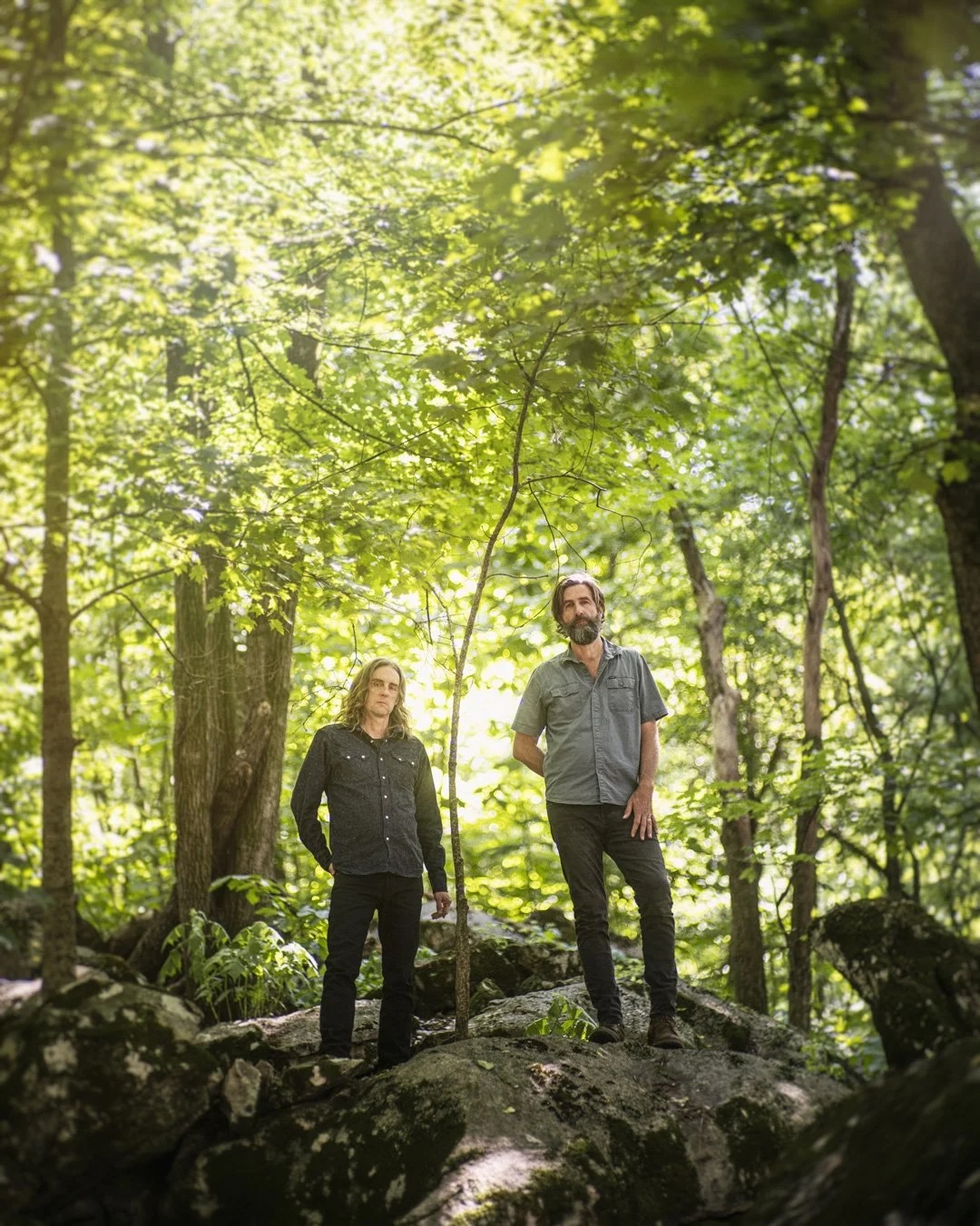
Tyler Ramsey first connected with Carl Broemel almost 15 years ago, when the two toured together—Broemel as the guitarist for My Morning Jacket and Ramsey as his equally skilled (and unassuming) counterpart in Band Of Horses. Fast forward to 2019. Ramsey had left BOH two years prior to focus on his solo career, and Broemel found himself with some spare time between MMJ commitments. The two hit the road for a series of shows that highlighted their intuitive chemistry and complementary playing styles. They floated the idea of an album together, but nothing came of it until everything ground to halt during the pandemic. They began exchanging ideas back then, eventually finishing the deal in 2024 at Broemel’s home in Nashville.
On Celestun (Duo Quest/Tone Tree), their skill sets so seamlessly intertwine that you can’t discern who’s playing what, which is sort of the point. A few names come to mind when listening to this quiet marvel: John Fahey, Leo Kottke and Bert Jansch, to name a few. It’s as if Celestun sprung forth from a highly capable (and empathetic) four-armed picker. Ideas and inspirations coalesce around a shared passion for playing—and doing it frighteningly well.
MAGNET’s Hobart Rowland met up with Ramsey and Broemel on Zoom to discuss Celestun and how it reflects their evolving relationship as collaborators and friends.
Celestun wouldn’t have happened without your friendship, so let’s start with the 2011 My Morning Jacket tour.
Ramsey: Like you often do in an opening band, I tried to stay out of their way as much as possible. Carl and I talked a little bit, but I don’t feel like we really got to know each other until we decided to go out and play music together. We kind of did it blindly. Carl came through Asheville (N.C.) with (Nashville-based instrumental duo) Steelism. Me and a friend went to see them play, and afterward, we talked. I don’t remember what the next step was, but somehow, we had a tour booked before we’d even really gotten together to play. We kind of had a crash course. Thankfully, it worked out incredibly well. We got along really well, and our musical styles blended really well. It was pretty magical.
Broemel: I remember seeing Band Of Horses play the Ryman, and Tyler did one of his songs, just singing and playing guitar. The role he played was similar to what I’m doing in my band. Maybe you’re not the lead singer, but you’re doing an important job. That really piqued my interest, because I’m kind of the same person. Anytime I play with Tyler, I feel like I am being challenged—and I’m also having a beautifully fun time.
From a songwriting standpoint, where did Celestun begin?
Broemel: Tyler sent me “Celestun” and “Elizabeth Brown,” and I sat with them, played along, wrote a part to the songs and sent them back. Then I sent him something, and he played along to it. And we just kept rolling.
How did the few vocal songs on the album come about? Were any of them originally supposed to be instrumentals?
Broemel: I don’t know about Tyler, but usually when I’m sitting down, I know whether I’m writing an instrumental or I’m writing a song song.
Ramsey: I think it’s pretty rare that I’ll have an instrumental and then all of a sudden I’m like, “Well, here’s a vocal part.” A lot of times, I do have instrumentals that go hand in hand with vocal tunes, but they’re intended to be separate movements or pieces. I think we just kind of found our way as we worked on it. We’d be working on the instrumentals, and then we’d say, “Well, let’s try this.” We were like, “Oh, that’s cool. What about you? Do you have one? Let’s add one of those.” And then, “Let’s do that, Neil (Young) song you do (‘Sail Away’). Now it feels like a record, doesn’t it?”
What is it about your playing styles that make them so complementary?
Broemel: Part of it is just intuition—and spending time on the guitar. I love watching Tyler sit and play guitar. I don’t think he realizes how cool it is just to watch him play guitar … or maybe he does. [Laughs] We’ve both been in complicated situations. I just wanted to get into that zone where we’ve stripped away almost everything else and gone back to basics.
Ramsey: There are some simple explanations. A lot of times we’ll use different tunings or put a capo on a guitar in a different place—so the guitars just naturally inhabit a different area of sonics. Stylistically, we both studied the guitar seriously, but in very different ways. And I think that’s really cool because it’s like we’re not two ends of the same magnet. We’re a positive and negative, you know.
So you reach the same end, only differently.
Ramsey: I feel like we do inhabit different territory. I’ve said this before about Carl, but I do feel like he’s got a better grasp on the wide spectrum of the possibility of the guitar. He’s able to play in My Morning Jacket. He’s able to compose and play songs that sound like beautiful classical pieces. He’s also able to shred a crazy solo and play a slide solo. I can fumble my way through a guitar solo, but that’s not my strong point. I think what I’ve come up with is more based on my limitations or lack of discipline. I tend to just play what comes to me, and I just keep playing that—so it becomes like part of a language I’ve learned or whatever. But a lot of times, I feel like it’s specific to me.
When I joined Band Of Horses, there were two other guitars onstage, so I was like, “Oh, I’m going to use these tunings. I’m going to put capos in weird places, and I’m going to inhabit a place that isn’t already filled up. I feel like Carl and I are both aware of what something needs. We’re not going to fill up all this space. We’re going to kind of dance around each other’s ideas—and that makes it really special.
See Tyler Ramsey & Carl Broemel live.