

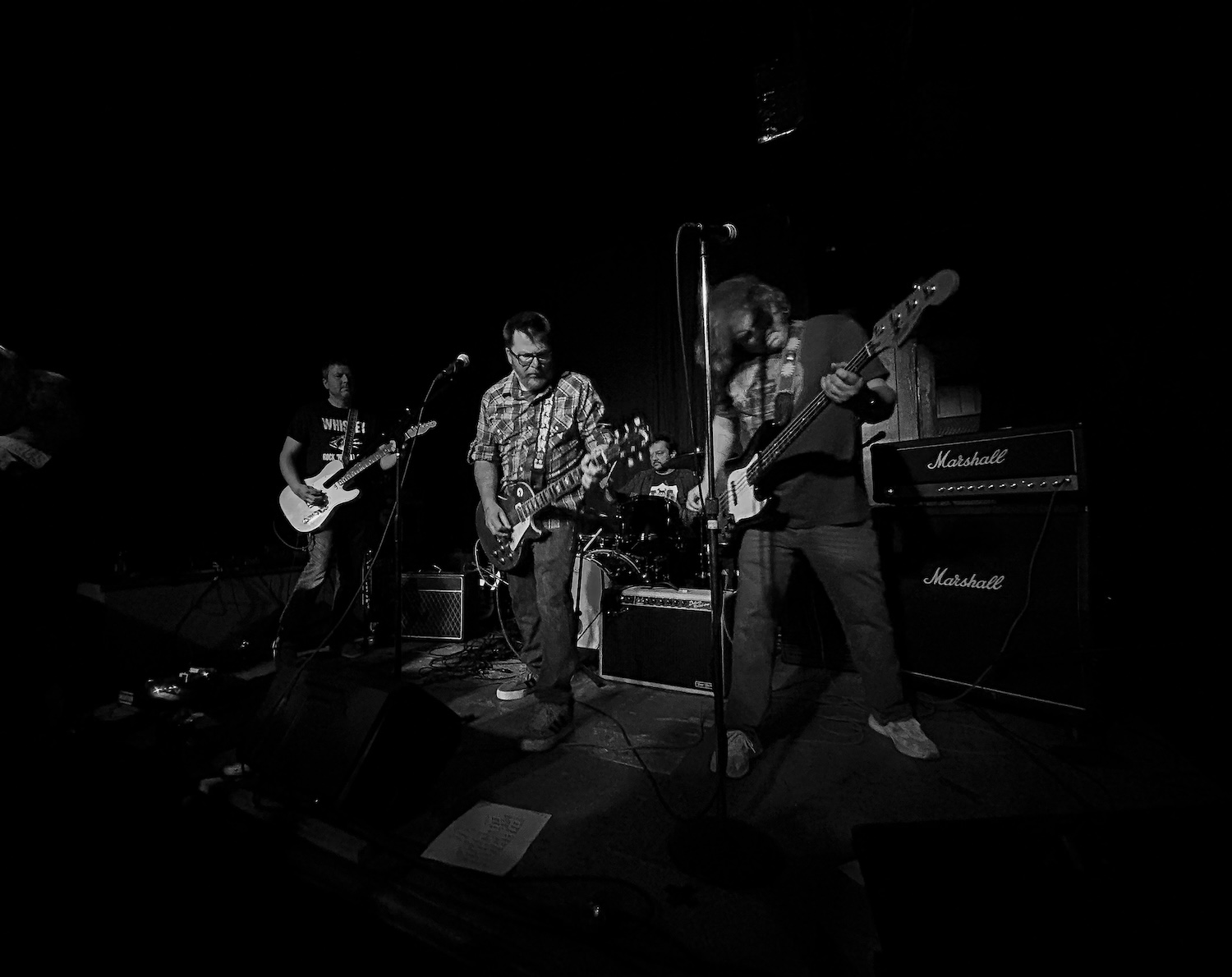
Grizzled Minneapolis vets—they’ll love that description—High On Stress have been at it since 2003. With the new Still Here (Rum Bar), the quartet—singer/songwriter/guitarist Nick Leet, drummer Mark Devaraj, bassist Jim Soule and guitarist Chad Wheeling—still somehow managed to deliver a peak LP 23 years later.
The band isn’t producing anything innovative (not an insult), just simple, catchy blasts of solidly melodic rock ’n’ roll. “Over/Thru,” co-written with Kevin Salem, sports an indelible chorus; the closing title track jangles at first then emotionally ends with Leet proclaiming, “I’m still here/And I’m not dead.” Still Here isn’t necessarily rootsy and it’s not purely power pop, though there are traces of the former and a bunch of the latter. Call it whatever, but if an album influenced by Tommy Keene, the Replacements, the Jayhawks, Soul Asylum and the like matters (it does), Still Here is a vital listen.
MAGNET’s Matt Hickey asked Leet a few probing questions about the new record, why the band almost called it a day and some other stuff you’ll discover as you scroll.
I think this is the best High On Stress record. Agree or disagree?
We’ve been around a long time and have made a lot of records. Hold Me In kind of came out of nowhere in 2020 and ended up being our biggest and most talked‑about one, which honestly surprised us. After that, I definitely felt nervous about following it up, but Mark, Jim and Chad can turn songs into magic. I’m fortunate to play in a band with such talented people and, more importantly, friends. With that said, I think this is the best thing we’ve done. Peter Jesperson, former manager of the Replacements, reached out the other day and said the same thing. He told me it’s our best work and that it “rocks like mad.” I love that line. Thanks, Peter!
Still Here is the band’s first album in six years. Any particular reason?
A lot can happen in six years. The band experienced divorces, new marriages, new kids, new houses—all the usual life stuff that somehow makes time fly by faster than you expect. I also spent a good chunk of that time distracting myself by creating and hosting the Figure Eights podcast, where I got to talk with people like Steve Albini, Jason Falkner, Jon Wurster and others. It was a total blast, but it definitely pulled me away from writing songs. Eventually things settled down, and when they did, the faucet kind of turned on. We ended up with 25 to 30 songs to choose from.
Hold Me In was released six years after the previous record, Leaving MPLS. I vaguely recall something about maybe you guys broke up during that time or had thoughts about it. Can you clarify that?
Our bass player, Jim, moved to Chicago in 2014. At the time, we had been together for 11 years and released four records. That’s a long time in band years. We had the opportunity to play shows with Tommy Keene, Jackson Browne, Tommy Stinson and even acted as Slim Dunlap’s backing band. It felt like the natural spot to get off the train. We did separate stuff for a while but gradually found our way back to each other. Hanging out and chatting and playing with Matthew Ryan at a songwriter series in Ottawa, Ill., in 2017 really opened my eyes. The dude is a modern-day poet, philosopher and a tremendous songwriter. It’s hard not to be inspired by someone like him. It definitely made me reassess what I wanted to be doing. I missed my band. Turns out they all missed it, too.
How did you end up co-writing “Over/Thru” with Kevin Salem? Did you by chance bond over your shared love of Tommy Keene?
Oh man, I love Kevin Salem—and you’re right, we all love TK, too. I actually met Kevin while doing the podcast. I asked him to be a guest, and we ended up talking for what had to be three or four hours. Just totally hit it off. After editing, it still turned into a two‑part episode. His solo records are fantastic, and he’s been this secret‑weapon sideman for people like Freedy Johnston, Rachel Yamagata, even Kesha and Mandy Moore. After that interview, we became text buddies, and at one point he even hooked up the baristas at his local coffee shop in Woodstock, N.Y., with High On Stress stocking caps. He played guitar on one of my solo songs and also offered to co‑write something together, which turned into “Over/Thru.” I absolutely love that song. He’s a great lyricist.
On this album, you also co-wrote “Under The Table” with Sam Powers, formerly of Superdrag, and you wrote a single last year, “Tethered,” with Dan Murphy, long ago a founding member of Soul Asylum. How are these collaborations happening?
Sammy P from Tennessee! I love Sam. Superdrag is one of my all‑time favorite bands—I’ve seen them three times, twice with Sam in the band. We became text buddies, mostly just talking basketball: Memphis Grizzlies vs. Minnesota Timberwolves, basically. He’s a great dude. I asked him if he ever wanted to write something together, and he sent over this great guitar part that ended up becoming the intro to that song. That’s where that super‑awesome Superdrag vibe comes from. Whenever I’m in Nashville, I usually make him grab a burger with me. Love Sam.
Dan was a funny one. He came to a solo show I was playing and pulled me aside afterward just to say nice things about my songs. Later on, I asked him to be on Figure Eights, and he said yes—I don’t think he realized at first that I was the same guy he’d talked to at the show. After that, I sent him a few songs I was working on, and he offered to play guitar and do some backing vocals. Once we finished those tracks, he suggested we write something together, which turned into “Tethered.” At one point he said, “It’s like we have the same influences!” and I told him, “Well, you are one of my influences, so that tracks.” I did give my old high‑school Soul Asylum shirt to my kid before Dan came over to my home studio—I didn’t want to weird him out.
You released a solo record (Detours) last year featuring other co-writes with Murphy, it must be mentioned. What was the impetus behind that LP?
Once the songwriting faucet turned back on, it didn’t really stop—I suddenly had too many songs. I pulled 12 aside for the High On Stress record and released another 10 on the solo album. It ended up being a great excuse to collaborate with friends, which is always my favorite part of doing anything like this. I got to work with Dan Murphy, Kevin Salem, Andrew Hyra (Billy Pilgrim), Brent Braniff, Henry Leet, Mary Leet, Steve Fontaine and Jim Soule, and it was just a really good time all around. Man, Andrew Hyra is the greatest singer I’ve ever met. I’m so lucky to get to sing with him on occasion. Those songs leaned a little more into the songwriter and experimental side, which felt freeing. I loved making it and will probably do another one at some point. It was great fun.
When I saw you guys recently, you played as part of a pop festival in Chicago, in a small club with, no offense intended, a pretty sparse crowd, which was certainly not a reflection on the band. Yet, you played like the show was at a packed arena. You must love performing live, but is it at all difficult to play for very few people?
That’s a great question. We’ve played shows for 5,000 people, a sold‑out First Avenue—and also for one bartender. That’s just part of the joy of being in a rock band—you never really know what you’re going to get. My thing has always been: Why take it out on the people who did show up? They bought a ticket, got a babysitter, spent their night coming out to see you. You should never punish the crowd. Some of the most memorable shows people ever attend are the ones where it feels like the band is playing just for them. I hate it when bands phone it in because the crowd is small. Playing live is glorious, and honestly, any room can be Madison Square Garden if you’re crazy enough to believe it yourself.