
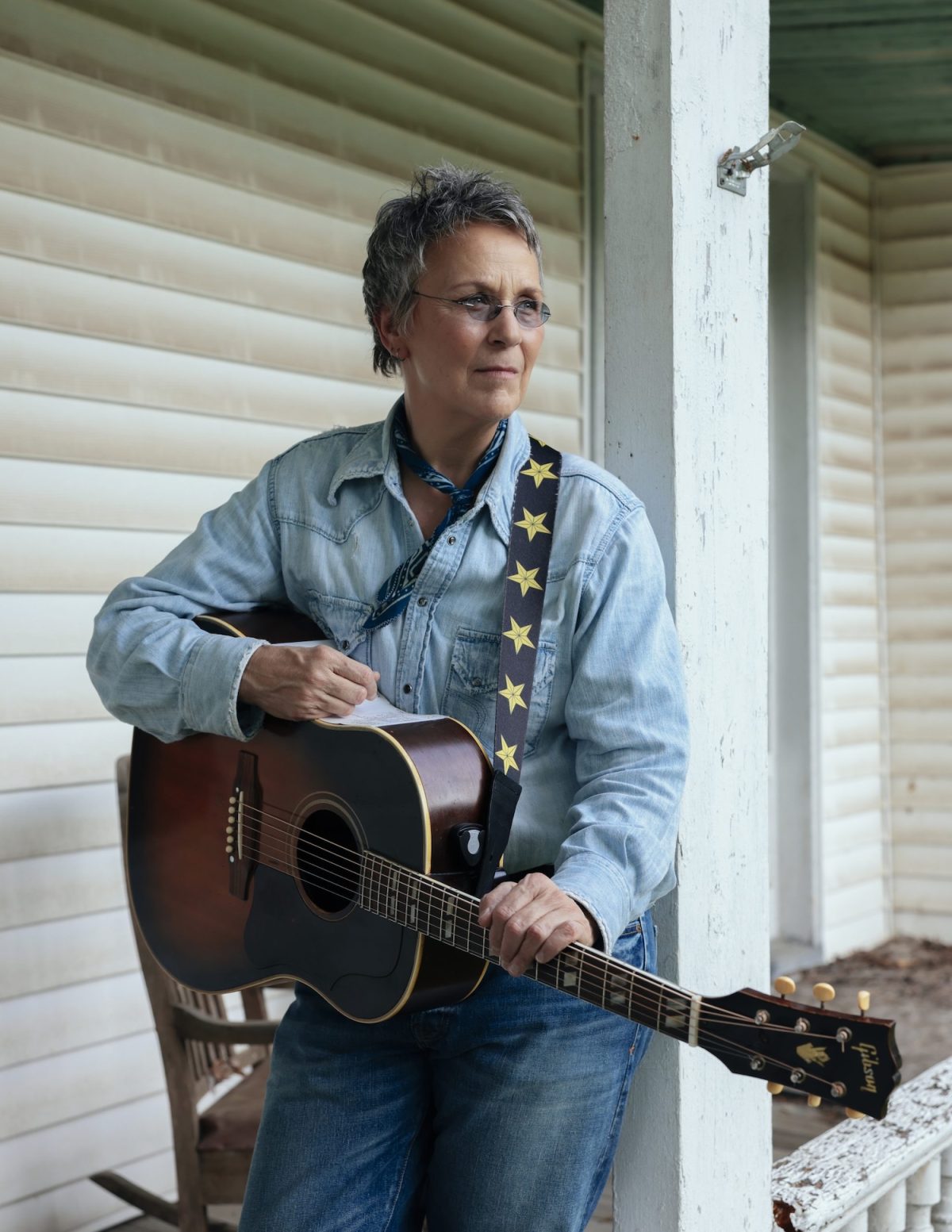
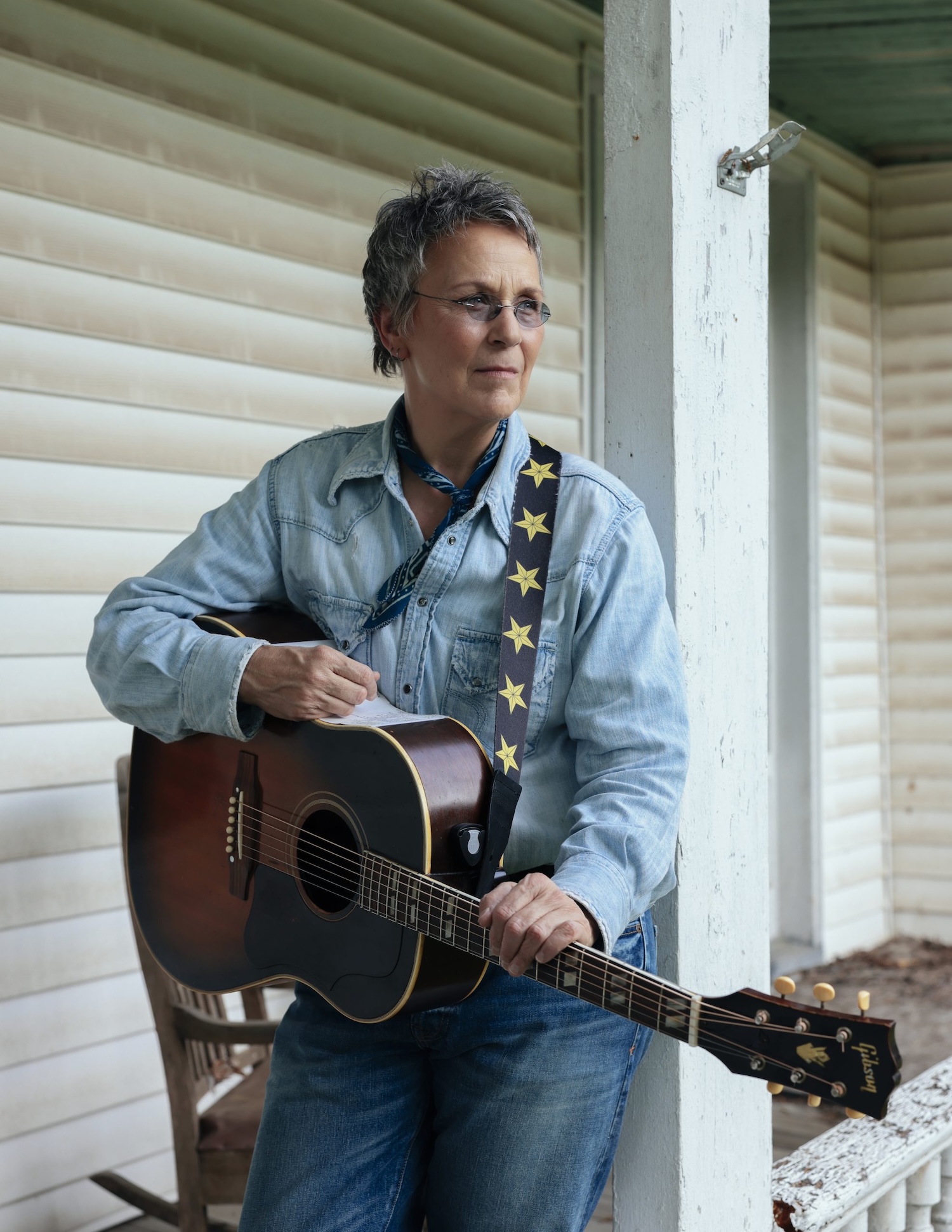
Mary Gauthier knows something about reckonings. She’s experienced a few herself, most consequentially when a drunk-driving arrest prompted her to get sober 36 years ago. In the decades since, the Nashville-based singer/songwriter has witnessed countless other reckonings, some leading to remarkable transformations, others ending tragically—and it’s shaped her multifaceted take on human nature.
On Reckoning (Soundly), Gauthier brings that unsentimental yet fundamentally hopeful perspective to nine songs confronting various personal, political and spiritual crises. The Grammy-nominated songwriter behind “Mercy Now,” “I Drink” and “Drag Queens In Limousines” has never shied away from difficult subject matter, but the urgency here feels especially pronounced. Gauthier began writing the material for her 10th studio album in response to the country’s increasingly volatile political climate. The music is deliberately spare, with Bruce Springsteen’s Nebraska as a lofty reference point. Gauthier initially tracked the songs with producer Mark Hallman in Austin, accompanied mostly by guitar and harmonica. She later brought the recordings to Nashville, where co-producer Neilson Hubbard added subtle instrumental touches.
MAGNET’s Hobart Rowland caught up with Gauthier on the road (where she most often resides) to discuss the Yankee folk tradition that shaped her beginnings, the looming influence of Guy Clark and the stories behind Reckoning.
You’ve built your career on a remarkably direct relationship with your audience. In an industry increasingly obsessed with streaming numbers and algorithms, how do you measure the impact of your music?
Just with my own five senses. It’s a ground game for me—it always has been. It’s where I belong, and it’s where I’m comfortable. I think of myself as an old-school troubadour, and that’s always about telling stories and meeting the public eye to eye in a smaller room, forging relationships based on emotional impact. That’s what my role models did when I was coming up in the Boston folk scene … people like Greg Brown, Cheryl Wheeler, Bill Morrissey, Dar Williams and John Gorka. That was the model I studied, and I just stayed true to it. No band, no bus, no bullshit. Can you hold an audience? Is the song going to hold the audience? Is it good enough? Is it written in a way that creates emotional impact—that makes people have an experience they’re going to value and come back next time? It was never hype. It was never the cool kids. It was something else.
You also spent almost five years opening for Guy Clark. How did that experience shape your understanding of songwriting?
There’s a lot of crossover similarity. He never toured with a band. He had Verlon (Thompson), and his songs did the heavy lifting. I was able to sit side-stage and watch the songs impact the audience—particularly the men—in a profound way. I learned a lot from Guy. “The Randall Knife” was an extraordinary thing to watch from side-stage. Cowboys putting their faces in their hat as they were moved to tears about their relationship with their dad. It’s beautiful. There’s a lot of similarity to what the New England folk artists were doing. Guy always said, “I’m a folk singer. I’m not a country singer. I’m not Americana. I’m a folk singer.” I believe Townes (Van Zandt) felt the same way. I’ve always pulled from what I learned from Guy and that Texas scene. A lot of it is split. There’s the Texas country scene, and then there’s the Texas singer/songwriter scene. I resonate more deeply with the singer/songwriter scene.
You mentioned Springsteen’s Nebraska as a sonic reference point for Reckoning. What made that album particularly relevant to these songs?
The songs came about as a trickle, and then the valve opened. Suddenly there was an urgency after the killings of Alex Pretti and Renée Good. It felt—and still does feel—like we’re in an emergency. The urgency struck me, and it became something that I wrote with a fire. Because each of these songs is a story—they’re little movies—I couldn’t help but think of Springsteen’s Nebraska. I recorded them in Austin with Mark Hallman and brought them to Nashville to be cleaned up. Neilson (Hubbard) said, “I can’t help it. I want to put a few things on there. Let me tell you, Springsteen’s Nebraska has more on it than you know. It’s not just him and his guitar and harmonica.” When Neilson added some of the magic dust, I thought, “Wow, this is beautiful. Let’s go with this.” It’s still very stripped down, with some embellishment.
You’ve said perfection is no longer useful because technology has made it accessible to everyone. Is it more about capturing the performance than getting everything exactly right?
That’s always sort of been the way, but producers would jump in and go, “Well, that there is just a little messy. Let’s try it again.” The great thing about Neilson and Mark is that they’re not thrown by that. They’re like, “Do I believe it? Does it feel real? Does it feel like Mary?” If it’s a little pitchy and the guitar is a little muted, one of the strings didn’t ring—that’s human. That’s good. That’s what we want, because that’s what creates emotional impact. The pearl snaps hitting the guitar create their own rhythm. It feels real. It feels alive. It feels like some human being is playing an instrument. I think that either consciously or subconsciously, that has a way of connecting with people.
You’ve said a reckoning can be personal, political or spiritual—and these songs inhabit all three realms. Have those things become more inseparable as you’ve gotten older?
It’s cumulative, I guess. I’m someone in recovery. In my use of the word, I think of a reckoning as a sudden confrontation with the truth. It’s where denial snaps. You pull that rubber band of denial until it snaps, and then the truth comes pouring in. I feel like a reckoning place is an opportunity. It’s not all darkness. It’s not all anxiety. It has a pivot point. I’ve had other reckoning places around sex and love issues. I had to make some decisions and stay single for quite a while and heal whatever was driving me to these nightmare relationships. There can be a collapse, or there can be an opportunity to do it differently.
Do you find you have fewer of those reckonings as you get older, or do they come in different forms?
I anticipate there will be more. I think it’s part of being alive. There are lessons that will continue to come. I do think we either get the lesson or we have to learn it in another way. They’re going to keep coming because that’s the nature of being human. Are they coming as fast? No. Am I hitting bottom as hard? No. But that’s personal. Politically, we’re in a hell of a spot. I have no idea what’s going to happen. None. But I feel in my heart that we’re reaching that place where there’s a fork in the road. We’re going to get through it somehow, but what does that mean? Does it mean collapse? Does it mean recommitting to the ideals in our Constitution and our democratic ideals? Which way will it go? I don’t think we know. It’s a cliffhanger. And how long will it take to clean up the mess? That’s the other thing I always think about. We’ve got to clean it from the ground up. What does that even mean personally and collectively?
“Some Times” began to take shape around a photograph of a black waiter on the Orange Blossom Special. What was it about that image that gave you the song’s narrator?
I was looking up the Orange Blossom Special because neither (co-writer) Vince Gill nor I knew what the hell that train was all about. It’s got its folklore because of country music and that song, but I didn’t know what the train was about. I was looking it up, trying to get the history of it, to chase down why it resonated with me. And I found that photo. For me, my narrative needs a narrator. Who’s the voice coming through this song? I landed on this guy, and he just kind of spoke to me. He looked like a man with a good job, a man with dignity and pride in his work. My guess was it was a union job, and probably he was able to take care of his wife and family on the wages he earned as a waiter on that luxury train. It was an elevated job for a black man during the ’30s, and so he became the narrator of my song. I don’t think he’s the narrator of Vince’s song. Vince wrote a different version of this song. But for me, he was the guy.
“Heaven” sat unfinished for more than a decade until you changed a single word. How did that small revision transform the song?
I wrote it with Lori McKenna in, I think, 2014. We both loved it, but she didn’t record it and I didn’t record it, which means it wasn’t right. There was a fan of mine who was also a playwright who came to a show Lori and I did together in San Francisco. Lori said, “He looks not well. Is he OK?” I said to her at that moment, “Well, he’s going to be OK if he believes in heaven.” He was dying of cancer. She said, “Oh, that’s a song.” So we wrote, “He’s going to be OK if he believes in heaven.” Fast-forward 10 or 12 years, and I revisited the song. I thought, “What if the ‘if’ guy becomes the ‘he believes’ guy?” The “he believes” guy is a different guy than the “if he believes” guy. Once we had this man’s faith, we had a guy who, in both our estimations, could see some spiritual movement and hope in his mortality that it’s not the end.
“Soldier Of Fortune” moves from the crucifixion to concentration camps to contemporary immigration enforcement. How did you find the human thread connecting those different historical moments?
I don’t write many songs like “Soldier Of Fortune.” That’s an angry song—that narrator is pissed. The narrator is looking through history and seeing that these ICE agents—or whatever you want to call them, these people who join ICE and take the $60,000 or whatever it is they get—represent a personality type. That personality type transcends time. That’s where the song came from. I was looking at the Stations Of The Cross in a stained-glass display during my nephew’s wedding. I’m staring at these Roman guards making a mockery of Christ, escorting him to his execution, spitting on him, putting the crown of thorns on him, gambling for his clothes. And I’m like, “Shit. That’s ICE.” It was a lightbulb going on for me. People say we’ve never seen the likes of this. We have.
Given everything Reckoning confronts, would you describe yourself as a guarded optimist?
I think that’s my personality type. The stories and the characters are making choices, and I believe most of them are going to make good choices. Not the characters in “Soldier Of Fortune”—they made bad choices, and they’re going to have to live with the consequences of that. But most of the characters—I love them. The old man in “Heaven” is going to leave this world in faith. I’ve seen many a friend do that. It’s a different kind of death than someone who’s horrified and terrified because they don’t have any sense of faith as they die. And the priest in “Judgment Day” doesn’t want to go on the front line and get hit by an ICE bullet shot by a frightened mercenary. But he can’t let his neighbor stand alone. He made the right choice. Is it going to end in martyrdom? It might. But he’s willing to do what he took his vow to do, which is love his neighbor as he loves himself. There’s dignity in his choice, deep dignity in his choice. That’s where I think the optimism comes from: the belief in the dignity of most people.
See Mary Gauthier live.