

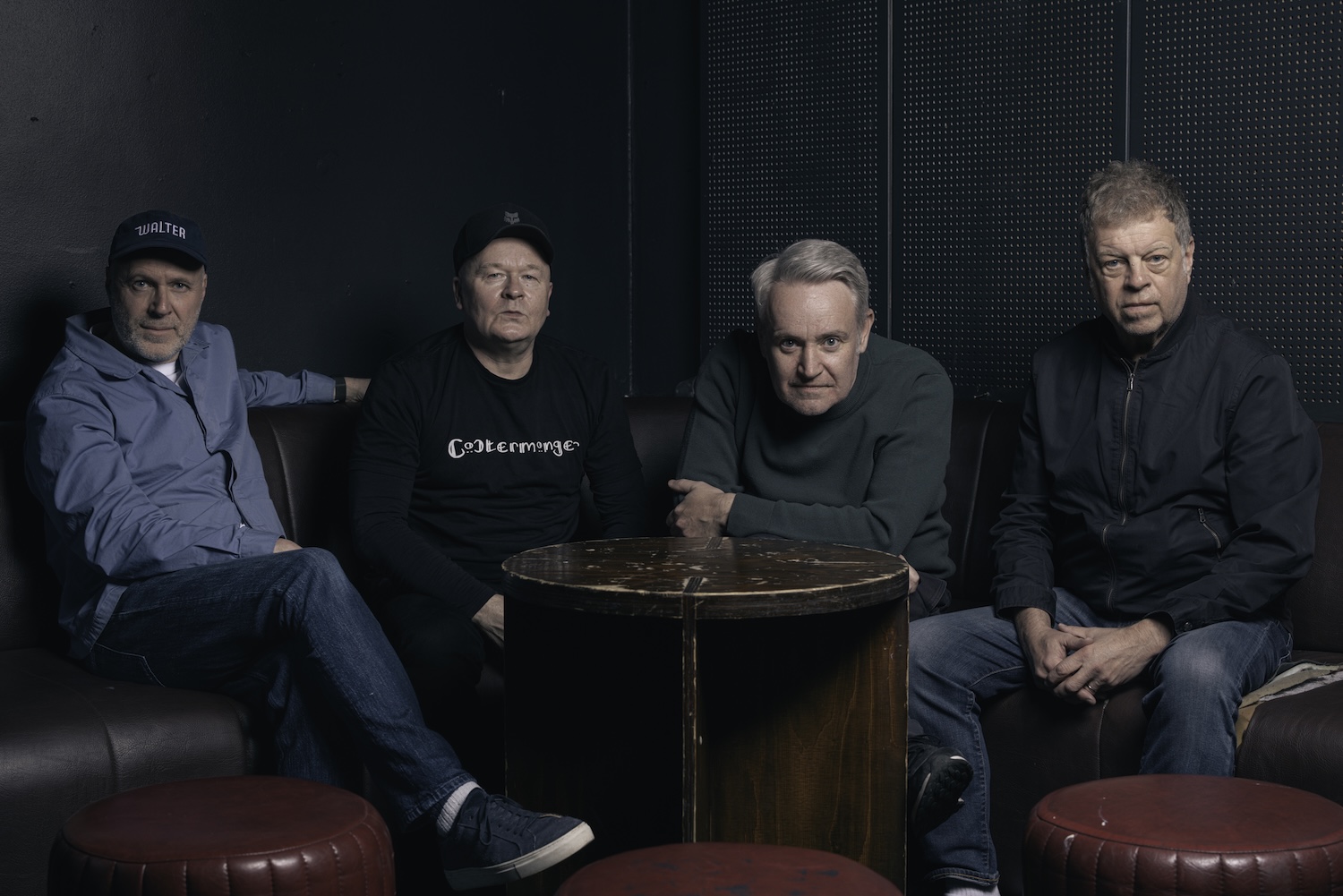
When Gene played what looked to be its final show at London’s Astoria in December 2004, there was little reason to expect the British foursome would share a stage again. But more than two decades later, singer Martin Rossiter, guitarist Steve Mason, bassist Kevin Miles and drummer Matt James appear to have picked up where they left off—longer in the tooth and wider in the middle, mind you, but still sporting that droll enthusiasm.
The reunion momentum was set in motion last year by the 30th anniversary of Gene’s 1995 debut, Olympian, an album whose overt Smiths-like vibe may have prevented it from getting the heaps of universal praise it so rightly deserved. That one-off London show has since evolved into a series of sold-out performances, a live album and the band’s first American tour dates in 24 years.
Formed in 1993, Gene emerged during Britpop’s commercial peak, maintaining a somewhat uneasy relationship with the movement’s prevailing attitudes. Even so, Olympian cracked the U.K. top 10, a feat the band duplicated with 1997 follow-up Drawn To The Deep End. Two less-successful studio LPs followed before the members went their separate ways. In the intervening years, Gene’s outsider mystique has grown alongside the median age of its fan base.
“I’ve always considered myself Welsh first, European second, socialist third … British is fairly low on the list,” Rossiter tells MAGNET’s Hobart Rowland. “The zeitgeist at the time was as far removed morally from what we stood for as a spoon is to a forklift truck.”
Here’s more from Rowland’s interview with Rossiter.
When Alan McGee and Kevin Fitzgerald approached you in 2024 about reuniting, what was your initial reaction?
“Sod it, why not?” The plan was to just meet up, but I think Alan and Kevin hoped that once we did, it would almost be impossible not to reform. Lo and behold, they were right.
Matt James has described the first meeting between the four of you as feeling almost like old times, with the familiar banter returning immediately. Was getting back together musically just as effortless?
Effortless makes it sound like we didn’t need to work hard. However, I will say that the effort was, dare say, fun. It’s a word I don’t get to say very often. I’m not even sure I can spell it.


Upon release, Olympian received considerable acclaim and a few mixed reviews. Do you think it was misunderstood in certain quarters when it first appeared?
The music press was following the established pattern at the time. I did think we might get an album past them before they borrowed Washington’s axe to chop down this particular cherry tree.
Still, the album has only grown in stature over the years. What was it like returning to those songs after so much time away?
Olympian is the sound of a young group learning their craft—and that’s its charm. Our job was not to lose that charm, and I hope we’ve achieved that.
Your October 2025 show at London’s Eventim Apollo drew more than 5,000 fans. Apollo (Costermonger), the live album you came away with, captures the audience singing along enthusiastically to just about everything. How did that hit you at the time?
Contrary to some reports, I am human and susceptible to emotional response. Onstage, I wear in-ear monitors, but I did take them out at one point to listen to the crowd—and they sang with the volume of three 747s arguing.
You’re returning to the United States for the first time in 24 years. What do you remember most about your earlier American tours?
I struggle to remember yesterday, to be honest. My recollections are tiny snapshots. Motels, trips to Mexico, sweaty walks, huge breakfasts, tour-bus bunks, Salt Lake City cafes, charming people, mountains and plains.
Now that you’ve rediscovered that band chemistry, do you see Gene as an ongoing creative proposition?
Yes, yes and yes. Now we just need to persuade everyone else.
See Gene live.