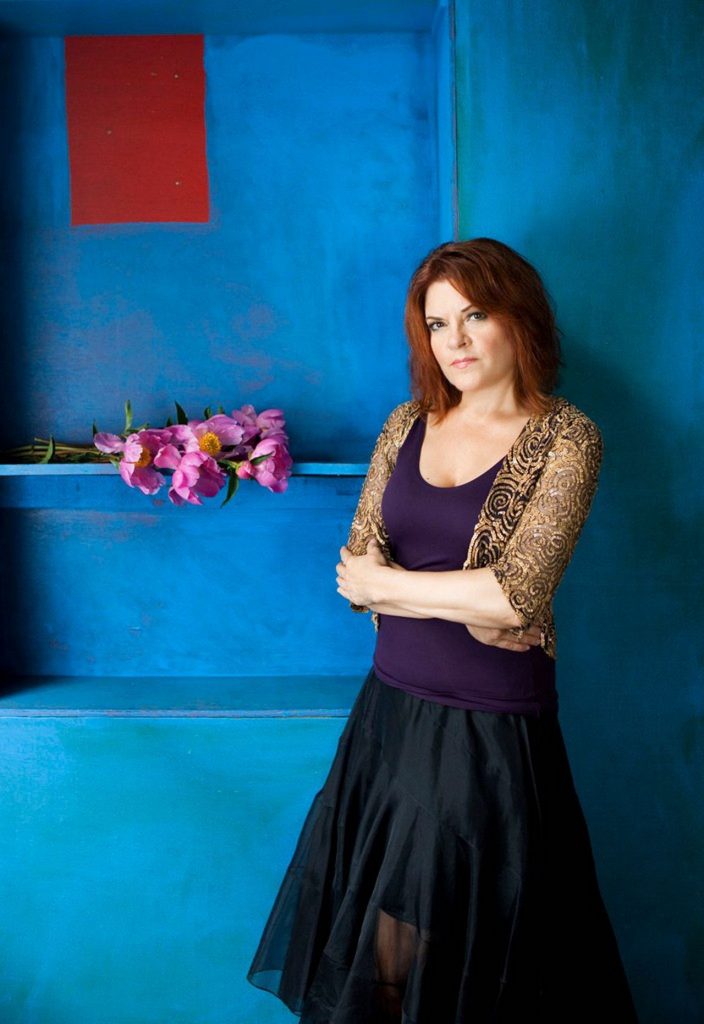
Unless you’ve spent the last 50 years cryogenically frozen in deep space, you may have heard of Rosanne Cash‘s father, Johnny Cash. When Rosanne locked in on becoming a successful country singer/songwriter, she had a formidable set of footsteps to follow. But she isn’t one to duck a challenge. Twenty of her singles cracked the top 20 in the country charts from 1979 to 1990, with 11 reaching the number-one spot. Her new album, TheList (out next week on EMI/Manhattan), is a terrific reworking of country classics, handpicked from a list of indispensable songs her dad made for her 36 years ago. Having Bruce Springsteen, Elvis Costello, Jeff Tweedy and Rufus Wainwright appear as guest artists on the record is a nice fit. Rosanne will be guest editing magnetmagazine.com all week long. Read our Q&A with her.
Cash: There are very few people in this world I actually worship, and Maira Kalman is one of those few. I haven’t gone so far as to make a shrine or keep a picture of Maira in a locket around my neck, but I’m close. Every time I read her blog And The Pursuit Of Happiness or her book The Principles Of Uncertainty or look at her photos or paintings, I get a rush of crazy energy in my stomach and a feeling that I might fly out of my body with happiness and inspiration. This is not something I feel every day, I promise. One of my favorite blog posts is on Paris: “The application of lipstick … The first superlative tassel … The wrapping of the parcel … The pink bed.” Yes, of course. That is Paris, exactly. Maira lives her life as a pure expression of art, a most elegant and gracious soul, a teacher and a poet. I love her very much. I want to look at people and at life the way Maira does. I am writing my memoir now, and I’m nearly finished. I have had a zerox of one of Maira’s paintings taped to the top of my computer the whole time I have been writing this book—for years. It is a picture of a woman in a respectable black dress with a white collar, standing by a tree, with a branch in her hand. At the bottom of the picture it says: “The woman stood in front of the tree before she went mad. She wrote a book and then she went mad. How do you go mad? How do you not go mad?” So, I read this every time I open my computer to work on my book, and you know, Maira is right.
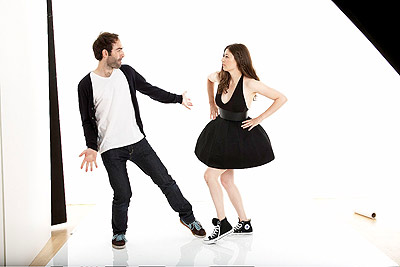
Indie-pop darlings Clare And The Reasons return with Arrow (out October 20 on Frog Stand). “Ooh You Hurt Me So” is another twinkling number so sweet it should come with a toothbrush. While Clare Muldaur and her husband, Olivier Manchon, might form the backbone of the group, Clare And The Reasons is a multi-instrumental festival, featuring glockenspiel, horns and kazoos. No wonder Sufjan Stevens is one of their biggest fans.
“Ooh You Hurt Me So” (download): https://magnetmagazine.com/audio/OohYouHurtMeSo.mp3
Rosanne Cash isn’t one to duck a challenge. Unless you’ve spent the last 50 years cryogenically frozen in deep space, you may have heard of her father, Johnny Cash. When Rosanne, who grew up in Southern California, locked in on becoming a successful country singer and songwriter she had a formidable set of footsteps to follow in. But succeed she did. Twenty of her singles cracked the top 20 in the country charts from 1979-90, with no fewer than 11 reaching the number one spot. After her emotionally draining, Grammy-nominated 2006 album, Black Cadillac, a work drawn from the recent deaths of her father, her mother, Vivian Liberto, and her stepmother, June Carter Cash, Rosanne felt it was time to get back to her indelible genetic roots. Her current album, The List (EMI/Manhattan), is a terrific reworking of country classics, handpicked from a list of indispensable songs her dad made for her 36 years ago. Having Bruce Springsteen, Elvis Costello, Jeff Tweedy and Rufus Wainwright appear as guest artists on the record is a nice fit, very unforced. Rosanne recently played the magical new collection for a rapt audience at the Country Music Hall of Fame in Nashville and was still basking in the glow of that special evening a few days later when she spoke with MAGNET from her New York home.
That’s a great story: how you picked the material for the new album from a list your Dad gave you back in 1973.
Yeah, I’d just graduated high school, and I went out on the road with him. We were on the tour bus, talking about songs, and he mentioned a song and I said, “I don’t know that one.” And he mentioned another, and I said, “I don’t know that one, either.” And he got very alarmed. I was so Beatles-obsessed and steeped in Southern California pop and rock that I didn’t know this essential part of my own musical genealogy. So, he spent the rest of the day making this list for me. It took him quite a while, and at the end of the day he wrote across the top “100 Essential Country Songs.”
Do you still have the list?
I do. And at the end he said, “This is your education.” I’ve kept that list for over 30 years.
Do you intend to do the other 88 eventually?
[Laughs] Uhh, not all 88! But there will definitely be a Volume Two. Yeah, and eventually I’m gonna do the right thing with the list, archive it properly. But right now I still want to keep it close to the chest.
I like the way you’ve buttressed the set with two of the cornerstones of country music: Jimmie Rodgers on one end and the Carter Family on the other.
Yes. Well, both of those are really essential to my dad’s—and anybody’s—overview of Southern and American music. The song I covered by the Carter Family, “Bury Me Under The Weeping Willow,” is the first one they recorded after being discovered [in 1927] by Ralph Peer.
You got Bruce Springsteen to accompany you on “Sea Of Heartbreak,” a Don Gibson song. How did that come about?
Actually, Don Gibson didn’t write it, but he had the first and definitive version. Hal David and Paul Hampton wrote it, if you can believe that. Both John [Leventhal, the album’s producer/arranger and Cash’s husband] and I knew that we wanted it to be a duet. . When we finished my part we said, “Who is the dream date?” [Laughs] And it was Springsteen, and we asked him. I thought there was a 50 percent chance he’d say yes. I knew how busy he was. And he doesn’t do duets that much. But he said yes immediately. I think he was taken by the idea of the list, and he knew the song. He’s so steeped in this music. It was a beautiful part, so romantic.
You two have a wonderful vocal blend, don’t you think? You should cut a whole album together.
Yeah, from your mouth to Bruce’s ear. [Laughs]
Next time I see him I’ll put the bee in his bonnet, promise. Tell me about “Take These Chains From My Heart,” a Ray Charles tune.
Yeah, that’s actually by Hank Williams. But you’re right about it being a big hit by Ray Charles. That was the version I knew best, too. Someone older than us would have known Hank’s version. But Ray Charles’ version is the one I had to get out of my head to be able to sing it.
How did you do that?
Well, by going back to Hank’s original intention. That was a high bar that Ray Charles set for that song. I’d heard it millions of times. But it’s just a freaking great song, and a great song deserves a lot of interpretations.
Yeah, in that same vein, you do your own thing to “I’m Movin’ On.” That’s not the loping, original version by the singing ranger, Hank Snow, or the amped-up live one by the Rolling Stones, either. You’ve slowed it way down.
Well, number one, if a woman sings “I’m moving on,” she’s got to do it with a certain sense of irony. A woman can’t really sing “that big eight-wheeler rolling down the track” with a straight face. So we had to make it sexy, a little sultry to make it work.
OK, “Heartaches By The Number,” a huge hit by Ray Price. I think he wrote it, didn’t he?
Oh my god, now you’ve got me. I should know this. Hold on, let me yell up to John. [Muffled question and answer from the next room] Oh yeah, it was Harlan Howard. Of course, Ray Price’s version was the one I knew the best. It’s a very structured, metered song, so I needed somebody who could bust open the chains on it, and that was Elvis [Costello]. He’s a good friend of mine. He’s a dear. He and I had actually done some work together over the last couple of years, so it was a natural ask. I did his show, Spectacles, and he, Kris Kristofferson and I have written two songs together and recorded them. And he asked me to be on Letterman with him a year or two ago.
“500 Miles” is by Bobby Bare, of “Detroit City” fame.
Bobby didn’t actually write it, although I think his name is on it. Bobby’s version was definitely the most heartfelt to me and the most moving version. I performed this the other night in Nashville at the Country Music Hall of Fame, where we presented these songs for the first time. And Bobby was there, sitting in the front row. I was nearly in tears, I swear to god.
How was it working with Rufus Wainwright, one of my current favorites, on Merle Haggard’s “Silver Wings”? I think he’s truly amazing.
He is truly amazing, I agree. You know, I’ve known his dad, Loudon, for a long time. In a way, it was like asking one of my kids’ friends to play [Laughs]. I thought he was going to do a straight harmony part, but he did these orchestral background parts that were really remarkable.
Did he got into his four octave thing?
No, but he used a couple of octaves [Laughs]
I once talked with Buddy Alan, Buck Owens’ son, about what I refer to as the “Jack Nicklaus effect,” being the offspring of a legendary person. Does it ever overwhelm you that you’re Johnny Cash’s daughter?
Not anymore. I’m not a kid anymore. It definitely did overwhelm me as a kid. And I think it would have been worse if I’d been a boy.
How did you overcome those early feelings?
I just kept my head down and kept working. I wanted to become a good songwriter, and I worked really hard and just stepped into that. You know, now is the time of life to step into your legacy and own what your parents pass on to you. Now is not the time for rebellion. That time has passed.
I’ve actually met Marijohn Wilkin, the co-writer of “Long Black Veil.” Her son, Bucky Wilkin, a good friend of mine, had a band in Nashville back in the ’60s called Ronny & the Daytonas. “Little G.T.O.” was a big hit.
I knew Marijohn a little bit when I was in my early 20s and admired her so much, because there were so few women songwriters at that time. She was definitely a role model for me. She’s the only female songwriter on this record, sad to say. “Long Black Veil” has a special place on this record. When we knew we were going to do the list, the first song I absolutely knew had to be on the record was “Long Black Veil.” It’s kind of the center of country music. I think my dad felt the same way. My dad did a great version on the Folsom Prison album, but Lefty Frizzell’s version is the one we both resonated with. It’s got everything: roots in Elizabethan music, it’s cinematic, it’s got a great narrative, the melody is perfect in that way that’s full of longing. It’s an amazing song.
If there ever were a song that’s a short story, that’s probably it.
That’s it. And Jeff Tweedy did such a great job. He molded the inflection in his voice to match what that song was about. He’s got almost a Bluegrass inflection.
“She’s Got You” by Patsy Cline. Was that a tough one to tackle?
That song was intimidating for me. Patsy Cline’s vocal was so iconic. At first I said, “I just can’t do this song. I cannot get past Patsy Cline.” And John told me, “You are born to sing this stuff.” Once I got to the heart of the song and saw what a great song it was, then I just had fun with it.
I like the way you don’t try to mimic any of the originals. It would be pointless.
I couldn’t. It would be pointless.
It would almost be like putting on blackface.
That’s exactly what I said! I said, “I couldn’t put on a costume, as if I were these people, or I had this upbringing.” I had to do these songs and bring my own sensibilities to them. My 35 years as a songwriter, the fact I’ve been a New Yorker for two decades—all that had to come into play.
OK, then “Girl From The North Country,” written by
Bob Dylan and performed by your dad and Dylan. How did you get beyond that?
Well, that was the other one. I told John that I can’t do this. It’s almost sacrilegious. Not only did I have Dad and Bob’s version of it in my head, there’s even TV footage of them doing it, so I had pictures of them doing it, too. So, John said, “No, let’s listen to Bob’s original version and approach it that way.” And Bob’s original version is a classic folk song in the Elizabethan tradition. Also I loved doing it in the folk tradition of the woman singing about another woman. It’s great because it expands the repertoire. I could be singing about my daughter or my sister or my mother. It adds mystery to it, too.
—Jud Cost
Rosanne Cash isn’t one to duck a challenge. Unless you’ve spent the last 50 years cryogenically frozen in deep space, you may have heard of her father, Johnny Cash. When Rosanne, who grew up in Southern California, locked in on becoming a successful country singer/songwriter, she had a formidable set of footsteps to follow. But succeed she did. Twenty of her singles cracked the top 20 in the country charts from 1979 to 1990, with no fewer than 11 reaching the number-one spot. After her emotionally draining, Grammy-nominated 2006 album, Black Cadillac, a work drawn from the recent deaths of her father, her mother (Vivian Liberto) and her stepmother (June Carter Cash), Rosanne felt it was time to get back to her indelible genetic roots. Her new album, The List (out next week on EMI/Manhattan), is a terrific reworking of country classics, handpicked from a list of indispensable songs her dad made for her 36 years ago. Having Bruce Springsteen, Elvis Costello, Jeff Tweedy and Rufus Wainwright appear as guest artists on the record is a nice fit, very unforced. Rosanne recently played the magical new collection for a rapt audience at the Country Music Hall Of Fame in Nashville and was still basking in the glow of that special evening a few days later when she spoke with MAGNET from her New York home. She will also be guest editing magnetmagazine.com all week long.
MAGNET: That’s a great story: how you picked the material for the new album from a list your dad gave you back in 1973. Cash: Yeah, I’d just graduated high school, and I went out on the road with him. We were on the tour bus, talking about songs, and he mentioned a song. I said, “I don’t know that one.” And he mentioned another, and I said, “I don’t know that one, either.” And he got very alarmed. I was so Beatles-obsessed and steeped in Southern California pop and rock that I didn’t know this essential part of my own musical genealogy. So, he spent the rest of the day making this list for me. It took him quite a while, and at the end of the day, he wrote across the top “100 Essential Country Songs.”
Do you still have the list? I do. And at the end he said, “This is your education.” I’ve kept that list for over 30 years.
Do you intend to do the other 88 eventually? [Laughs] Uh, not all 88! But there will definitely be a Volume 2. Yeah, and eventually I’m gonna do the right thing with the list, archive it properly. But right now I still want to keep it close to the chest.
I like the way you’ve buttressed the set with two of the cornerstones of country music: Jimmie Rodgers on one end and the Carter Family on the other. Yes. Well, both of those are really essential to my dad’s—and anybody’s—overview of Southern and American music. The song I covered by the Carter Family, “Bury Me Under The Weeping Willow,” is the first one they recorded after being discovered (in 1927) by Ralph Peer.
You got Bruce Springsteen to accompany you on “Sea Of Heartbreak,” a Don Gibson song. How did that come about? Actually, Don Gibson didn’t write it, but he had the first and definitive version. Hal David and Paul Hampton wrote it, if you can believe that. Both John (Leventhal, the album’s producer/arranger and Cash’s husband) and I knew that we wanted it to be a duet. When we finished my part we said, “Who is the dream date?” [Laughs] And it was Springsteen, and we asked him. I thought there was a 50 percent chance he’d say yes. I knew how busy he was. And he doesn’t do duets that much. But he said yes immediately. I think he was taken by the idea of the list, and he knew the song. He’s so steeped in this music. It was a beautiful part, so romantic.
You two have a wonderful vocal blend, don’t you think? You should cut a whole album together. Yeah, from your mouth to Bruce’s ear. [Laughs]
Next time I see him I’ll put the bee in his bonnet, promise. Tell me about “Take These Chains From My Heart,” a Ray Charles tune. Yeah, that’s actually by Hank Williams. But you’re right about it being a big hit by Ray Charles. That was the version I knew best, too. Someone older than us would have known Hank’s version. But Ray Charles’ version is the one I had to get out of my head to be able to sing it.
How did you do that? Well, by going back to Hank’s original intention. That was a high bar that Ray Charles set for that song. I’d heard it millions of times. But it’s just a freaking great song, and a great song deserves a lot of interpretations.
Yeah, in that same vein, you do your own thing to “I’m Movin’ On.” That’s not the loping, original version by the singing ranger Hank Snow or the amped-up live one by the Rolling Stones, either. You’ve slowed it way down. Well, number one, if a woman sings “I’m Movin’ On,” she’s got to do it with a certain sense of irony. A woman can’t really sing “that big eight-wheeler rolling down the track” with a straight face. So we had to make it sexy, a little sultry, to make it work.
OK, “Heartaches By The Number,” a huge hit by Ray Price. I think he wrote it, didn’t he? Oh my god, now you’ve got me. I should know this. Hold on, let me yell up to John. [Muffled question and answer from the next room] Oh, it was Harlan Howard. Of course, Ray Price’s version was the one I knew the best. It’s a very structured, metered song, so I needed somebody who could bust open the chains on it, and that was Elvis (Costello). He’s a good friend of mine. He’s a dear. He and I had actually done some work together over the last couple of years, so it was a natural ask. I did his show, Spectacle, and he, Kris Kristofferson and I have written two songs together and recorded them. And he asked me to be on Letterman with him a year or two ago.
“500 Miles” is by Bobby Bare, of “Detroit City” fame. Bobby didn’t actually write it, although I think his name is on it. Bobby’s version was definitely the most heartfelt to me and the most moving version. I performed this the other night in Nashville at the Country Music Hall Of Fame, where we presented these songs for the first time. And Bobby was there, sitting in the front row. I was nearly in tears, I swear to god.
How was it working with Rufus Wainwright, one of my current favorites, on Merle Haggard’s “Silver Wings”? I think he’s truly amazing. He is truly amazing, I agree. You know, I’ve known his dad, Loudon, for a long time. In a way, it was like asking one of my kids’ friends to play. [Laughs] I thought he was going to do a straight harmony part, but he did these orchestral background parts that were really remarkable.
Did he go into his four-octave thing? No, but he used a couple of octaves [Laughs]
I once talked with Buddy Alan, Buck Owens’ son, about what I refer to as the “Jack Nicklaus effect,” being the offspring of a legendary person. Does it ever overwhelm you that you’re Johnny Cash’s daughter? Not anymore. I’m not a kid anymore. It definitely did overwhelm me as a kid. And I think it would have been worse if I’d been a boy.
How did you overcome those early feelings? I just kept my head down and kept working. I wanted to become a good songwriter, and I worked really hard and just stepped into that. You know, now is the time of life to step into your legacy and own what your parents pass on to you. Now is not the time for rebellion. That time has passed.
I’ve actually met Marijohn Wilkin, the co-writer of “Long Black Veil.” Her son, Bucky Wilkin, a good friend of mine, had a band in Nashville back in the ’60s called Ronny & The Daytonas. “Little G.T.O.” was a big hit. I knew Marijohn a little bit when I was in my early 20s and admired her so much, because there were so few women songwriters at that time. She was definitely a role model for me. She’s the only female songwriter on this record, sad to say. “Long Black Veil” has a special place on this record. When we knew we were going to do TheList, the first song I absolutely knew had to be on the record was “Long Black Veil.” It’s kind of the center of country music. I think my dad felt the same way. My dad did a great version on the Folsom Prison album, but Lefty Frizzell’s version is the one we both resonated with. It’s got everything: roots in Elizabethan music, it’s cinematic, it’s got a great narrative, the melody is perfect in that way that’s full of longing. It’s an amazing song.
If there ever were a song that’s a short story, that’s probably it. That’s it. And Jeff Tweedy did such a great job. He molded the inflection in his voice to match what that song was about. He’s got almost a bluegrass inflection.
“She’s Got You” by Patsy Cline. Was that a tough one to tackle? That song was intimidating for me. Patsy Cline’s vocal was so iconic. At first, I said, “I just can’t do this song. I cannot get past Patsy Cline.” And John told me, “You are born to sing this stuff.” Once I got to the heart of the song and saw what a great song it was, then I just had fun with it.
I like the way you don’t try to mimic any of the originals. It would be pointless. I couldn’t. It would be pointless.
It would almost be like putting on blackface. That’s exactly what I said! I said, “I couldn’t put on a costume, as if I were these people or I had this upbringing.” I had to do these songs and bring my own sensibilities to them. My 35 years as a songwriter, the fact I’ve been a New Yorker for two decades—all that had to come into play.
OK, then “Girl From The North Country,” written by Bob Dylan and performed by your dad and Dylan. How did you get beyond that? Well, that was the other one. I told John that I can’t do this. It’s almost sacrilegious. Not only did I have Dad and Bob’s version of it in my head, there’s even TV footage of them doing it, so I had pictures of them doing it, too. So, John said, “No, let’s listen to Bob’s original version and approach it that way.” And Bob’s original version is a classic folk song in the Elizabethan tradition. Also I loved doing it in the folk tradition of the woman singing about another woman. It’s great because it expands the repertoire. I could be singing about my daughter or my sister or my mother. It adds mystery to it, too.
We’ve been fans of New Jersey’s finest since even before their first album came out back in 1994, so let’s just say we’re used to sitting around waiting for them to take their sweet-ass time putting out new music. (Three albums in more than 14 years makes the Wrens about as prolific as Boston, which is kind of like being as tall as Sebastian Saraceno.) As reported in a Wrens Watch Special Report, January 9 marked a huge milestone for the guys: guitarists Charles Bissell and Greg Whelan, bassist Kevin Whelan and drummer Jerry MacDonald. They issued “Pulled Fences,” their first new (well, sort of new) song since 2003’s The Meadowlands. Perhaps motivated by finally releasing something, the band convened—not in a real studio, but in Kevin’s basement—36 weeks ago to begin work on its new album. And not only that, the Wrens recorded an actual song (which you can download for free here). When we checked in with Bissell 33 weeks ago, he took exception with our good-natured sarcasm and quickly ended the interview. After ignoring us for a while, Bissell finally gave us a progress report; it seems that while other bands get together and record, the Wrens stay apart and talk to each other on the phone. Or they do nothing at all. Or they update their Facebook pages. Twenty-eight weeks ago, Bissell informed us he was “too busy” to respond to our questions, but he did promise us some exclusive Wrens mp3s in the near future. Twenty-seven weeks ago, he didn’t even bother responding to our emails, prompting us to call him an unprolific Ryan Adams. That got Bissell’s attention, who 26 weeks ago apologized (profanely) and promised us an exclusive Wrens mp3 for the April 6 Wrens Watch. After not delivering, he said he’d come through the next week, but he didn’t. When Bissell ignored us again (Wrens Watch, April 20 and April 27), we speculated the Wrens were actually recording. Or maybe Bissell was just being a jerk. But then he told us 21 weeks ago he’d have a new Wrens mp3 for us. And guess what? The man finally came through. Download a demo of “Z,” which was written and performed by Kevin. We emailed Bissell numerous times to thank him for “Z” and ask him how the new record is progressing, but like we told you 19 weeks ago, he was unresponsive. He did email us a photo for 18 weeks ago, though, so we had that going for us. Which was nice. Seventeen weeks ago, we got an email from Bissell saying, “Headed to bed but might have something for you.” As reported 16 and 15 weeks ago, other than a strange email from him referencing Fat Albert, we hadn’t heard from him since. Fourteen weeks ago, we told you that Bissell, apparently on vacation, said he would have a new song for us “as soon as I get home on Saturday,” but he never came through. Bissell returned our emails 13 weeks ago, but he didn’t send any new Wrens music. He did, however, send a truly tasteless Michael Jackson joke, and since it was actually funny enough for us to tell it to others, we gave Bissell a pass. Twelve weeks ago, Bissell—on vacation yet again—emailed to say, “Maybe I can actually send a song to you after I get home Sunday.” Then guess what? He emailed us his first new Wrens demo, and like we told you 11 weeks ago, it’s a really good song. Ten weeks ago, Bissell emailed us to say he recorded another new demo, but he’s keeping that one for himself. He also said, “Smellmineitsucks,” whatever that means. Though we emailed Bissell repeatedly nine weeks ago, we didn’t even get so much as a “Smellmineitsucks.” Eight weeks ago, Bissell sent this missive: “We gonna see ballgame this summer? And I don’t mean a view of you working your pockets on a street corner.” (We think Bissell just might have a shot at a cameo in the next Judd Apatow movie, Unfunny People.) Anyway, Bissell was supposed to respond to us with his thoughts on the recent 20th anniversary of the first live show by the band that eventually came to be known as the Wrens, but he didn’t. Seven weeks ago, we did get an email saying he didn’t have enough free time to “justify replying to explanatory spam from MAGNET,” so maybe Bissell is a (mildly) funny person after all. Six weeks ago, five weeks ago and four weeks ago, we got nothing. Three weeks ago, we did find out that the Wrens have shows at Maxwell’s in Hoboken, N.J., scheduled for December 3 and 4, but we didn’t learn this from Bissell. Two weeks ago, Bissell emailed us a number of times, but he didn’t answer any Wrens-related questions. We did find out that he is playing a solo benefit show in Brooklyn on October 28 with They Might Be Giants and Nada Surf (they should call it Nerd Aid), but again, we didn’t learn this from Bissell. Last week, when asked what was new with the Wrens, Bissell responded, “Nothing. No things. At all. No recording, no new songs, no get-togethers.” This week, we learned that the first Maxwell’s show will feature a setlist voted on by fans via the Wrens website (we requested “Brand New Apartment”), while the second will be comprised of as many news songs the band can play. You get the feeling the first show will probably be much longer than the second one.
Thanks to Richard Hawley for guest editing magnetmagazine.com this week. Be sure to check out his new Truelove’s Gutter (Mute). Here’s the video for the album’s first single, “For Your Lover, Give Some Time.”


 Unless you’ve spent the last 50 years cryogenically frozen in deep space, you may have heard of Rosanne Cash‘s father, Johnny Cash. When Rosanne locked in on becoming a successful country singer/songwriter, she had a formidable set of footsteps to follow. But she isn’t one to duck a challenge. Twenty of her singles cracked the top 20 in the country charts from 1979 to 1990, with 11 reaching the number-one spot. Her new album, The List (out next week on EMI/Manhattan), is a terrific reworking of country classics, handpicked from a list of indispensable songs her dad made for her 36 years ago. Having Bruce Springsteen, Elvis Costello, Jeff Tweedy and Rufus Wainwright appear as guest artists on the record is a nice fit. Rosanne will be guest editing magnetmagazine.com all week long. Read our Q&A with her.
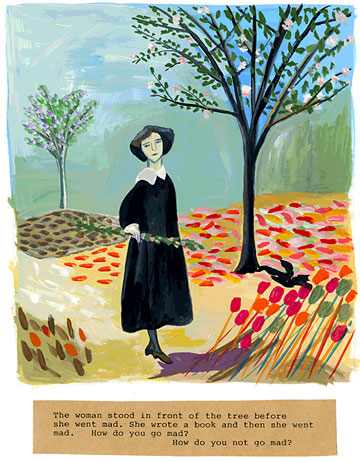 Cash: There are very few people in this world I actually worship, and Maira Kalman is one of those few. I haven’t gone so far as to make a shrine or keep a picture of Maira in a locket around my neck, but I’m close. Every time I read her blog And The Pursuit Of Happiness or her book The Principles Of Uncertainty or look at her photos or paintings, I get a rush of crazy energy in my stomach and a feeling that I might fly out of my body with happiness and inspiration. This is not something I feel every day, I promise. One of my favorite blog posts is on Paris: “The application of lipstick … The first superlative tassel … The wrapping of the parcel … The pink bed.” Yes, of course. That is Paris, exactly. Maira lives her life as a pure expression of art, a most elegant and gracious soul, a teacher and a poet. I love her very much. I want to look at people and at life the way Maira does. I am writing my memoir now, and I’m nearly finished. I have had a zerox of one of Maira’s paintings taped to the top of my computer the whole time I have been writing this book—for years. It is a picture of a woman in a respectable black dress with a white collar, standing by a tree, with a branch in her hand. At the bottom of the picture it says: “The woman stood in front of the tree before she went mad. She wrote a book and then she went mad. How do you go mad? How do you not go mad?” So, I read this every time I open my computer to work on my book, and you know, Maira is right.


 Indie-pop darlings
 We’ve been fans of New Jersey’s finest since even before their first album came out back in 1994, so let’s just say we’re used to sitting around waiting for them to take their sweet-ass time putting out new music. (Three albums in more than 14 years makes